Recent economic indicators show storm clouds on the horizon when it comes to worsening inflation and high prices. Let me walk you through the bad news.
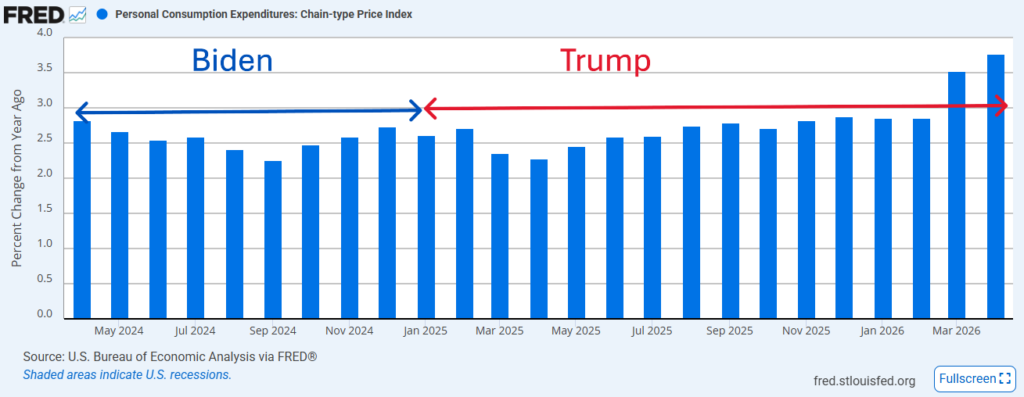
Personal Consumption Expenditures (PCE) hit a three-year high in April.
The Federal Reserve’s preferred inflation index is the Personal Consumption Expenditures, or “PCE”. Most economists consider PCE to be a more accurate and comprehensive measure of inflation than the Consumer Price Index (CPI). Below I display PCE rates going back two years to April 2024. As you can see, during Biden’s last year in office, the rates hovered around 2.5%. During the first year of Trump’s second term, rates were comparable, or maybe slightly higher. But in March 2026, the PCE rate jumped to 3.5%; and in April, the rate again jumped to 3.8%. These are the highest PCE rates in over three years.
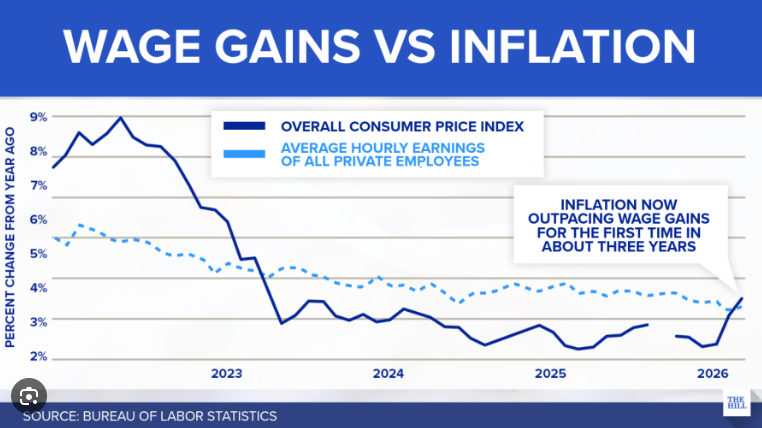
Inflation is greater than wage growth for the first time in three years.
The second bad piece of news is that beginning in April, inflation (Consumer Price Index or “CPI”) has overtaken wage growth for the first time in three years. As the graph below indicates, inflation was at 3.8%, while average wage growth was at 3.6%. This means that your increase in wages is not keeping up with inflation, thus leaving you with less buying power. Americans had been enjoying wage increases that exceeded inflation since 2023. As of this April, no more.
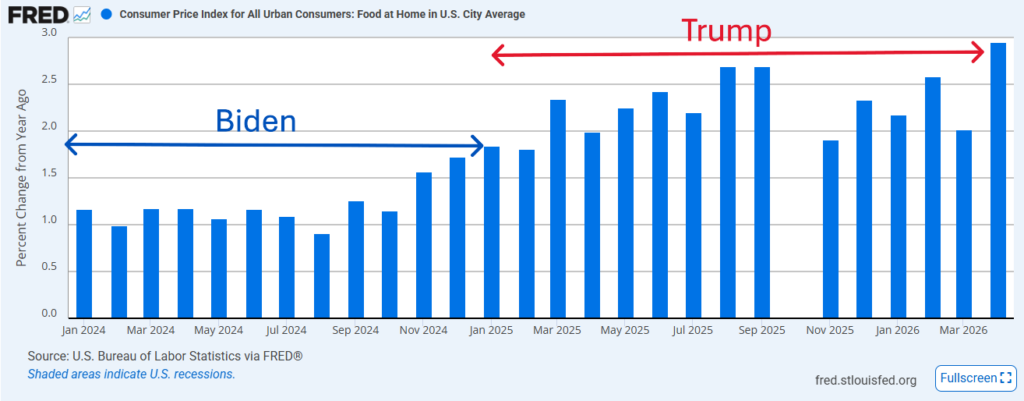
The inflation rate for groceries (“Food at Home”) has increased, especially since April.
The third piece of bad news comes with your trip to the grocery store. There’s a specific metric called “Food at Home” that measures inflation in grocery prices. Below I’m displaying this metric going back to January 2024, Biden’s last year in office. As you can see, food inflation hovered at just over 1% during most of Biden’s last year. Since Trump took office, food inflation has always been above 1.8%. It went over 2.5% three times, and it jumped to 2.9% in April 2026. The USDA forecasts that the inflation rate for Food at Home in 2026 will average 3.2%.
Gas prices are coming down, at least for now; but how long will it take for them to return to normal ($3.00 per gallon)?
Now you might say that at least gas prices are coming down. Over the last several days, the US average price for regular gas dropped about 18 cents per gallon. With the prospect of an extended cease fire and the opening of the Strait of Hormuz, shouldn’t we expect prices to come tumbling down? While gas prices should come down if the situation doesn’t again get out of hand, the real question is how long it might take for prices to return to “normal” (around $3.00 per gallon)?
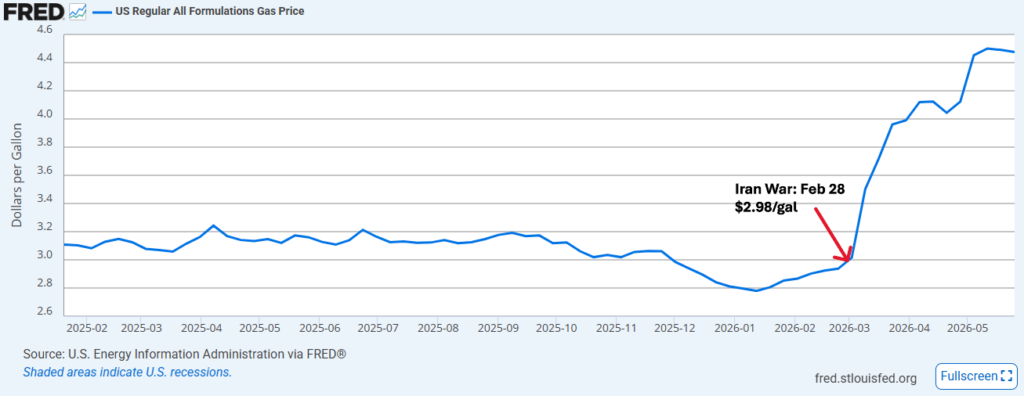
Below I display gas prices (US average/regular) since Trump came into office. Prices got as low as $2.80 per gallon in the December/January timeframe, and were at $2.98 when the President launched the war with Iran on February 28. Gas prices peaked at $4.57 per gallon (a $1.59 increase) on May 20th and we’ll assume they don’t rise above this level. $4.57 per gallon represents a 53% increase in price in 81 days. How long might it take before gas gets back to $3.00 per gallon?
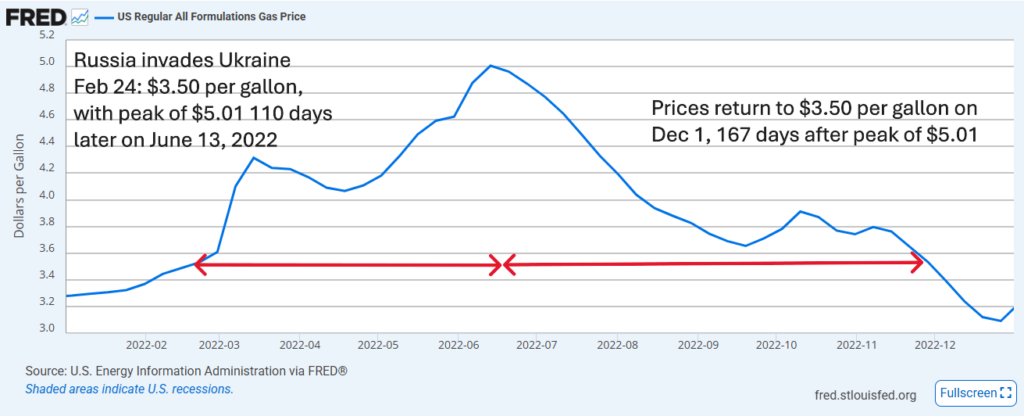
History provides an answer with Russia’s invasion of Ukraine (see graph below). On February 24, 2022, when Russia invaded Ukraine, the US average price for regular gas was around $3.54 per gallon ($3.50 per gallon on February 21). By June 13, 2022—110 days later—the price peaked at $5.01 per gallon. It took until December 1, 2022—167 days—for prices to return to $3.50 per gallon. Thus, the price went up around $1.50 per gallon in 110 days; and it took almost six months for prices to return to normal.
Americans have soured on the President’s handling of inflation and prices; and our lived experience is causing us to reject all the happy talk coming from Trump and Republicans.
President Trump and his Republican colleagues tell us the economy is the best ever. They want us to believe that inflation and high prices have been defeated, and that our paychecks far outpace the rate of inflation.
Polling says that the vast majority of Americans aren’t buying the happy talk. A recent Economist/YouGov poll reveals only 25% of us approve of Trump’s handling of inflation and prices, while 69% disapprove. Even 36% of Republicans are in the “disapprove” column. These numbers are record lows for Trump. Further, the Index of Consumer Sentiment, which measures how Americans feel about the economy, is currently at its lowest point in history, going back to 1961.
Finally, the situation with Iran remains fragile, regardless of whether the ceasefire is extended and the Strait of Hormuz is reopened. In an optimistic scenario, a good agreement with Iran could lead to gas prices returning to near $3.00 per gallon in the space of three or four months. It’s also possible that inflation measures (PCE, CPI, Food at Home) could return to pre-war levels. On the other hand, the situation with Iran could go south, resulting in more war and a closed Strait of Hormuz. This would certainly lead to more economic hardship for Americans.
Should the optimistic scenario prevail, Trump and Republicans will attempt to sell the return to pre-war inflation and prices as a victory. But Americans are not likely to agree. Instead, we’ll remember his promise to “end inflation” (meaning 0% inflation). We’ll remember his promise to “cut energy costs in half” (meaning $2.00 gas). And we’ll remember his promise to “bring down grocery prices” (meaning prices lower than when Biden was in office). MAGA will be prepared to applaud, but the vast majority of Americans will see a President who failed to deliver on his promises.
Leave a Reply