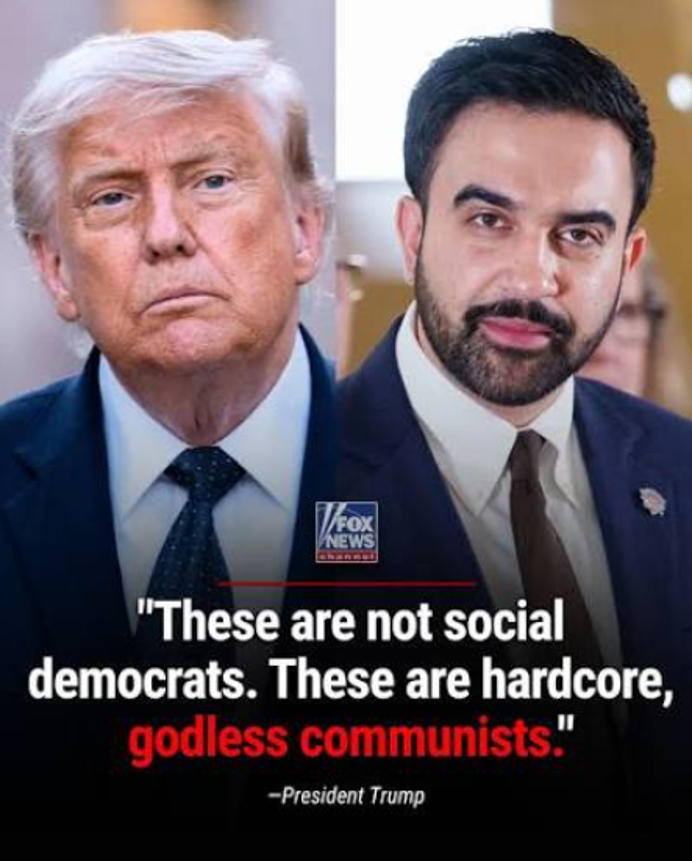
As we move inside 100 days until the November midterm elections, it’s timely to assess the endgame, especially since the word “Communist” just popped up in the jargon. Virtually every opinion poll finds Americans increasingly disapprove of President Trump’s performance. They also disapprove of his handling of many key issues such as inflation, prices, the economy, the war with Iran, and even immigration. The loss of support is most pronounced among Independents; but even Republican support has eroded. Still, most Republicans continue to back Trump’s policies and believe he is delivering on his promises.
The trouble for Trump and Republicans is that they don’t have near the level of public support they enjoyed when the President entered office in January 2025. Many Republican Congressional seats are now in jeopardy. To remain in power, Republicans must pursue a two-part strategy. First, they need to convince voters that Trump/Republican policies are working and that promises are being kept. Second, they need to convince voters that the policies and actions of Democrats are extreme and dangerous. Painting Democrats as radical and dangerous distracts attention from the failed performance by Trump and his party. It also encourages voters to see Republicans as the safer alternative.
In this post I take a deep dive to assess the Republican endgame strategy. First, I examine Trump’s (GOP) policies, including whether they are working, whether promises are being kept, and what public opinion has to say about these matters. This enables conclusions about whether public sentiment could be turned around before the election. Second, I examine the Trump/Republican strategy to portray Democrats as Communists who endanger America and its people. To what extent might Republicans successfully paint policies and positions of Democrats as dangerous and extreme “Communism”? Will this threat of Communism gain traction? Or will voters likely see it as a smokescreen for diverting attention from Republican failures?
Policies and Promises
Let’s start with Trump’s (GOP) policies, including whether they are working, whether promises are being kept, and public opinion on these matters. My list of policies comes from oft-repeated campaign statements as well as Trump’s White House Priorities, and the 2024 Republican Party Platform. I acknowledge this compilation is not exhaustive, but believe it captures the policies and promises Americans view as most important (see US Polling Data Issue Polling Tracker, and Economist/YouGov poll of July 25-27).
1. End Inflation and Lower Prices
- End inflation and make America affordable again. (Republican platform)
- “Starting on day one, we will end inflation and make America affordable again, to bring down the prices of all goods.” (Trump promise)
- “Under my administration, we will be slashing energy and electricity prices by half within 12 months, at a maximum 18 months.” (Trump promise)
- On the 2024 campaign trail, Trump repeatedly pledged to bring gasoline prices below $2 a gallon.
Performance evaluation: Trump and Republicans did not bring about an end to inflation. Instead, inflation continues at levels well above 3% in recent months. Gas is above $4 per gallon (average US price for regular) and has never been below $2.70 per gallon (average US price) during his second term. Trump and Republicans have thus failed on the promise of $2 gas. Groceries are more expensive, as the rate of inflation for “Food at Home” has gone up in recent months. Trump’s comprehensive tariffs drove up costs for groceries, household goods, and residential construction costs. His war of choice with Iran also increased inflation. Finally, energy and electricity prices have yet to be cut in half, and Trump has been in office more than 18 months.
Public opinion: A recent poll (Economist/YouGov, May 29-June 1) found 72% of Americans disapprove of Trump’s handing of inflation, while only 24% approve. The Economist also found that Trump’s net approval rating for his handling of inflation and prices is -43, the lowest of his term, which started out at +2. Finally, Real Clear Politics provides an average of numerous polls on this matter. The June 17-July 20 “RCP Average” was 67.5% disapprove and 29.5% approve on Trump’s handling of inflation and prices.
Critically, Americans have consistently identified “Inflation and prices” as their most important issue. The fact that Trump has not delivered on his promises as well as the increasing disapproval numbers tell us that public sentiment is not likely to rebound in the run-up to the election. The war with Iran is still not settled and continues to drive inflation upward. Also, the President is reinstituting widespread tariffs, which will also drive up inflation. No sales pitch from Trump and Republicans is going to convince Americans that inflation has been defeated.
2. Grow the Economy (in particular, Manufacturing and Jobs)
- Stop outsourcing and turn the United States into a manufacturing superpower (2024 Republican platform)
- On the campaign trail Trump repeatedly pledged to revive U.S. manufacturing jobs and usher in a “golden age” of American-made goods.
- Other campaign promises focused on reindustrializing America. Key pillars include imposing broad tariffs on foreign imports, cutting corporate tax rates for domestic producers, and rolling back clean energy regulations to lower business costs.
Performance evaluation: Quarterly GDP Growth (Real Gross Domestic Product) ranged between a -0.6% and +4.4%% since Trump took office in January 2025. The 2nd Quarter of 2026 just came in at a tepid 1.5%. During the last two years of Biden’s term (2023 and 2024) GDP growth averaged around 3% per quarter. While Trump’s GDP numbers can be considered good, Biden’s were better.
Since Trump has been in office, manufacturing jobs and plant construction are way down. Monthly job growth during Trump’s term has been erratic and modest. Six of his 18 months in office have resulted in job losses; and Biden’s job numbers are significantly greater than Trump’s (see FRED, All Employees, Monthly change, thousands of persons). Finally, in April 2026, inflation overtook wage growth when the Consumer Price Index rose by 3.8% annually while average hourly earnings increased by a lesser 3.6%. This trend continued in May, and in June wage growth and inflation were equal at 3.5%.
Trump did implement widespread tariffs, but the U.S. Supreme Court struck down key parts of his authority. He is reinstituting tariffs using different legal authorizations. Trump and Republicans also enacted legislation to extend tax cuts to corporations. Also, clean energy regulations were rolled back. As of yet, the economy has not significantly expanded (Real GDP) as a result of these efforts.
Public opinion: A recent poll (Economist/YouGov, June 5-8) found 63% of Americans disapprove of Trump’s handling of the economy, while only 24% approve. The RCP Average (June 17-July 20) was 59.8% disapprove and 37.4% approve. Clearly, Americans don’t think Trump is doing a good job when it comes to the economy.
The economy is also identified as one of the most important issues for Americans. Again, since the start of his term, Trump’s approval numbers on his handling of the economy have steadily declined. Americans aren’t feeling it, especially because their perceptions of the economy are so colored by their experience with inflation and prices. Again, Trump and Republicans aren’t going to be able to convince Americans that the economy is booming.
3. End Wars and Keep the United States Out of War
- Prevent World War III, restore peace in Europe and in the Middle East (2024 Republican Platform)
- “Under Trump, we will have no more wars, no more disruptions, and we will have prosperity and peace for all.” (Trump promise)
- On the campaign trail, Trump repeatedly promised to end the war between Russia and Ukraine within 24 hours.
- On the campaign trail, Trump stated that Iran would never be allowed to have a nuclear weapon.
Performance evaluation: Trump started a war with Iran on February 28, 2026. It has been going on for more than five months, with no end in sight. One of his major reasons for striking Iran was to prevent it from developing nuclear weapons. On the other hand, he repeatedly claims to have “totally obliterated” Iran’s nuclear stockpiles. The Trump Administration has yet to provide evidence of an “imminent threat” of Iran developing a nuclear weapon.
Trump did not end the war between Russia and Ukraine, either within 24 hours or in the 18+ months he has been in office. On the other hand, Trump claims to have ended several wars and claims to have brokered peace.
Public opinion: Surveys from The Economist/YouGov Poll (July 10-13), indicate that 59% of Americans disapprove of Trump’s handling of the war with Iran, while just 31% approve. Twice as many Americans oppose the war as support it. And, only 27% of American adults think the war was the “right decision,” while 57% say war was the “wrong decision.” Other polls show similar results. The Economist finds the Iran war is now at its least popular since polls began.
As to Trump’s handling of foreign policy and national defense, polls indicate that roughly 37% to 40% of Americans approve of Trump’s overall foreign policy, while 56% to 60% disapprove. Trump’s approval numbers for foreign policy and national defense were higher at the beginning of his term. The war with Iran has negatively affected his approval ratings on foreign policy and national defense.
With just three months until the election, it’s extremely doubtful that there will be a complete and successful end to the war with Iran. There still is no agreement that assures Iran will not develop nuclear weapons. Nor is there agreement regarding the Strait of Hormuz. The Iranians know that the Trump Administration is motivated to get an agreement before the elections. They can thus hold out for major concessions. Absent an agreement that clearly advances America’s interests (i.e., a win), public opinion is not likely to swing back in favor of Trump’s handling of the war, national defense, and foreign policy.
4. Tough Immigration Enforcement
- Seal the border and stop the migrant invasion (2024 Republican platform)
- Carry out the largest deportation operation in American history (2024 Republican platform)
- Trump’s Administration and his campaign set a specific target and operational goal of deporting at least one million unauthorized immigrants annually
- Other promises include a pledge to sign an Executive Order ending “Birthright Citizenship” and a pledge to finish the border wall.
Performance evaluation: The Trump Administration is largely keeping its promises to seal the border, carry out mass deportations, and build the border wall. Almost immediately, the Trump Administration drastically reduced the number of illegal border crossings. Trump also immediately began to increase deportations by directing Immigration and Customs Enforcement (ICE) to arrest and detain undocumented immigrants regardless of criminal background. Law-abiding migrants living and working the the country for a decade or more were also rounded up and deported. Also, ICE agents were sent out in roving patrols to find and arrest illegal immigrants where they worked and gathered.
The Department of Homeland Security (DHS) reports that between 675,000 and 900,000 deportations and removals have been carried out since January 2025. The Administration also claims an additional 2.2 million “self-deportations;” however, independent migration analysts question these self-deportation estimates.
While the President signed an Executive Order ending Birthright Citizenship, it was immediately challenged in court. As most legal experts predicted, the Executive Order was ruled unconstitutional by the US Supreme Court.
Public opinion: During the 2024 campaign, the public strongly supported sealing the border. Also, a significant majority supported mass deportations. Support for deporting those who committed crimes was very strong, while support for deporting those without criminal backgrounds was mixed. Coming into office, a February 2025 Economist/YouGov poll found 51% approved of Trump’s handling of immigration, while 43% disapproved.
Within the first six months, public opinion began to change. The public became increasingly concerned regarding the tactics and use force by ICE agents. Support also eroded regarding the deportation of those without criminal backgrounds.
A recent Economist/YouGov poll (July 17-20, 2026) revealed that 54% of respondents disapprove of Trump’s handling of immigration, while only 39% approve. That same poll showed Americans do not have confidence in ICE. 58% said ICE used too much force, while only 30% thought the use of force was justified. 48% supported abolishing ICE, while 40% opposed.
Given the trend towards disapproval, Trump and Republicans are not likely to reverse public opinion regarding their policies and actions on immigration. For the most part, it’s only the Republican base that is lauding his performance on immigration. Also, polling reveals that immigration is now taking a back seat to inflation, prices, and the economy when it comes to issue importance. Trump’s record on immigration isn’t going to attract new voting blocks to help Republicans win the midterms.
5. Renew and Expand Tax Cuts for Individuals and Corporations
- Large tax cuts for workers and no tax on tips (2024 Republican platform)
- On the campaign trail, Trump promised to permanently extend the 2017 Tax Cut and Jobs Act, which was set the expire at the end of 2025. In addition to tax cuts for individuals, that law also provided tax cuts for corporations.
- On the campaign trail, Trump also promised, “No tax on tips,” “No tax on overtime” and “No tax on Social Security benefits.”
- Finally, Trump and the Republican party platform promised to fight for and protect Social Security and Medicare, with no cuts. On the campaign trail, Trump also promised to protect Medicaid. However, he noted that the government could go after “waste, fraud, and abuse,”
Performance evaluation: In July of 2025, Trump and Republicans passed the One Big Beautiful Bill Act (OBBBA). This legislation permanently extended the tax cuts for individuals and corporations. It also enacted provisions to address his promises for No tax on tips, no tax on overtime, and no tax on Social Security. Because these extensive tax cuts will decrease federal revenue by about $4.9 trillion over 10 years, deep spending cuts had to be included in order to avoid running up Budget deficits and the National Debt. Among the programs cut deeply were Medicaid, Medicare, and Supplemental Nutrition Assistance Program (SNAP).
According to the nonpartisan Congressional Budget Office (CBO), the legislation cuts federal Medicaid spending by nearly $1 trillion over ten years (2025–2034). It also triggers an estimated $536 billion in automatic spending cuts to Medicare over this same period due to statutory PAYGO deficit. While the OBBBA didn’t directly cut Medicare, the CBO reports that the bill’s large deficit increases will activate mandatory cuts under PAYGO. Even with these deep cuts, the CBO estimates OBBBA will add $4.2 trillion to the National Debt through Fiscal Year 2034.
Trump and Republicans argue that they did not cut Medicare, Medicaid, or SNAP. Instead, they insist they were eliminating “waste, fraud, and abuse.” They added new work requirements and mandated more frequent eligibility monitoring to address these concerns. They also declined to extend enhanced premium tax credits that were scheduled to expire. The effects of these changes will be treated in the next section.
Public opinion: Despite cutting taxes for individuals and corporations, the OBBBA is proving to be unpopular. Right after the bill’s passage, a July 2025 Economist/You Gov poll found only 32% supported the legislation, while 51% opposed it, and 17% had no opinion. Nearly a year after the bill’s passage, a June 2025 Navigator Research poll found that 34% of Americans approved of the law, 53% disapproved, and 13% were unsure. The graphic below depicts the major reasons that large majorities of Americans have concerns about the OBBBA.
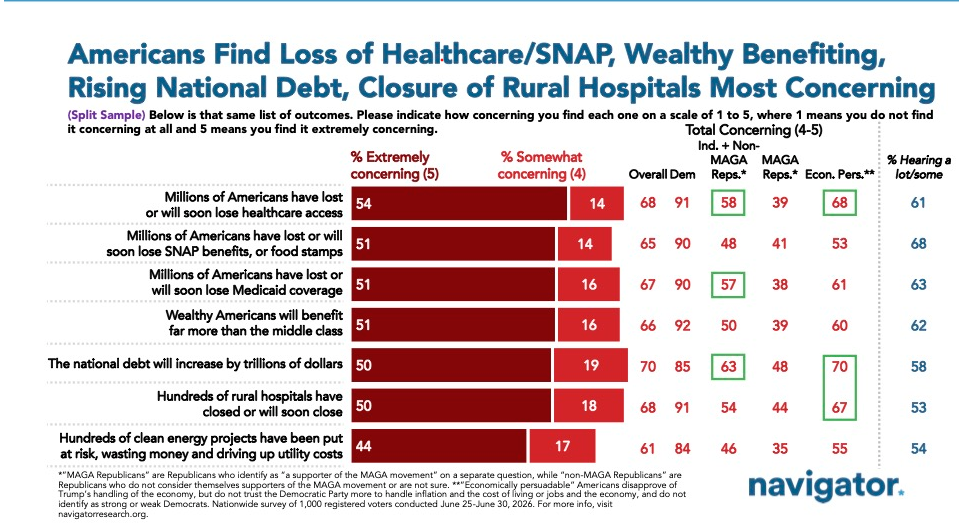
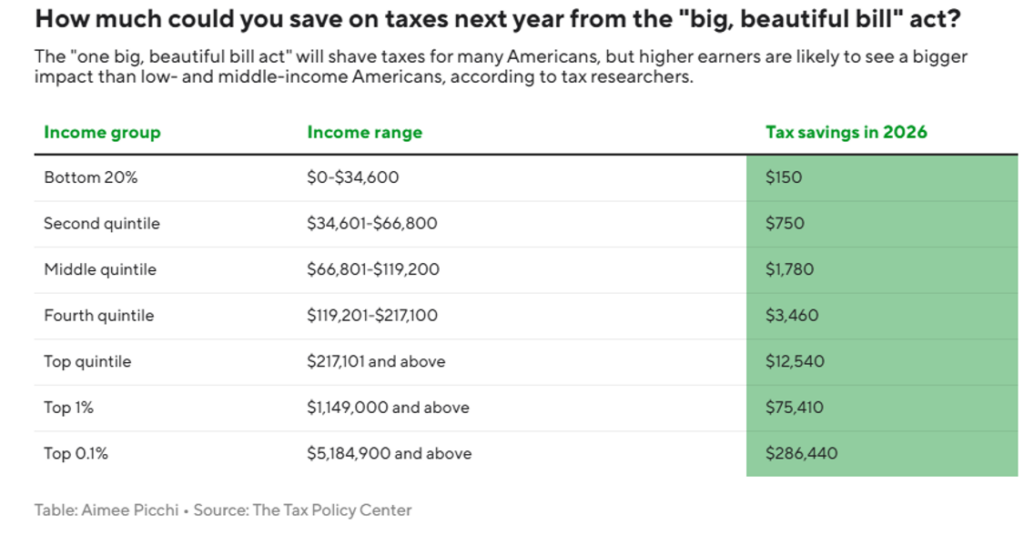
Clearly, the people are concerned that lower and middle class Americans are losing access and services, while the wealthy enjoy the lion’s share of the tax cuts. The graphic below shows just how much more those at the wealthy end are getting. Those earning less than $120,000 aren’t getting much of a tax cut.
Trump and Republicans launched a somewhat deceptive information campaign to change public perception regarding the OBBBA. First, at the last minute, the title “One Big Beautiful Bill Act” was stripped from the legislation, leaving it with no short title. A few months later, Trump and Republicans rebranded the legislation as “The Working Families Tax Cut.” This title was simply made up without any legislative action; it has no legal force and effect.
Also, Americans were told the legislation created the largest tax cuts in American history and that they would be receiving historic tax refunds. The “average” tax refund would exceed $3,400, 11% more than the previous year. This was deceptive because the huge refunds received by the wealthy are driving up the “average” refund. Also, a Tax Foundation study found the average refund is $2,300, not $3,400. Even using the Administration’s $3,400 figure, this only translates to an extra $377 (11% of $3,400). This extra money disappears when we consider the cost of Iran war per household is $1,100 (to cover the extra costs for gas, groceries, airfare, and interest rates). Also, Trump’s tariffs, added an extra cost of $1,000 to $2,500 per household.
6. Improve Health Care
During his campaign, Trump pledged to lower costs for healthcare and prescription drugs, protect Medicare and Social Security, promote chronic disease prevention through the “Make America Healthy Again” (MAHA) initiative, and replace the Affordable Care Act (Obamacare).
Performance evaluation: Trump and Republicans argue that they did not cut Medicare, Medicaid, or SNAP. Instead, they insist they were simply eliminating “waste, fraud, and abuse.” To address these concerns, they enacted new work requirements and mandated more frequent eligibility monitoring. They also decided not to extend enhanced premium tax credits that were scheduled to expire.
According to the CBO, OBBBA’s health care provisions are expected to leave 10 million more Americans uninsured by 2034. Average monthly premiums for marketplace enrollees increased from $113 in 2025 to $178 in 2026, a 58% increase. Sign ups for the Affordable Care Act (ACA) fell by 5 percent, or 1.2 million people, during the 2026 enrollment period. SNAP participation fell by 10 percent, or more than 4 million people, between the OBBBA’s enactment in July 2025 and March 2026. Given that Medicaid and SNAP work requirements and eligibility verification don’t kick in until December 2026 (after the midterm elections), even more enrollment losses can be anticipated for 2027 and beyond.
President Trump is pursuing lower prescription drug costs through voluntary “most-favored-nation” agreements with major pharmaceutical companies. He also launched a direct-to-consumer discount portal “TrumpRx.” However, independent analyses reveal that participating companies still raised prices on hundreds of other brand-name pharmaceuticals. Also, critics note that some online prices overlap with existing generic alternatives or pre-discount coupons.
Public opinion: A recent Economist/YouGov survey (July 25-27) showed only 31% of Americans approve of Trump’s handling of health care, while 59% disapprove, and 10% have no opinion. Trump is underwater on the issue of health care by nearly 2 to 1. The people are concerned about the affordability of health care and the loss of services (cuts to Medicare, Medicaid, closure of rural hospitals). While Republicans support the MAHA initiative and TrumpRx, most Democrats and Independents are more concerned about affordability and retaining services from Medicare and Medicaid. Consequently, Trump and Republicans don’t have any viable options for reversing public opinion on their health care policies and performance.
7. End the Climate Change Hoax and Unleash American Energy
- Climate change is a hoax (oft-repeated campaign statement by Trump)
- Exit the Paris Agreement (global warming, climate change, and greenhouse gas commitments for the planet)
- Cancel the electric vehicle mandate and cut costly and burdensome regulations
- Maximize domestic fossil fuel production (“Drill, Baby Drill”)
- Make America the dominant energy producer in the world by far, and create energy independence
- Halt major climate data collection, research, and monitoring programs across federal agencies
Performance evaluation: Upon taking office, Trump withdrew the US from the Paris Agreement and issued a host of Executive Orders. Here is a list of some of the key actions. He repealed the “Endangerment Finding” that allows regulation of greenhouse gases under the Clean Air Act. He reduced mileage standards for vehicles. He paused funding on clean energy grants, loans, and other funding provided by the Biden Administration’s climate initiatives. He directed agencies to eliminate EV mandates. He opened up federal lands for drilling. He revoked rules regarding refrigerants. He revoked rules on coal-fired power plants. And he repealed numerous Executive Orders issued by President Biden. Also, via OBBBA, he and Republicans reallocated funds that had been set aside for clean energy programs under Biden’s Infrastructure Investment Act and other federal legislation. Finally, he and Republicans reduced funding for federal agencies (EPA, NOAA, FEMA, BLM, and others) and restricted their reporting, data gathering, and research.
According the the US Energy Information Administration, America was already the dominant energy producer in the world before Trump took office in 2025. The US passed Russia to become the top natural gas producer in 2009, and in 2013 passed Saudi Arabia to become the world’s top petroleum producer. And, in 2023, the US became the world’s leader in crude oil production. In 2019, the US became “energy independent”, when it exported more energy than it imported.
On the other hand, the US continues to import crude oil. The United States imported an average of 6.169 million barrels of crude oil per day in 2025. This is down slightly from the 6.588 million barrels per day in 2024, and the 6.478 million barrels per day in 2023.
By unleashing American energy and increasing oil production, Trump promised to lower the cost of gasoline to $2 per gallon. Unleashing American energy would enable prices for everything to come down. This has not happened. Largely because of the war with Iran, gas prices are up more than $1 per gallon, and diesel prices are up more than $1.60 per gallon since February 28, 2026.
Public opinion: Except for Republicans, most Americans have soured on Trump’s anti-climate change and pro-energy agenda. Included are actions to deny climate change, revoke regulations that protect the environment and advance clean energy initiatives, reduce and eliminate funding streams, and curtail federal agencies with environment and climate responsibilities. Early in his Administration, a February 9-11, 2025 Economist/YouGov poll found 37% of Americans approved of his handling of the Environment and Climate Change, while 45% disapproved, and 19% had no opinion. More recently, a July 25-27, 2026 Economist/YouGov poll found only 31% of Americans approve of Trump’s handling of the environment, while 56% disapprove. A recent article in the Guardian reports that about two-thirds of Americans say they are worried about the climate crisis according to polling by Yale and the George Mason Center for Climate Change Communication.
Another recent Economist/YouGov poll found that Americans don’t buy Trump’s argument that climate change is a hoax. 62% of Americans believe that the world’s climate is changing due to human activity, while 25% say there is climate change, but it’s not due to human activity. Only 5% say climate change isn’t occurring.
In the next 90 days it’s extremely unlikely that Trump and Republicans will convince voters that they are doing a great job with unleashing American energy and denying climate change. In fact, it’s much more likely that more Democrats and Independents will be voting because of their concerns about climate change and the environment.
8. Other Policies and Promises
Other Trump/Republican policies and promises include:
- Safeguarding elections (ID requirements, limiting mail-in ballots, ending voting by illegal aliens)
- Reducing crime and criminal justice reform
- Abortion
- Protecting 2nd Amendment rights and gun controls
These policy matters are clearly important, but only the matter of elections and election security is likely to impact the upcoming midterm elections. Trump and Republicans have claimed that there is widespread voter fraud connected with mail-in ballots and the lack of voter ID requirements for voting. They have also claimed widespread voting by illegal immigrants. They have not offered evidence or proof that these problems are extensive, or that they have been at a level to influence the outcome of an election. Prior investigations at the federal level refute contentions by Trump and Republicans.
Under federal law, the states have the responsibility to establish the rules for elections. No state has found widespread voter fraud related to mail-in ballots. Nor has any state found widespread voting by those assuming another person’s identity. Nor has any state found widespread voting by undocumented immigrants.
If Trump and Republicans lose control of one or both chambers of Congress in November, they will likely contest the results. They will argue the elections were rigged. But these claims must either be proved in court, or in election challenges and audits established by law.
Conclusion: The evidence is overwhelming that Americans increasingly disapprove of the policies and performance of the Trump Administration (Republicans), boosting the chances that Democrats will regain control of the House of Representatives, and possibly the Senate.
On all the major policies that will bring voters to the upcoming midterm elections, the Trump Administration and Republicans are saddled with disapproval numbers in the range of 60-75%. Most of the time, only 25-40% of Americans approve of Trump’s/Republicans handling of these key policies. The disapproval numbers have increased significantly since Trump took office. And, with just three months until the election, conditions don’t look good for turning these numbers around. Prices for gas, groceries, and everything else are not likely to decline. Inflation will continue and the economy is not likely to rebound. The war with Iran is not likely to come to a clear win for the US; instead, it is likely to drag on without resolution.
For 18 months, Americans have constantly been told how great things are with Trump and Republicans in control. The economy is the best ever, inflation is defeated, prices are way down, and historic tax refunds are in our pockets. The messaging campaign has worked for Republicans and the MAGA base; but most Americans, including huge percentages of Independents, aren’t buying it.
Over the last several days (July 25-31), Real Clear Politics shows that Democrats are up between 5.4 and 6 points on the Generic Congressional Vote. This RCP average is derived from about a dozen polls on the subject, and is thus considered reliable. What’s the big deal, you ask? Going back to 2010, the political party that was up on the Generic Congressional Vote 100 days out always picked up a significant number of seats in the House of Representatives. In 2010, the GOP was up by 3.4 points and picked up 63 seats. In 2014, the Democrats were up by 1.4 points and picked up 13 seats. In 2018, Democrats were up by 7.3 points and picked up 41 seats. And in 2022, the GOP was up by 2.2 points and picked up 9 seats.
To win in November, Trump and Republicans have to do something more. Yes, they must continue to sell their successes in order to prevent further erosion in the Republican base. But the low approval numbers and history say they are in deep trouble. Somehow they have to convince voters, particularly Independents, to eschew voting for Democrats. Their solution is to sound the alarm that the Democratic party is being taken over by Communists.
The Democratic Party is Being Taken Over by Communists
To examine this second component of the Republican midterm strategy, we’ll start by identifying what President Trump and other Republicans say are the key threats of a Communist takeover. Next, we’ll analyze whether the threat is real and imminent. We’ll look at the Democratic Socialists of America, the organization whose members Trump and Republicans insist are Communists. We’ll look at its size, structure, and policy agenda. To what extent are its members and candidates it endorses in Congress or running for Congress? Are these members and those it endorses actually Communists? And how imminent and likely is it that the Democratic Party is being taken over by Democratic Socialists/Communists? Finally, we’ll assess whether voters will buy the threat of Communism coming from a takeover of the Democratic Party.
1. What Trump and Republicans Are Saying About a Takeover of the Democratic Party by Communists
Here’s a sampling of recent quotes, one from President Trump and another from House Speaker Mike Johnson:
“And as you saw with the communists elected in New York City recently — they’re communists, they’re not social Democrats — they want to completely destroy the traditional American way of life. . . It’s becoming a communist party. These are not social Dumocrats, these are hardcore, God-less communists. . . .This is the most serious threat to our country since its existence, in my opinion . . .”
President Trump addressing the Faith and Freedom Coalition Conference on June 26, 2026
“We’re fighting right now in Congress over whether we’re going to maintain our status as a constitutional republic or we’re going to trade that in, dismantle the foundations and go down this dark road of death to communism. That is the question on the ballot this fall. . . . These crazy little mini-Mamdani’s who are popping up all around the country; they are a danger to you and your family. . . . The American people have to decide in November, in a midterm election for Congress and Senate. It’s not something that we would’ve projected. I hoped and prayed it would never come to this, but here we are. The barbarians are in the gate.”
House Speaker Mike Johnson (R-La.) at a press conference at the Republican National Committee on July 14, 2026
Here’s what President Trump and Speaker Johnson decry as some of the threats coming from the Communists taking over the Democratic Party :
- They will make promises they know they can’t keep, like free rent, free houses, free food, free everything
- Within two or three years of free everything, the country will fail as it always does with Communism; Americans will live in squalor in a third-world county
- They want to pack the Supreme Court
- They want the House of Representatives to run everything and abolish the Senate
- They want to remove the President
- They want to abolish all borders
- They want mass amnesty to anyone who can come onto our shores without exception, even for terrorists and hardened, dangerous criminals
- They don’t want prisons
- They don’t want to fund the police
- They will attack all religions, particularly Christianity
2. How Real and Imminent is a Takeover of the Democratic Party by Communists?
Trump and Republicans are arguing that government officials who are members of The Democratic Socialists of America (DSA), or who are endorsed by DSA, are actually Communists. Let’s take a look, starting with how DSA describes itself on its website:
“The Democratic Socialists of America is the largest socialist organization in the United States, with over 100,000 members and chapters in all 50 states. We believe that working people should run both the economy and society democratically to meet human needs, not to make profits for a few.”
Home website of the Democratic Socialists of America
Wikipedia gives us more detail about the DSA. It’s July 2026 membership is now over 120,000, still a very small organization. DSA is not a political party, rather, it’s an organization focused on the principles of democratic socialism, “a big tent on the left wing of the political spectrum.”
Here’s how Wikipedia describes its platform:
“DSA’s platform calls for reforms such as a Green New Deal, single-payer healthcare, and tuition-free higher education, with a long-term aim of social ownership and democratic control of the American economy. DSA’s foreign policy is anti-imperialist, strongly supporting spending cuts and footprint reductions to the U.S. military while also supporting pro-Palestinian and anti-Zionist causes.”
Wikipedia, Democratic Socialists of America
I went onto the DSA website and examined its platform in greater depth. There are several extreme elements that do, in fact, match what the President and Republicans are contending. The DSA platform calls for the elimination of the US Senate and a revamped House of Representatives. Congress would then choose the President and the Supreme Court justices. ICE would be abolished, and the Department of War would be defunded. Policing would be reformed and significantly defunded. Housing would be established as a human right.
I also went onto the website of the Communist Party of United States of America (CPUSA) and examined its Program. This document goes on for ten or more pages to describe the Party’s broad goals and beliefs. I found some similarities with the DSA platform, especially the notion of the government being run by the working class, and ending capitalism and replacing it with socialism. But the Program does not match with the specific recommendations in the DSA platform. There are no calls to abolish the Senate, have Congress choose the President and the Supreme Court justices, abolish ICE, defund the Department of War, etc.
The President and Republicans are thus wrong in declaring that members of the DSA are Communists. The DSA and the CPUSA are separate organizations with separate platforms. Trump and Republicans can legitimately argue the two organizations share some of the same goals and policies. But, as we’ll see shortly, significant majorities of the American public also support several of the policies proposed by DSA and the CPUSA. That does not make these Americans Communists. Nor does this make the CPUSA a powerful force. In fact, there are currently only 11,000 members of the CPUSA. And, in May 2026, Newsweek reported that in all of the United States–federal, state, and local government–there were just three Communist officials currently holding office (all in local government). America’s Communist Party is thus tiny, and exerts little influence.
While it’s fair to characterize the platform of the DSA as extreme, the likelihood of the platform actually being implemented or enacted is nil. Many of changes would require amending the Constitution. This takes a two-thirds vote by each chamber of Congress and ratification by three-fourths of the states. Currently, there are only two members of the DSA serving in Congress. The Congressional Progressive Caucus (CPC) has 100 members (1 Senator and 99 members of the HR); but it’s policy agenda is far less extreme. The CPC is not proposing or supporting the far-reaching amendments to the Constitution called for by the DSA. The CPC hasn’t called for an end to mass incarceration. It hasn’t called for defunding the police. It hasn’t called for abolishing borders. In short, the current Congress couldn’t possibly produce the votes to move the extreme policies advocated by the DSA.
But let’s dig deeper on this point. Currently, only six Democratic Socialist candidates are running for seats in Congress. Most DSA candidates, or candidates supported by DSA, were defeated in the primaries. It’s impossible to imagine how a DSA member could be elected as the Democrat leader in the Senate and House. It’s even more impossible to imagine, should that DSA member be elected as the Democrat leader, how that person could control the votes of their fellow Democrats. The Democratic Party is a big tent party, and most Democrat members of Congress are either “establishment” or “moderate.” Many of these Democrats serve constituencies who are middle of the road or moderate. These Democrats don’t support the DSA platform; and if they did it would be political suicide. Finally, allowing the impossibility that the DSA leader could control all Democrat votes, it’s unthinkable that there could be a two-thirds vote in both the House and Senate in order to amend the Constitution.
In summary, there is absolutely no threat of a takeover of the Democratic Party by Communists. Nor is there a threat of a takeover of the Democratic Party by Democratic Socialists (DSA). Instead, Trump and Republicans have conflated several of the extreme positions of the DLS with Communism. They then argue that based on a few wins around the country, this Communism (Democratic Socialism) is spreading like wildfire and is taking over the Democratic Party. Time Magazine sums it up nicely:
“To be clear, the Democratic Party has not been taken over by communists. The democratic socialists who have won high-profile primaries this year generally support expanding government programs while still operating within a market-based economy. There are also no members of Congress who openly identify as members of the Communist Party, and no Communist Party candidate has won state or federal office in modern American history.”
Time, July 13, 2026
3. Will Voters Buy the Threat of a Communist Takeover of the Democratic Party?
My analysis indicates that some blocks of voters will buy the imminent threat of a Communist takeover of the Democratic Party. First, it’s probable that Trump’s base, Republicans and MAGA, will ignore reality (the prior discussion above) and believe there’s an imminent threat of Communism. A July 17-20 Economist/YouGov poll found 64% of Republicans believe there is a “major” or “moderate” threat of Communism. Second, older voters, who are more likely to have memories of the evils of Communism, could be susceptible to the threat of Communism rearing its ugly head. The same poll found 51% of those 65 and older, and 49% of those 45-64, say Communism is a “major” or “moderate” threat.
On the other hand, there are several blocks of voters who are likely to reject or shrug off the imminent threat of Communism. First, many younger voters may dismiss the label of “Communism” and not fear the label of “socialism.” They don’t have memories of the evils of Communism. And many may favor European-style social programs. The same Economist/YouGov poll cited above found that only 37% of those 18-29, and 35% of those 30-44 see Communism as a major or moderate threat. Second, voters with higher levels of education should be more aware that Democratic socialism is not the same as Communism. They will also more likely know that Democratic socialism isn’t taking over the Democratic Party. The same Economist/YouGov poll found that only 31% of those with a college degree thought there was a major or moderate threat of Communist. On the other hand, 50% of those without a college degree thought there was a major or moderate threat. Third, it’s likely that those struggling with high living costs, housing problems, and other financial problems might be disillusioned with capitalism and be more receptive to socialism (see this story in the Christian Science Monitor).
Finally, of course, Democrats and Independents may not buy the imminent threat of Communism. The same Economist/YouGov poll found only 29% of Democrats, and only 40% of Independents, thought there was a major or moderate threat of Communism.
To sell the imminent threat of Communist takeover of the Democratic Party, Trump and Republicans are doing more than conflating Democratic socialism with Communism. They will also conflate policies long advocated by Democrats as Communism. Let me give you some examples:
- They will say raising taxes on corporations and the wealthy is Communism because that’s a main plank of the DSA platform.
- When Democrats argue that addressing affordability requires expanding government-funded programs, Republicans will say this is Communism because it’s what the DSA advocates.
- Republicans will say aggressive government efforts to address climate change is Communism because the Green New Deal and other environmental programs are part of the DSA platform.
- They will say stronger federal protections for workers is Communism because that’s what the DSA platform advocates.
- They will say Universal Healthcare, “Medicare for All” or expanding the public option for health care is Communism because the DSA platform advocates these policies.
- They will say electoral reform, such as eliminating the Electoral College (in favor of electing the President by popular vote) is Communism because that’s what DSA advocates.
I don’t believe this conflation campaign will be successful in turning the tide against Democrats. The problem for Trump and Republicans is that substantial majorities of Americans are now backing the policies cited above. In fact, 50% of Americans now support abolishing ICE; and Gallup and Pew Research polls consistently show Americans want to eliminate the Electoral College.
Conclusion: Trump and Republicans aren’t likely to convince many additional voters to turn away from Democrats because the party is supposedly being taken over by Communists.
It’s going to take a convincing argument to win over those who have soured on President Trump and Republicans because of failed policies and broken promises. That argument falls apart when voters come to understand that the threat is neither real nor imminent. And many voters will be offended when they see policies they support being branded as “Communism.” And, finally, many voters just don’t feel that threatened when it comes to labels such as “Communism” or “socialism.”
Final Thoughts
In American hyper-partisan politics, each side too often resorts to painting the other side as evil, corrupt, and dangerous. We eschew working cooperatively to find middle ground and solve problems. Instead, the quest is to gain and maintain control, to impose our agenda, and to demonize the other side. Trump is a master at doing these things. But he is failing, and his prospects for turning things around in November are dismal.
The hope for the future is that we choose leaders who want to work in a bipartisan manner to solve problems. We need leaders who don’t demonize the other side and only care about gaining and maintaining control. May it be that America finally learns this lesson as our current President fades into obscurity.
Leave a Reply