Fifth in a series, “Rejecting the Politics of Division and Embracing Unity”
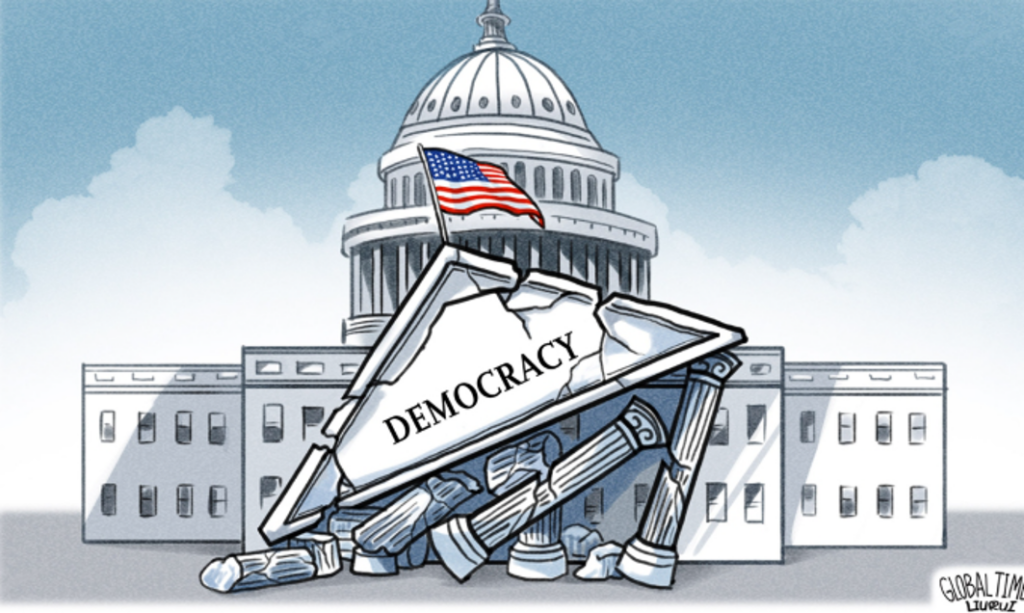
A democracy cannot survive without an informed and engaged citizenry. We, the people, created a form of government that requires us to be involved in decision-making. We took on this responsibility because we did not want a king or a dictator making all the rules and telling us what to do.
What a democracy requires from its citizens is cogently stated in this quote from The Colleges of Law:
“Framers of the Constitution presupposed an educated and informed citizenry capable of sustaining self-government through reasoning, discerning information, and exercising good judgment. Liberty, as they understood, cannot be sustained without an educated populace capable of civic participation.”
The Colleges of Law, December 26, 2025.
In this article we’ll examine the status of civic literacy and political engagement in America. How well educated and informed are Americans in terms of how our government operates and the important policy issues of the day (civic literacy)? And, how active are we in carrying out our responsibilities as citizens (political engagement)? Engaged citizens vote, stay informed, communicate with elected officials and fellow citizens, volunteer, and more.
Importantly, we’ll explore demographic data telling us where levels of civic literacy and political engagement are high or low based on such factors as age, educational attainment, gender, race, and political party. This information gives us a deeper understanding of the problems.
The analysis starts with an inquiry into the status of civic literacy, and political engagement in America. I then discuss the implications of these findings when it comes to preserving democracy in a deeply divided country. Finally, I conclude with some thoughts on a way forward.
A 2025 nationwide survey by the U.S. Chamber of Commerce Foundation found that 58% of American adults could not pass a basic civics test; but most Americans are confident of their own knowledge while they see the general public as uninformed.
A June 2025 survey by the U.S. Chamber of Commerce Foundation found that 58% of US adults could not pass a basic civics test. Further, despite that fact that most failed, 74% of those surveyed were confident they could explain how government works to someone from another country. This says Americans tend to have a low level of civic literacy, but don’t know it. In fact, we seem to be pretty confident of our knowledge of civics.
The actual survey questions, responses, and the civics test itself were not made available. Thus, I was unable to draw conclusions regarding the validity of the test, the cutoff for determining pass or fail, or the results by demographic group.
Other surveys, such as the annual Annenberg Civics Knowledge Survey and the American Bar Association’s Survey of Civic Literacy report on responses by individual question. For example, 87% of respondents correctly answered that the first ten Amendments to the Constitution is called the Bill of Rights. However, these surveys neither determine nor report pass/fail percentages for the entire quiz.
Finally, the ABA’s Survey of Civic Literacy queries respondents on how well informed the general public is about how government operates. In 2023, 53% said the public was “not very informed”, and 17% said the public was “not at all informed.” Clearly, Americans don’t think the general public is well informed about how our government operates.
A 2022 study reported in The Conversation also found that most Americans think they know much more about politics than they actually do.
A September 2022 article in The Conversation reported on a study involving 1,209 participants. The researcher, Ian Anson, found around 70% were “overconfident” in their knowledge of politics:
“Many respondents who believed they were top performers were actually among those who scored the worst. Much akin to the results of a famous study by Dunning and Kruger, the poorest performers did not generally realize that they lagged behind their peers.”
Ian Anson, Associate Professor of Political Science, University of Maryland
The researcher also found that the overconfident respondents failed to change their attitudes once they were informed their assertions were false. Noted Anson, “[T]heir attitudes toward falsehoods remained inflexible, likely because they – wrongly – considered themselves political experts.”
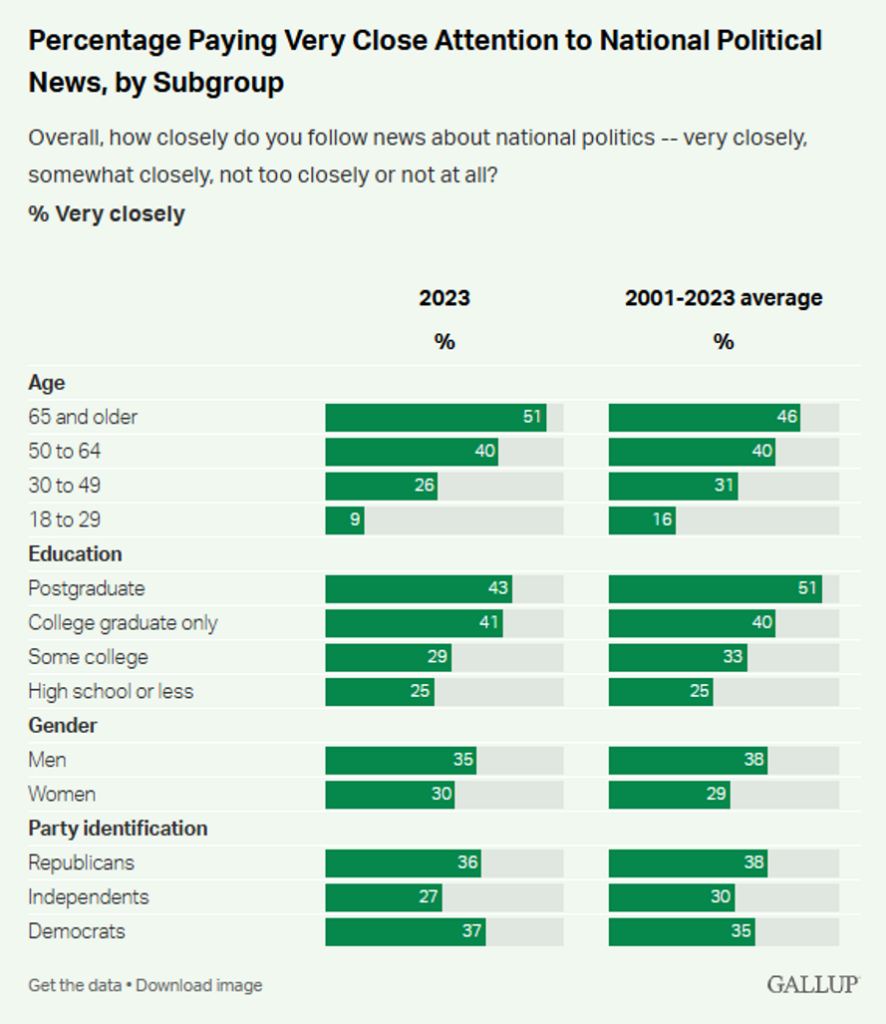
A tracking poll by Gallup finds that, over time, only about 35% of American adults “very closely follow” national political news; also, some demographic groups—such as the young and the less educated—have much smaller percentages who “very closely follow” political news.
The most recent Gallup analysis is October 2023. Going back to 1995, the average percentage of Americans who “very closely follow” news about national politics is 35%. This percentage varies from 23% to 43% in different years. In particular, interest almost always peaks in presidential election years. In the 2023 survey, the results were: 32% “very closely follow”, 41% “somewhat closely follow”, 19% “not too closely follow”, and 8% “not at all follow.”
Perhaps more importantly, there are some big differences when it comes to demographics (see below). As you can see from the 2023 results, the following groups have significantly smaller percentages for “very closely” following political news: 18-29 year olds (9%), 30-49 year olds (26%), those with a high school education or less (25%), and Independents (27%). On the other hand, those who are older (over 50), more highly educated (college or postgraduate degrees), and either Democrat or Republican are more likely to “very closely” follow political news.
A 2024 YouGov study regarding “disengaged voters” found that those who say they follow political news “only now and then” or “hardly at all” score much lower on a political knowledge test than the average score for all registered voters.
Disengaged voters can be defined as people who are registered to vote but who don’t follow politics closely. A YouGov study from July 2024 found that, demographically, disengaged voters are more often younger, more often female, and more often less educated than politically engaged voters.
Another key finding from the study was that “disengaged voters” (those who say they follow political news “only now and then” or “hardly at all”) score much lower on a political knowledge test than the average score for all registered voters.
Below I provide the graphic that sets forth the actual numbers:
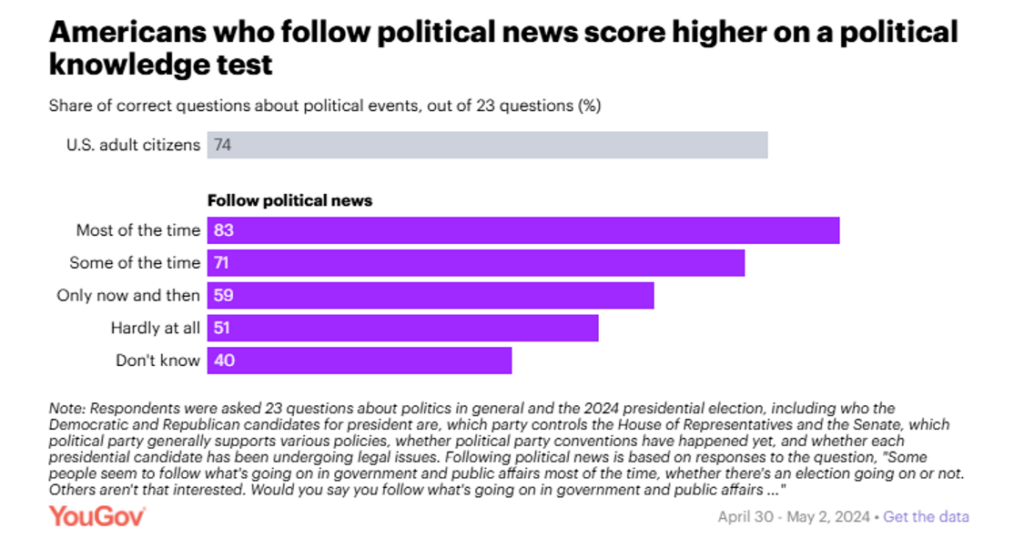
As you can see, the average score for US adults on the political knowledge test was 74. However, the average score for those who say they follow political news “Hardly at all” was 51. For those who say they follow political news “Only now and then” the average score was 59. For those who follow news “Some of the time”, the score was 71, close to the average for all voters. On the other hand, the average score for those who follow political news “Most of the time” was 83. This score is well above the average for all citizens, and well above those who follow “Only now and then” or “Hardly at all.”
Finally, the YouGov survey also revealed that, “Disengaged voters consume less news from all sources except social media and people they know.” When compared to engaged voters, disengaged voters rely less on television, news websites, radio, podcasts, print newspapers, magazines, and other media.
A 2022 Pew Research analysis found that Americans at the extremes of the ideological continuum tend to be the most active (politically engaged) in national politics.
A January 2022 Pew Research analysis found:
“U.S. adults who fall on either end of the ideological spectrum are more active than other Americans across several measures of political engagement, from voting to posting about politics on social media to donating to campaigns. Americans who hold less consistently liberal or conservative views, by contrast, tend to be less engaged on these topics.”
The above analysis and another report from Pew Research find those at the extremes are more politically engaged because their beliefs are closely linked to their personal identities and are driven by strong emotions such as fear, anger, and hate. For extremists, politics isn’t simply a matter of policy preferences; instead, politics are part of their core identity. A deep dislike and distrust of the opposing party—partisan animosity—drives political activism by those at the extremes.
The fact that people at the extremes are the most active in politics does not mean, ipso facto, that they are the most knowledgeable or the most rational. Research shows that those at the ideological extremes are often subject to cognitive inflexibility, unwillingness to compromise, and a desire for clear-cut moral certainty.
A 2025 Harvard Youth Poll found that young people (18-29) are less politically engaged not because of apathy, but mostly because they are frustrated with the system.
The most recent Harvard Youth Poll (2025, conducted annually) reveals that those 18-29 have a deep distrust in institutions. They are strongly dissatisfied with both the Republican and Democratic parties. They feel their generation’s needs are being ignored by politicians. The vast majority believe the country is headed in the wrong direction and that their futures are unstable. They feel overwhelmed and are struggling to get by, especially with respect to finances. Put together, these sentiments indicate that young people are withdrawing from political engagement mostly because they are frustrated, and not because of apathy.
The findings outlined above have troubling implications when it comes to preserving our democracy and uniting our deeply divided country.
Without going into detail, let me list and briefly describe what I see as the five most troubling implications of the findings just discussed.
1. A large percentage of Americans—probably well over 50%—have limited civic literacy. Many do not know how our government works. And many don’t even have a basic understanding of the issues of the day. This threatens our democracy because our citizenry is poorly informed. To make matters worse, nearly three-fourths of us (74%) have confidence in our level of civic literacy. We don’t understand or don’t admit that we have deficits that need to be addressed. Finally, our limited civic literacy exposes us to the threat of being manipulated by politicians and political parties.
2. Most Americans—upwards of 70%—are overconfident in their knowledge of politics. Too many believe they are experts when the opposite is true. This presents a danger to democracy because these individuals aren’t actually informed citizens. Worse, because they lack the self-awareness to realize their mistakes, they are unlikely to change their views.
3. Nearly two-thirds of Americans (65%) either don’t follow national political news at all, or only follow it “somewhat closely” or “not too closely”. Only about a third of citizens “very closely follow” national political news. Sadly, this percentage is much smaller for the young (18-29) and less educated (high school or less). Many aren’t closely following political news because they already see themselves as experts. And many don’t closely follow political news (especially the young) because they are frustrated with the system.
4. For those who make the effort to follow political news “most of the time” or even “some of the time” this commitment pays off. These individuals rank considerably higher when it comes to political knowledge. The trouble is, again, that around two-thirds of Americans don’t realize or see the need to make this effort.
5. Because Americans at the political extremes tend to be the most politically engaged, they have an outsized effect on the nation’s politics and polarization. They dominate political discourse because they are highly engaged, vote regularly, and use social media to amplify conflict. UC Berkeley researchers conclude that these “superpolitical tribes” at the extremes are a leading cause of division. They say roughly 67% of the American public is the “exhausted majority” that is fed up with the right-left divide. Psychology Today reports that many Americans are “tuning out” of politics because they find it so stressful and exhausting. And Pew Research reaches the same conclusion.
Most of the implications described above are especially pernicious because they are self-perpetuating. Many Americans are deficient in civic literacy; however, they don’t do anything about it because they view themselves as competent. Many Americans with limited political knowledge have a cognitive bias (the Dunning-Kruger effect) to greatly overestimate their competence; thus, they keep making mistakes because they lack the self-awareness to realize they are wrong. Because many Americans feel anxious, stressed out, and exhausted by politics, they tune out; but this only causes them to be less informed and politically engaged. Americans at the extremes of the political spectrum dominate in terms of political engagement; but their messaging and behaviors exhaust, alienate, and fatigue many Americans into tuning out. Finally, many younger voters are frustrated with a political system that isn’t responding to their needs, causing them to disengage from politics.
The Way Forward
The way forward is to break out of these self-perpetuating cycles, something much easier said than done. Fundamentally, unless most of us change our behaviors, American democracy will continue to be threatened and deeply divided. For example, until the political system and politicians do more to reach out to young Americans, and until the young stop letting frustration inhibit their political participation, the young will remain politically disengaged.
Here, then, are six recommendations on a way forward:
1. Each of us needs to do a self assessment. Here are some questions we should be asking ourselves. Am I really as informed about how government works and the issues of the day as I think I am? Have I tuned out of following political news and remaining politically engaged because I am stressed out, exhausted, or frustrated by the way politics is practiced in America?
2. Each of us needs to make some commitments towards improving our civic literacy and political engagement. A good starting point is to broaden our sources of political information and take more time to become politically informed. Relying on a single source that is biased (e.g., Fox News or MS NOW) is too easy and is part of the problem. And so is relying on our friends and social media echo chambers. It will take courage to search for information that challenges or contradicts our beliefs. On the other hand, we are now free to discount the stressful and exhausting communications from those at the political extremes. Don’t let them drive you away from being politically informed and engaged.
3. Each of us needs to improve our fact-checking skills. Our daily lives are bombarded with misinformation and lies. With artificial intelligence (AI) it’s easy to ask whether a statement is true or reliable. Also, there are numerous fact-checking websites that enable you to validate assertions made by politicians, media outlets, and others. Part of being a good citizen is the ability to find the facts and the truth.
4. Each of us needs to be more vocal in terms political engagement, particularly in terms of communicating with elected officials, friends, family, and fellow citizens. Don’t let the people at the political extremes dominate political discourse with their polarizing content. They have had a monopoly on communications for far too long. Practice being factual, civil, and open to discussion. Avoid being confrontational, condemning, and absolute. Your job as a citizen entails giving input to your elected officials. It also entails dialogue with friends, family, and fellow citizens, enabling you to change your views and change theirs.
5. Political parties and politicians need to do more to reach out to younger voters as well as other Americans who have tuned out of politics (become politically disengaged) because of frustration, exhaustion, or stress over the way politics is being practiced. The political parties and politicians tend to be polarizing because they want the other side to be seen as wrong, dangerous, corrupt, dishonest, and evil. This helps win elections. On the other hand, millions of Americans have left the Republican and Democratic parties because these parties are so divisive and extreme. On balance, political parties and politicians should be motivated to regain these alienated groups. To do so, however, they will need to be less partisan and shrill.
6. Researchers, think tanks, educational institutions, and public policy organizations need to keep spreading the word and refining our knowledge regarding civic literacy, political engagement, and threats to our democracy. Americans need to know that we have low levels of civic literacy and political engagement. We need to know that we often make mistakes despite feeling confident about our knowledge. We also need to know that those at the political extremes have caused many of us to feel exhausted and frustrated with politics, thus driving us away. We need to know that our democracy is threatened if we are not informed and politically engaged as citizens. These institutions need to keep sounding the alarm because too many of us have disengaged in recent years.
In the big picture, saving our democracy rests on tens of millions of Americans making a renewed commitment to be better citizens. Slowly but surely, too many of us have been driven to tune out of politics. Slowly but surely, our levels of civic literacy and political engagement have eroded. This has enabled those at the political extremes to fill the void and dominate. Blaming others and remaining on the sidelines will only further weaken our democracy. It’s time to turn the corner and become the informed and engaged citizenry that our precious democracy demands.
Leave a Reply