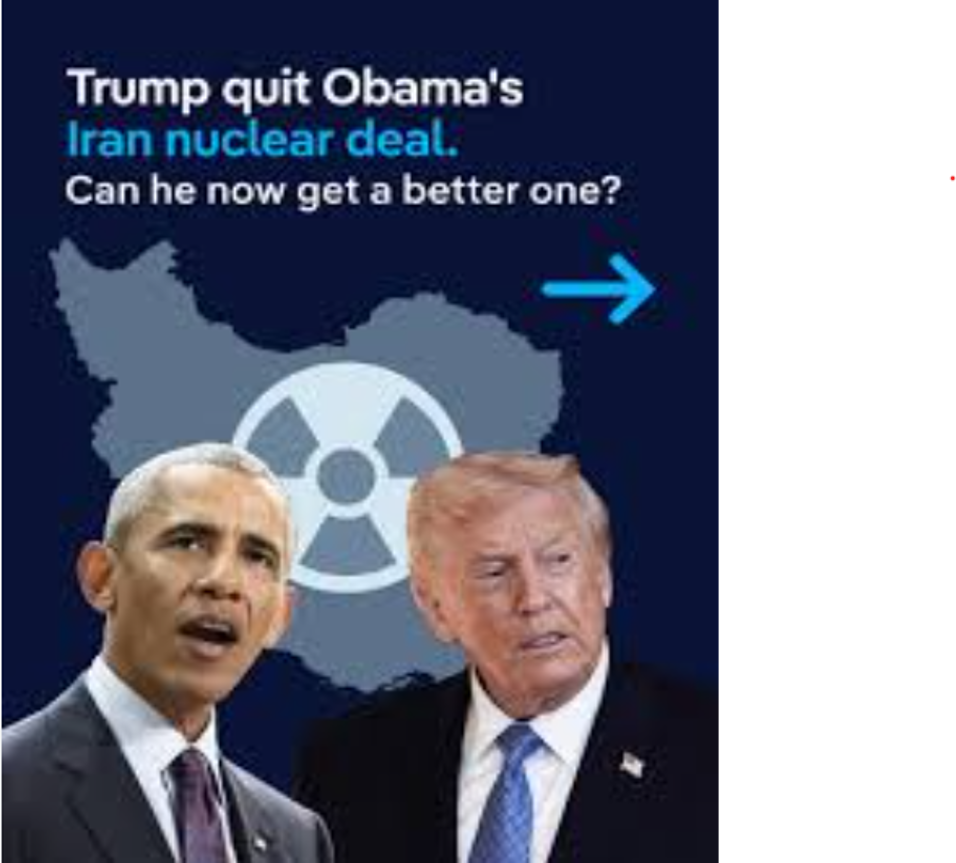
President Trump continues to bash Obama’s 2015 Iran Nuclear Deal (the Joint Comprehensive Plan of Action, or JCPOA) as the “worst deal ever.” He argues that it failed to permanently prevent Iran from having a nuclear weapon. It also failed to address the full range of threats posed by Iran, especially its growing missile capabilities. He further argues Iran was even more dangerous when the JCPOA let it off the hook from a wide array of sanctions. Finally, under Obama’s horrible one-sided deal, Iran was certain to have a nuclear weapon unless he acted. Thus, in his first term (May of 2018), Trump withdrew the US from the JCPOA.
Upon withdrawing, Trump reimposed economic sanctions on Iran. These sanctions focused on oil exports, shipping, banking, and other key industries. His intent was to create a “maximum pressure” campaign that would force Iran back to the bargaining table. The President assured us that he would bring Iran to heel with a much better deal that protected America from the full range of Iranian threats.
What played out over the remainder of Trump’s first term—and indeed last eight years—is hardly a success story. Let me take you through the sad history and lessons learned.
From the outset, President Trump failed to appreciate Iran’s long history of standing firm against outside aggression—whether it be war, the threat of death, or enduring the harsh effects of economic sanctions.
When Trump recently threatened to bomb Iran “back to the Stone Age” and warned, “a whole civilization will die tonight, never to return again,” here’s what The Conversation had to say:
“These statements show not only extreme belligerence, but Trump’s complete lack of understanding of Iran’s long, resilient culture and civilisation and the fortitude of its people. . . Iran has been subjected to much internal strife and foreign power intervention, but it has never been colonised or subjugated. At every difficult moment in their history, Iranians have fought to preserve what is theirs.”
The Conversation, ‘No fear of roaring lions’: Iran has a long history of standing firm against outside aggressors, May 5, 2026
Iranians approach war, the threat of death, and enduring hardship much differently than westerners. In their culture, the virtue of dying for a greater cause is deeply woven into Iran’s history and religious identity. History tells us that Iran will not be cowed by the threat of annihilation. Nor will it quickly give in if the going gets rough and its people suffer the harsh effects of economic sanctions.
President Trump failed to appreciate that the JCPOA was actually a hard-fought agreement with a very tough negotiator.
Going back to the late 1970’s and early 1980’s, the US and other countries have been concerned about Iran developing nuclear weapons. Going back 25 years, President George W. Bush used a multi-part strategy that involved international coalition building (especially with the UK, France, and Germany), economic sanctions imposed by the UN and US, covert operations, and the threat of military action. Like the presidents before him, Bush was unsuccessful in getting Iran to curtail its nuclear weapon ambitions.
Up until 2004, Iran had resisted all efforts to pressure it into agreeing to curtail its nuclear weapon ambitions. In that year, Iran and the EU-3 (Britain, France, and Germany) entered into the Paris Agreement. Iran agreed to temporarily stop enrichment and conversion activities, including those related to centrifuges, and committed to working with the EU-3 to find a diplomatic solution. The US did not participate in this agreement and instead viewed it with skepticism and distrust. In August of 2005, incoming Iranian President Mahmoud Ahmadinejad accused the Iranian Paris Agreement negotiators of treason. Talks fell apart and Iran resumed its uranium enrichment activities.
Another decade passed before President Obama took up the fight for a negotiated agreement. The JCPOA took 20 months of intense negotiations to complete. The process began in November 2013, with the adoption of a “Joint Plan of Action.” On one side was Iran, and on the other side were the 5 permanent members of the UN Security Council (US, Russia, China, France, and the United Kingdom) along with Germany and the European Union. Finally, for the first time ever, Iran agreed to specific restrictions on the number and type of centrifuges in operation, the level of uranium enrichment, and the size of its enriched uranium stockpile. In addition, it agreed to extensive monitoring measures by the International Atomic Energy Agency (IAEA).
Given Iran’s history and culture of negotiation, it’s not surprising that the JCPOA took so long and was so difficult. Iran’s negotiators and the Iranian government are famous for protracted and complex negotiations. They seek to wear out their counterparts. Iranian culture and religious tradition prioritize patience and endurance as core virtues. Negotiators thus embrace “strategic patience,” where the country will endure sanctions, war, and other pressures until circumstances turn in its favor. Also, negotiators often approach bargaining from a position of mistrust and being under siege. The long history of foreign interventions and wars leads negotiators to take defensive, loss-minimizing stances. Finally, negotiators often invoke national pride and honor to insist on demands that demonstrate strength and resolve. They avoid any deal that might appear humiliating.
If you need further convincing, watch this clip from CNN: Here former U.S. hostage negotiator Roger Carstens maintains that the Iranians are tougher negotiators than the Russians, the Chinese, and even the Taliban. He notes they often move the goal posts and that you never know if you have an agreement until the very end.
After Trump withdrew from the JCPOA and launched his “maximum pressure campaign,” Iran refused to negotiate, stating that it would not return to the bargaining table under the duress of Trump’s sanctions.
True to its colors, Iran told Trump that no amount of pressure would bring it to the table. Iran’s Supreme Leader, Ayatollah Ahmad Khatami, put the country’s response in a nutshell when he said, “Negotiation under pressure is surrender and the Iranian nation will never tolerate such disgrace.” (Tehran Times)
Iranian leaders also insisted that they would only consider returning to negotiations if the US returned to the JCPOA and withdrew its unilateral sanctions.
Finally, instead of dealing directly with the US and the Trump Administration, Iran initially attempted to negotiate with the remaining signatories of the JCPOA (the U.K., France, Germany, China, and Russia) to see if they could salvage the economic benefits of the agreement.
Following Trump’s withdrawal from the JCPOA, Iran began to significantly increase uranium enrichment and its stockpiles of enriched uranium.
For a complete step by step timeline of Iran’s uranium enrichment activities after Trump withdrew from the JCPOA, see The Iran Primer. Here are some highlights:
In July 2019, Iran surpassed the 300-kilogram limit of 3.67% enriched uranium. Iran increased the purity of its enriched uranium to 4.5% in 2019, far exceeding the 3.67% JCPOA cap. By January 2021, Iran began enriching to 20% at its Fordow facility. By April 2021, it began enriching uranium to 60% purity, a level with no practical civilian application and a short step from 90% weapons-grade. Between December 2024 and June 2025, Iran doubled its 60% stockpile by further enriching its 20% stock.
As of mid-2025, reports (see also, Arms Control Association) indicate Iran had accumulated a total enriched uranium stockpile of over 10,000 kilograms (approximately 11 tons), a massive increase from the 300 kg cap imposed by the deal.
To give you a better picture of what all these numbers and percentages mean, let me display them graphically, thanks to Statista:
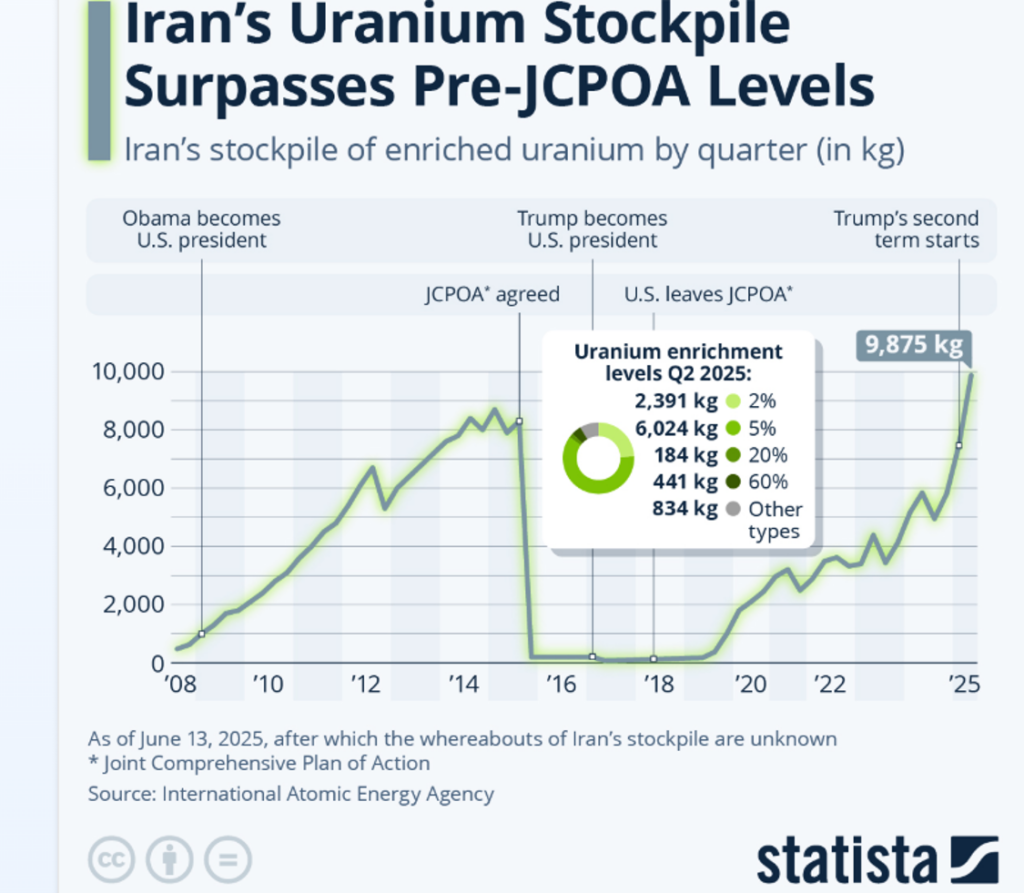
As you can see, Iran’s stockpiles of enriched uranium plummeted with the signing of the JCPOA; and ever since 2018, have been climbing. The stockpiles now exceed pre-JCPOA levels.
While the JCPOA didn’t address the full range of threats presented by Iran, or permanently prevent it from developing nuclear weapons, the agreement was a breakthrough; also, Iran was in full compliance at the time Trump withdrew.
Experts acknowledge that Iran has the largest and most diverse missile arsenal in the Middle East. When the JCPOA was being negotiated, US negotiators tried to include limitations on Iran’s missile capability, but Iran rejected these limitations as deal-breakers. America’s negotiating partners China and Russia were also unsupportive of including missile limitations, leaving the US with little leverage in this regard. As a result, the text of the JCPOA itself focuses strictly on nuclear capabilities.
Also, US negotiators repeatedly pushed for longer timelines (20 years) and permanent restrictions during the initial JCPOA talks. However, due to Iran’s resistance, they ultimately had to compromise, especially because China and Russia weren’t strong about longer timeframes. The compromise resulted in a tiered structure of “sunset clauses” that phase out restrictions between 10 and 15 years.
It’s also true that the JCPOA didn’t do anything to roll back Iran’s network of proxy military forces throughout the Middle East. The Obama Administration determined that restrictions on proxy forces were not tied to the primary purpose of restricting Iran’s nuclear program. To not further complicate the negotiations, the matter of proxy forces was not included in the negotiations.
In withdrawing from the JCPOA and reinstating the “maximum pressure” campaign, President Trump essentially determined that he could negotiate a much better deal that included controls on Iran’s missile program, much longer (or permanent) restrictions Iran’s effort to obtain a nuclear weapon, a rollback of Iran’s proxy forces, and an end to other threats from Iran. In so doing, he disregarded the fact that the JCPOA was the first-ever time that Iran agreed to specific rollbacks in its nuclear weapon ambitions. Further, these rollbacks were being extensively monitored, and Iran agreed to penalties and sanctions in the event of noncompliance. Trump chose to ignore these breakthroughs and 20 months of intense negotiations. The US negotiators had tried mightily to pursue most of the matters that Trump was later raising concerns about. But Iran would not agree.
At the time Trump withdrew from the JCPOA, Iran was in full compliance. The agreement was reached without launching major combat operations against Iran. There were no American casualties. Nor did our country spend tens of billions of dollars going to war. The world and the US didn’t have to endure the closing of the Strait of Hormuz and skyrocketing gas prices. In short, Trump’s withdrawal from the JCPOA was probably an act of pure hubris.
In order to prevent Iran from having nuclear weapons, the American people strongly favor a negotiated agreement rather than going to war; unfortunately, around two-thirds of Americans believe President Trump has been ineffective in his negotiations with Iran.
Below I’m displaying the results of a recent Critical Issues Poll from the University of Maryland. As you can see, over two-thirds of Americans (69%) favor the path of a negotiated agreement to limit Iran’s nuclear program to peaceful ends. Very strong percentages of Republicans (64%), Democrats (78%) and Independents (67%) share this view. Only 14% of Americans favor the path of using military action to destroy Iran’s nuclear program.
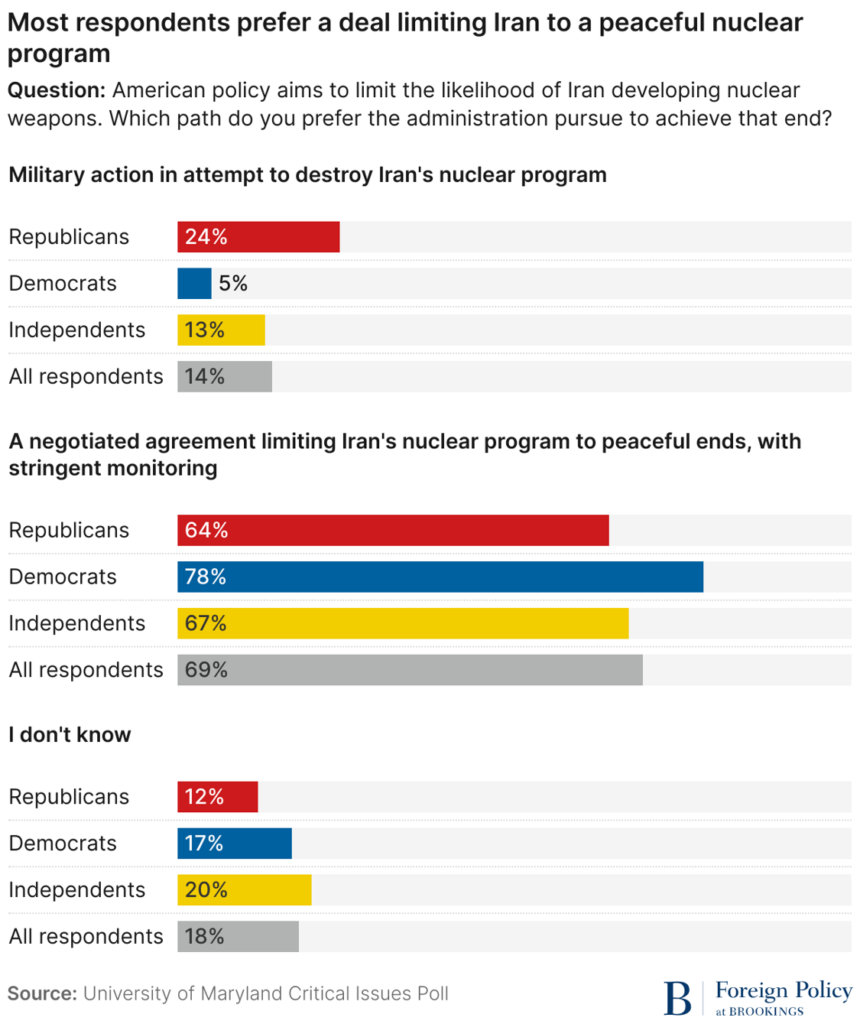
Americans clearly favor the path taken by President Obama in developing the JCPOA. However, they aren’t sanguine that President Trump is the world’s best dealmaker that he says he is. In a recent Economist/YouGov poll, almost two-thirds of Americans (64%), said Trump was very ineffective (46%) or somewhat ineffective (18%) in negotiating with Iran. Just over a third (36%) view him as very effective (10%) or somewhat effective (26%).
Final thoughts: In dealing with the threat of Iran, President Trump has been both naïve and arrogant; currently, we are not better off, and it’s not clear he will deliver on his promises.
In withdrawing from the JCPOA, Trump was both naïve and arrogant. He disregarded Iran’s long history of dealing with foreign aggression and enduring hardship. He didn’t appreciate that Iran was an extremely tough negotiator, and he dismissed the fact that the JCPOA was a hard-fought breakthrough that was actually working.
In initiating major combat operations against Iran, Trump again acted with naivety and hubris. He assumed Iran would cave like Venezuela. But Iranians are not afraid of war, death, or hardship. In fact, giving up would be a disgrace. Dying for a cause is glory. Iranians will endure hardship, and they will find ways to fight back.
Trump is also arrogant and naïve in believing he can force a broad-based negotiated settlement on Iran. It’s highly unlikely Iran will permanently give up its ambition and capacity to develop nuclear weapons. It’s also highly unlikely that Iran will agree to major curbs in its missile program or cease to use proxy forces. Instead, Iran will give ground very sparingly, often moving the goalposts. Iranian negotiators know that President Trump is unpopular, that Americans will increasingly oppose the war, and that the political consequences of the current stalemate hurt Trump and the Republicans. They are betting the President won’t take the path of wiping out their civilization simply because they want to keep negotiating during a ceasefire.
Trump walked away from an agreement—albeit imperfect—that was working. He initiated major combat operations that certainly reduced Iran’s capacity to fight and terrorize. But Iran can build back. Nor did Trump permanently eliminate the threat of Iran having nuclear weapons. The country continues to fight, and its blockade of the Strait of Hormuz has huge effects on the US and world economy. In the current stalemate, Iran has yet to agree to any reduction of its stockpiles of enriched uranium; it has yet to agree to any reduction in its missile program; and it has yet to agree to curtailing its proxy forces.
America was better off under the JCPOA than it is under the current stalemate. If Trump is able to permanently eliminate the threat of a nuclear Iran, destroy or set back its missile capacity for decades, and set back its aggression and terrorist activities, we can then declare ourselves better off. But not until then; and we should judge the President based on what he actually delivers instead of what he proclaims.
Leave a Reply