Most Americans are generally aware that President Trump’s job approval numbers have fallen since taking office in January. But not many of us are savvy regarding the nature and extent of this decline, especially as it relates to the demographic coalition he put together to win the White House. Also, not many of us understand the implications of this decline when it comes to gauging how successful Trump might be for the remainder of his term.
I decided to do a deep dive to determine where Trump’s support has eroded and what it means for the next three and a half years. Let me share what I found.
To gain insight into where Trump’s support has eroded, we should analyze the crosstabs for his job approval at two points in time—upon entering office and at the six-month mark.
Let’s start by reviewing the crosstabs for “President Trump Job Approval” from two EconomistYouGov surveys. One was conducted January 26-28, 2025 (after his first week in office); and the second was conducted on July 4-7, 2025 (just shy of six months). Take a few minutes to peruse these tables and see what conclusions you draw.
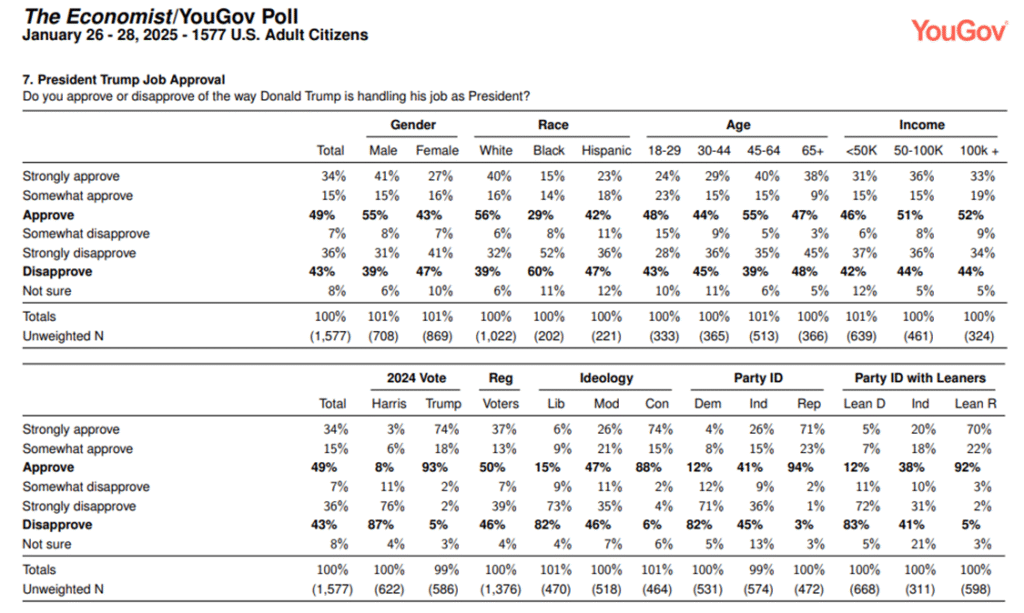
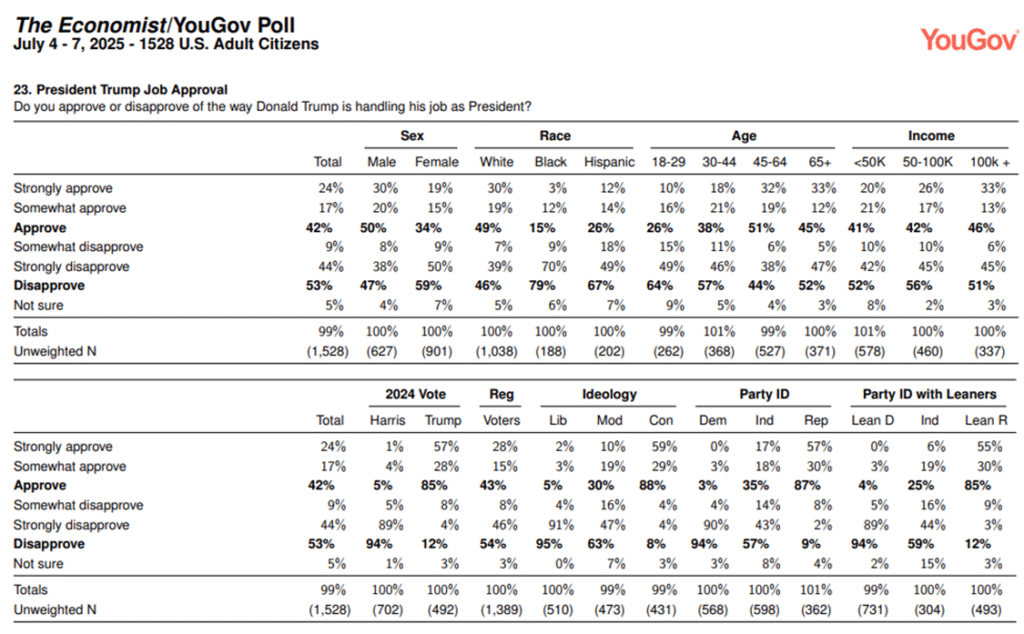
As you can see, Trump came into office with a net positive approval rating. He enjoyed 49% approval versus 43% disapproval after his first week in office. In fewer than six months, Trump is now “underwater” with 42% approval versus 53% disapproval. His approval percentage has slipped 7 points (49 to 42); while his disapproval percentage has increased 10 points (from 43 to 53).
But let’s look under the hood and see if we can discern where Trump is losing support. Is the slippage across the board or limited to certain demographics?
- In January, 55% of Males approved of Trump’s performance (39% disapproved); whereas in July his approval slipped to 50%, and 47% disapproved. In January, 43% of Females approved of his performance; while in July, only 34% approved (and 59% disapproved).
- In January, 56% of Whites approved of Trump (39% disapproved); whereas in July approval slipped to 49% approval and 46% disapproval. In January, Blacks were 29% approval versus 60% disapproval; while in July only 15% approved, and 79% disapproved. In January, 42% of Hispanics approved, while 47% disapproved; but in July only 26% of Hispanics approved while 67% disapproved.
- In January, Trump enjoyed positive approval numbers from age groups 18-29 (48% to 43%), and 45-64 (55% to 39%). By July, his approval numbers were underwater for every age group except 45-64. For 18-29, 64% disapproved; for 30-44, 57% disapproved; and for 65+, 52% disapproved.
- In January, Trump enjoyed positive approval numbers from every income group (<50K, 50-100K, and >100K). By July, Trump flipped to disapproval with all three of these income groups.
- In January, 93% of those who voted from Trump approved of his performance; whereas in July, only 85% approved of his performance.
- In January, 94% of those who identified as Republicans approved of his performance; whereas in July this number slipped to 87% who identified as Republicans.
- In January, 41% of those who identified as Independent approved of his performance, while 45% disapproved. In July, 57% of Independents disapproved of his performance, while only 35% approved.
Trump’s job approval numbers have declined with respect to every key demographic, suggesting the base of support he assembled to win election no longer exists.
Clearly, Trump’s approval numbers slipped with every demographic. In particular, key demographics that helped him win election in November are increasingly disapproving of his performance. This includes younger voters 18-29, Independents, Hispanics and Blacks. His job approval numbers are not yet underwater with respect to those who traditionally support him, including, especially, males, Whites, and Republicans. But even with these demographics, Trump’s approval numbers have slipped.
When we put Trump’s falling approval numbers into historical perspective, his decline is worse than most other presidents, and the odds of turning the numbers around are very low.
Going back 75 years, Trump’s job approval numbers do not compare favorably with those of other presidents during their first six months in office. A recent Gallup analysis finds that Trump’s numbers at this point in his second term are considerably worse than almost all presidents going back to Harry Truman (June 1949). Only Trump’s job approval numbers for this stage in his first term (38%), and Bill Clinton (41% in June 1993) are worse than Trump’s current numbers.
Another question we should be asking about these numbers is the likelihood of Trump being able to turn them around. After all, it’s early in his term. Surely, he can turn things around, can’t he?
History tells us that presidents don’t usually radically improve their job approval numbers during the course of their terms. Instead, job approval numbers tend to go down or vary slightly during the course of a term. For instance, Trump started out his first term with a 44% approval rating, and fell to a low of 36% in December 2017. His numbers fluctuated in the range of 36% to 44% for most of his first term, briefly reaching of high of 49% in May of 2020. For his entire first term, Trump’s approval rating averaged 41%.
But there have been times in history when presidents radically improved their job approval numbers. This has happened when there is an external event that creates monumental change, and the president acts decisively. Probably the best example is the terrorist attacks of September 11, 2001. President Bush’s approval numbers skyrocketed from 51% to 90% in conjunction with that event. And he finished the term with an overall average of 62% approval.
On the other hand, external events bringing monumental change don’t alone result in better job approval ratings. Rather, the critical variable is how the president responds to the event. For instance, the Covid-19 pandemic of 2020 was clearly a huge worldwide event. When it started in January, Trump’s approval rating was at 46%. It went to a high of 49% by May; but by the end of the next month (June), it was down to 39%. Clearly, Trump did not distinguish himself in the way he handled the pandemic.
Trump can largely ignore his declining job approval numbers so long as Republicans control both chambers of Congress (House and Senate) and so long as Congressional Republicans continue to support his policy agenda.
Even though Trump’s job approval numbers have declined, this does not stop Congress from enacting his agenda. At this point in time, the Republican-controlled Congress is steadfastly supporting his agenda and policy proposals. Thus, even if significant majorities of Americans sour on his leadership, Trump will continue to be able to impose his will as long as Congressional Republicans have his back.
On the other hand, it is entirely foreseeable that Trump will not continue to enjoy universal support from Congressional Republicans. In his first term, a handful of Republicans were instrumental in defeating his proposals to repeal and replace the Affordable Care Act (Obamacare). Other Republicans blocked him on Border Wall funding, emergency declarations, and government shutdowns. The more Trump’s job approval falters, and the more his policy actions become unpopular with the American people, the greater the chance he will not get enough Republican votes to pass his proposals.
As Trump’s job approval numbers continue to decline, and as he continues to impose policies that are unpopular with majorities of Americans, this increases the odds that Republicans will lose control of one or both chambers of Congress in November 2026.
Since the Congressional Republicans are clearly doing Trump’s bidding, voters are likely to hold these members accountable when election time rolls around. The hard truth for Congressional Republicans is that only registered Republicans and a minority of Independents (about 35% of Independents) approve of the way Trump is governing. Large majorities of Americans disapprove of his “One Big Beautiful Bill.” And large majorities don’t like the way he is handling the economy, inflation and prices, or even immigration.
As voters sour on the President’s leadership, and as they see him imposing laws and policies they cannot support, they are likely to hold Congressional Republicans accountable for enabling the President. History is replete with examples of a president winning the White House and both chambers of Congress, only to lose control of one or both chambers in the Midterms two years into office. For instance, Obama, Trump, and Biden all lost the House of Representatives two years into their terms.
Conclusion: At the six-month point of his term, it is increasingly likely that Trump’s job approval ratings will continue to remain low, that he will be less able to depend on current Republican majorities in the coming months, and that Republicans are likely to lose control of one or both chambers of Congress in November 2026.
In just six months, Trump has lost some degree of approval and support from every demographic group. Many of his policies and actions are opposed or disapproved by significant majorities of Americans. One might have thought “victories” such as as his “One Big Beautiful Bill,” the well-executed bombing of Iranian nuclear facilities, solid jobs reports, and a secure border would have produced skyrocketing job approval numbers. But this has not been the case.
Instead, a majority of Americans disapprove of the way he is handling the economy. They are even more disapproving because prices and inflation aren’t going down, as he promised. They see the tax cuts mostly benefitting the very wealthy; and they are concerned about the huge cuts to Medicaid, SNAPS, and other programs for the poor. And they aren’t buying all of his actions on tariffs.
Trump needs a major economic boom to have a chance of improving his job approval numbers. But our economy is not booming. Instead, GDP growth went negative for the first time in years in Trump’s first quarter in office. Inflation is still above the Fed’s preferred target of 2%. And most economists and business leaders conclude that Trump’s system of tariffs will lead to more inflation and higher costs for consumers. Gas and grocery prices haven’t come down, and most Americans continue to struggle with their personal finances, including credit card debt. In short, what’s on the horizon is more likely a recession than an economic boom.
Republicans and about 35% of Independents—around 43% of the voting populace—continue to support and approve of President Trump’s performance. They believe there is no inflation, that the One Big Beautiful Bill will create an economic boom, and that the President is doing an excellent job of delivering on his promises. But belief does not make these things so. In my view these supporters are living in denial. And I believe that declining conditions in coming months will cause even more Americans to disapprove of the President’s performance.
But Trump and his supporters will go down swinging, and he will always claim to be the best president in history. Buckle up!
Leave a Reply