First in a series, “Rejecting the Politics of Division and Embracing Unity”

While the fate of our country may be assessed at different points in time, the November 2028 election can be a crossroads if Americans go to work to reject the politics of division and embrace unity.
When it comes to politics and the fate of our country, we can assess conditions at different points in time. First, there’s the immediate. Here we’re preoccupied with affordability, prices, inflation, the economy, the war with Iran, mass deportations, and the dizzying array of initiatives coming out of the Trump Administration. The immediate is hard to escape, and current polls show 58% of Americans believe the country is off on the wrong track.
Second, there’s the near-term—particularly the November 2026 midterm elections. Here we’re preoccupied with whether Democrats will capture one or both chambers of Congress, and the impact this will have on the remainder of Trump’s term. Will he continue to exercise near free rein; or will he be held in check for his final two years? I’m sure most of us want our party to prevail and are feeling anxious about the upcoming midterms.
And, finally, there’s the longer-term—particularly the November 2028 election—where we will choose a new president and again shake up the composition of Congress. Here we’re preoccupied with where we’re going as a country and a democracy. Will we continue to be badly divided, politically polarized, and pessimistic about the direction of the country? Or will we heal the divisions and political polarization and come together as Americans? Here I bet most of us want our party to prevail. But polls also tell us a substantial majority of Americans are fed up with division and partisan politics.
But there’s a rub. While continuing with the politics of division and polarization doesn’t require any action on our part, America will not spontaneously unite. Instead, we, the people, must want this to happen. And we must prepare ourselves and undertake extensive work to make it happen. Our political parties, many of our elected officials, and others have vested interests in continuing with the politics of division and polarization. They will not go down without a fight. Americans must mobilize and pave the way to elect leaders who embrace unity over division. Put simply, we must lay the groundwork for a paradigm shift to bipartisan cooperation and unity.
The November 2028 election can be a crossroads because it will be our first real opportunity to execute this paradigm shift. The upcoming 2026 midterms are certainly crucial. But President Trump, who is highly invested in the politics of division and blame, will remain in office and is unlikely to change his ways. Also, the political parties and congressional leaders remain intent on practicing the politics of blame and division. November 2028 gives us about two and a half years to mobilize Americans to reject the politics of division and embrace unity. Given the task, we’re going to need every bit of this time.
What do we need to do to persuade millions of Americans to change their attitudes and behaviors regarding politics?
To advance the cause of unity and assist with the necessary paradigm shift, I am offering a series of posts over the next several months. I have two aims: to help you and others decide whether to commit to this paradigm shift, and to help prepare us for the work involved.
While the complete series of posts remains a work in progress, I can provide the framework. For each bullet point below, I will be offering at least one post (but usually several) to assist you and others.
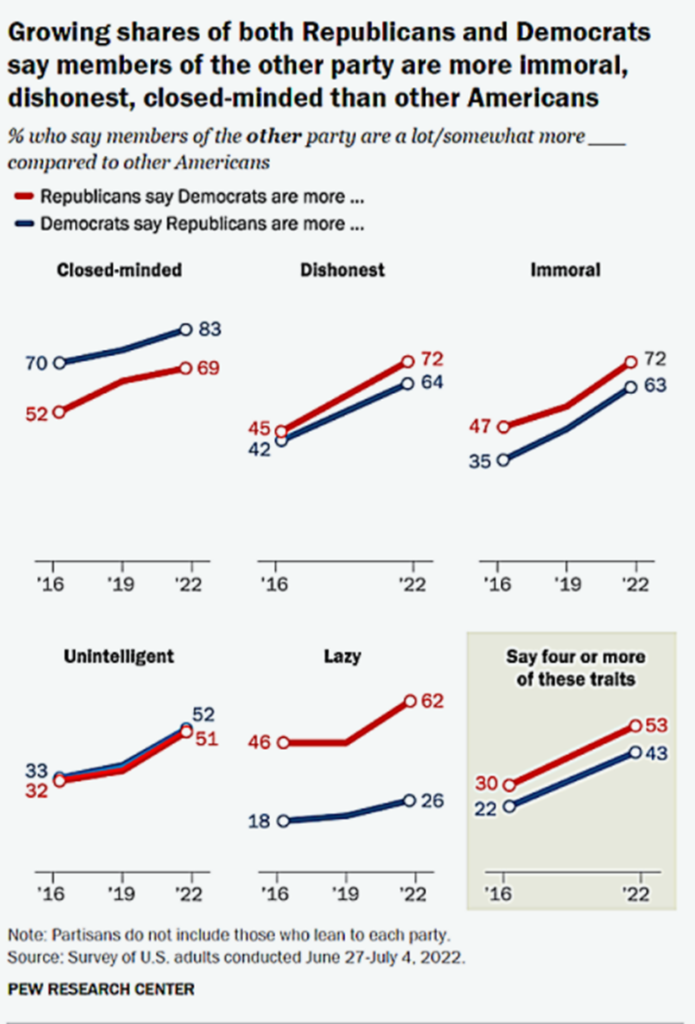
- First, each of us needs to decide whether we are content with the politics of division and blame; or whether we want to work for a more united country, where the parties work to find common ground and act on common interests. Do you want your political party to gain control, impose its agenda, and reverse the opposing party’s policies? Or do you want the parties to work together on common interests—especially policies that are supported by majorities of Americans? The latter requires a willingness to accept compromise. Those of you at the extremes of the political spectrum thus face a particularly tough decision. Also, as shown below, Democrats and Republicans increasingly view the opposing party and its members in a very negative light. Many of you are bound to be skeptical about working with the other party.
- Each of us needs to audit our echo chamber—the sources we use to gain information about politics and current events. Engaging your friends, family, co-workers and others on issues of the day, politics, and the quest for unity will be improved if you gain information from a balanced, objective, and diverse set of sources. You can hardly persuade anyone of the benefits of balanced and objective information if the sources you use are one-sided and unreliable. Finally, in the big picture, we can’t move towards unity as long as Republicans rely heavily on Fox News and other conservative outlets, and Democrats rely heavily on outlets with liberal bias.
- Each of us should attempt to improve our skills in policy analysis, research, critical thinking, fact checking, and respectful political dialogue. In the months ahead you’ll be engaging many people in political dialogue and discussion. You’ll also continue to be inundated with statistics, statements from political leaders, position papers, and the like. It’s important to know how to fact-check and validate what you are hearing and reading. This will help you discover when you’re being duped or misled; and it will also help you inform others who are being duped or misled. Finally, political dialogue is tough. Communication can turn confrontational and counterproductive in an instant. It’s important to have skills that foster communication, trust, and respect in your dialogue with others.
- Each of us should decide the kind of political leader we want to elect and contribute to. Will we continue to vote for and support hyper-partisan candidates who consistently blame the other side and stoke division, anger, and fear? Will we only support candidates who express a commitment to find middle ground and work in a bipartisan manner? Will we communicate these expectations to candidates and those elected to office? And will we monitor the performance of the officials we elect and let them know of our concerns? Finally, what should we do when our elected official faces severe punishment from party leaders and/or the President if they help forge and support a middle ground compromise?
- Each of us needs to decide whether we will contribute to or support political party organizations at the national, state, or local level that use hyper-partisan tactics. For instance, should we continue to give money to the national Republican and Democratic parties when they use these funds to attack and blame the opposing party? Also, will we continue to support interest groups at the national, state, or local level that use blame and division on a partisan basis? The tension we face here is that we may feel strongly about a given issue (e.g., abortion (right to choice), right to life, gun rights, gun control, climate change) and may not care if the organization uses blame and division in its messaging. And we may feel so strongly about a particular issue that we’re unwilling to accept any sort of compromise.
The task before us is daunting, and our chance of success is low.
Candidly, the task before us is daunting. The odds are against a successful paradigm shift to bipartisan cooperation and unity. But not trying condemns us to a political system that is broken and failing us.
Our current hyper-partisan system is dysfunctional in at least three ways. First, the focus is more on gaining power and exercising control than it is on solving problems. Republicans and Democrats have been taking turns exercising power and cancelling each other out. One side gains control of the White House and Congress, enjoying a period of glory while the other side fights it tooth and nail. Eventually, the other side gains control and enjoys its period of glory while the other side resists. With each change of power, the losing side’s gains are erased. Over time, the country’s problems only fester.
Second, we aren’t effectively and durably solving the country’s problems. In our hyper-partisan system, both Democrats and Republicans fail us in this regard. The parties take a problem, place the entire blame on the opposing party, and push a silver-bullet solution. They ignore the fact that almost all problems have multiple causes and can’t be fully solved unless all or most of these causes are addressed. Inevitably, problems don’t disappear; instead, they tend to come roaring back over time. Annual budget deficits and the skyrocketing national debt are a case in point.
Third, and finally, the hyper-partisan back and forth only leaves Americans more divided, angry, and untrusting than ever. Every year it gets harder and harder to move Americans to embrace bipartisan cooperation and unity.
Conclusion
Personally, I am deeply committed to helping our country turn away from the dysfunction of hyper-partisan politics. For 30 years I worked to forge unity among California’s largely autonomous community colleges. Subsequently, I spent 18 years imparting public policy skills to law school students focused on government and public policy careers. After nearly 50 years, I remain convinced that the best public policies are forged when parties come together to explore common interests, treat each other with respect, focus on the facts, find common ground, and continue working to improve relationships and trust.
The November 2028 election can be a turning point for our country. But it’s not going to happen unless millions of Americans answer the call to reject the politics of division and embrace unity. I hope you’ll be one of these people, and that you’ll take up the cause to persuade those within your social circle to follow suit. I humbly offer this series of posts to help you and others along the way.
Leave a Reply