“President Donald Trump’s call for Republican-led states to redraw their congressional boundaries ahead of the 2026 elections has triggered a redistricting arms race across the U.S.”
On July 15, President Trump asked Texas to redraw its congressional districts to help keep Republican control of the House of Representatives in the November 2026 midterms. Since this time, at least 15 additional states—several Democrat and several Republican—have either adopted or are considering plans for redistricting. Some states have at least taken their proposals to the people for approval; but most are accomplished through a vote of the legislature and a signature of the governor. While redistricting is normally done once every 10 years, in connection with the decennial census, federal law doesn’t prohibit redistricting more often. Suddenly, a third of our 50 states are involved in “mid-decade redistricting,” a heretofore rare practice.
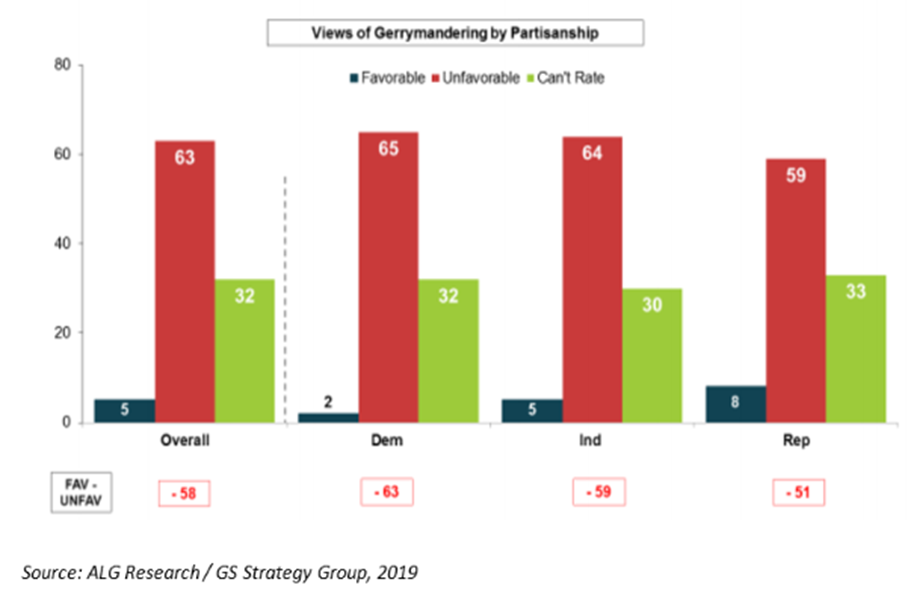
Public opinion polling on partisan redistricting—more pejoratively known as “partisan gerrymandering”—reveals two findings. First, around two-thirds of Americans don’t like or support partisan gerrymandering. We don’t like it in concept, and we have felt this way for a long time. And second, because gerrymandering is a complicated and somewhat esoteric subject, around a fourth of Americans say they aren’t sure of what to think. Only a very small percentage of us—less than 10%–actually have a favorable view of the practice.
I decided to write about partisan gerrymandering for three reasons. First, too many Americans aren’t fully aware of how gerrymandering works and just how unfair it is. Second, I wanted to explore the nature and extent of opposition to partisan gerrymandering. Just how concerned are we about the practice? And third, given our concerns, what can be done to remedy the situation? What are the solutions, and what are the prospects for success?
The unfairness of partisan gerrymandering is best exposed by illustrating its techniques and applying numbers.
Because gerrymandering is a complex topic, it’s difficult for the average citizen to comprehend the huge unfair advantage it can confer to a political party in control of a state. I found the best way to illustrate the inequity is provide an example that applies gerrymandering techniques along with numbers. In our example, we’ll see how a hypothetical state with equal numbers of Democrat and Republican voters can be gerrymandered so that one political party controls 85% of that state’s seats in Congress.
Let’s start with the basics, focusing on the House of Representatives of the US Congress. With 435 seats and a US population of 430,000,000, each House seat represents approximately 750,000 people (430 million divided by 435). Normally, redistricting is done every ten years, in connection with National Census.
Let’s take a hypotherical state with a population of 15 million. This state would get 20 House seats or 20 districts (15,000,000 divided by 750,000). Let’s further assume that of this 15 million people, 60% are of voting age and registered to vote. This equates to 9 million potential voters. And, if we take the 9 million registered voters, and divide by the number of districts (20), there would be roughly 450,000 registered voters in each district.
Of this 9 million registered voters in the state, let’s further assume that 4.5 million are Democrat/lean Democrat, and 4.5 million are Republican/lean Republican. Democrats and their leaners tend to be concentrated in the urban areas, while Republicans and their leaners tend to be concentrated in the rural areas. As to suburban areas, some are heavily Republican, some are heavily Democrat, and some are evenly balanced. Historically, the state’s 20 seats have tended to be evenly split in terms of Democrat and Republican control. Rarely is the split other than 10-10, 9-11, or 8-12.
But let’s further assume that in the 2024 elections Republicans won control the State legislature and the governor’s office. With complete control of state government, they can apply gerrymandering techniques to gain unfair advantage. Because the Constitution and federal law don’t prohibit states from doing redistricting more frequently than every 10 years, our hypothetical state is free to act mid-decade. Here’s what they can do:
- With “packing” they can create 3 districts in urban areas where Democrats/lean democrats constitute at least 70% of registered voters. These districts will essentially be conceded to Democrats. The idea is to include as few Republican voters as possible in these districts, thus enabling the state’s remaining Republican voters to be allocated to other districts. Thus, if they can find a way to get a district to be 80% or 90% Democrat, this would be even better.
- With “cracking” they can take an urban area with a very high concentration of Democrats and split that area into two or three districts that have high concentrations of rural Republicans and/or high concentrations of suburban Republicans. They can thereby prevent an urban Democrat district and create two or three Republican districts.
- As to the remaining area of the state, with the careful drawing of district boundaries, they can create districts that are relatively “safe” for Republican candidates (e.g., where registered Republicans or Republican leaners outnumber registered Democrats or Democrat leaners by 5% to 10%).
In this example the Republicans could conceivably pull off a gerrymander that allows them to capture 17 (85%) of the state’s 20 Congressional House seats. This is a neat trick considering that they and their leaners only comprise 50% of the state’s registered voters. The opposite can be true in states where Democrats control the legislature and the governor’s office. It is just as easy for Democrats to control 85% of the seats in a state where they and their leaners only constitute 50% of voters.
Still need convincing? Let’s take an actual state, Texas, and look at its recent gerrymander. Party registration statistics from the Independent Voter Project show Texas with 17.486 million registered voters, including 8.134 million Democrats (46.5%), 6.601 million Republicans (37.8%), and 2.751 million unaffiliated (15.7%). With Republicans in control of the Legislature and the Governor’s Office, they adopted a gerrymander intended to enable Republicans to control 30 of Texas’ 38 seats (79%) in the House of Representatives. Neat trick: Republicans stand to win almost 80% of the congressional House districts with far less than 50% of the state’s registered voters.
In summary, partisan gerrymandering is in conflict with democratic principles and is just plain unfair. People are being placed in districts so that their candidate has no chance of winning, or so that their vote is wasted on an overwhelming win for their candidate. There is something inherently wrong when a political party and its leaners make up half of a state’s eligible voters, and yet only elect 15% of congressional House members representing the state. And, as we’ll see, the American people believe the practice is unfair and should be illegal.
The American people—including Republicans, Democrats, and Independents—are against partisan gerrymandering and think it should be illegal or not allowed.
“Although the practice is common in red and blue states, partisan gerrymandering regularly polls poorly among voters on both sides of the aisle.”
Here are some examples of recent polling. In a Economist/YouGov survey, August 1-3 over two-thirds of Americans (69%) thought partisan gerrymandering should be illegal. Here are the numbers:

In a subsequent Economist/YouGov survey (August 9-11), 69% of Americans said that partisan gerrymandering should not be allowed, including 80% of Democrats, 71% of Independents, and 57% of Republicans. Only 9% thought it should be allowed, while 22% were unsure.
An earlier survey in 2019 by ALG research found that large majorities of Democrats, Independents, and Republicans viewed partisan gerrymandering “unfavorably”, while only tiny percentages viewed it “favorably.” Here are the numbers:
Thus, while the unfairness of partisan gerrymandering is clear, and while most Americans of all political parties are against it, what can be done to prevent it? What are the potential remedies?
Historically, the U.S. Supreme Court was willing to place restrictions on partisan gerrymandering; but in 2019 it decided that “partisan gerrymandering claims present political questions beyond the reach of the federal courts.”
Historically, the U.S. Supreme Court recognized the basic unfairness of partisan gerrymandering, particularly in terms of “one person, one vote” and the equal protection clause of the Constitution. It ruled that the Supreme Court could take on challenges to such gerrymandering. But at the same time, the Court struggled to come up with an approach or standards to evaluate these challenges.
Finally, in 2019, in the case of Rucho v. Common Cause, the Supreme Court decided that while partisan gerrymandering may be “incompatible with democratic principles,” the federal courts cannot review such allegations because they present “nonjusticiable political questions” outside the jurisdiction of these courts. In its narrowly-decided 5-4 opinion, the Court noted that Congress, as well as state legislatures and state courts, had the power to control and regulate partisan gerrymandering. The Supreme Court thus washed its hands of this matter.
The prospects for the Supreme Court to change its views on partisan gerrymandering anytime soon are zero. The court is going the opposite direction, and is poised to conclude the federal courts shouldn’t even be taking on racial gerrymandering challenges.
Congress could act to prohibit redistricting at times other than the decennial census, to require redistricting by independent commissions, or to establish redistricting criteria; but it’s highly unlikely that Congress will take any of these actions in the current environment.
One way to limit partisan gerrymandering is for the federal government to enact a law that prohibits states from redistricting their Congressional House of Representative seats at times other than the decennial census (i.e., once every 10 years), or in response to a court order. While this would not eliminate partisan gerrymandering, it would restrict it to once every ten years. Bills to do so have been introduced by a Republican (H.R. 4889, Kiley) and a Democrat (H.R.5837, Davis). Neither bill has moved, and it’s almost certain that President Trump would veto such a measure if it were to reach his desk.
Bills were also introduced in September to enact a comprehensive solution to partisan gerrymandering, known as the “Redistricting Reform Act of 2025” (H.R.5449 in the House, and S.2885 in the Senate). These bills, sponsored by Democrats and Independents, would require states to use independent redistricting commissions to draw congressional districts. They would also prohibit mid-decade redistricting, and establish criteria for drawing districts. Neither of these bills has moved, and President Trump would surely veto any such legislation reaching his desk.
States can take action through their legislatures, their courts, and their initiative processes to limit or prohibit partisan gerrymandering; but the prospects for most states taking action are limited.
States can take actions through their legislatures to prohibit mid-decade redistricting, establish independent commissions, and establish criteria for drawing districts. Republican states that attempt to do so will face pressure from President Trump and the Republican party nationally. Democrat states will be reluctant to take these actions so long as Republican states continue to practice gerrymandering. In fact, Democrat states will remain more likely to gerrymander in order to counteract Republican efforts to do the same. And we can expect that Republican states will not give up this option as long as they see Democrat states pursuing it.
Individuals and organizations can also file state court actions challenging gerrymandering based on their constitutions (e.g., equal protection) or statutes). Successful challenges could lead to action in a handful of states. However, litigation can be expensive, and the courts may be as reluctant as the US Supreme Court to take on partisan gerrymandering.
Finally, about half of the states (26) have the initiative process whereby the people can revise state law (statutes or the state Constitution) by qualifying and presenting ballot proposals to the voters. Initiative measures are usually expensive, especially because of the advertising costs involved when pushing a controversial proposal. Consequently, the initiative route is only likely to lead to action in a small number of states.
Americans should rise up in anger and demand that their political parties, elected officials, and candidates commit to changing state and federal law to prohibit mid-decade redistricting.
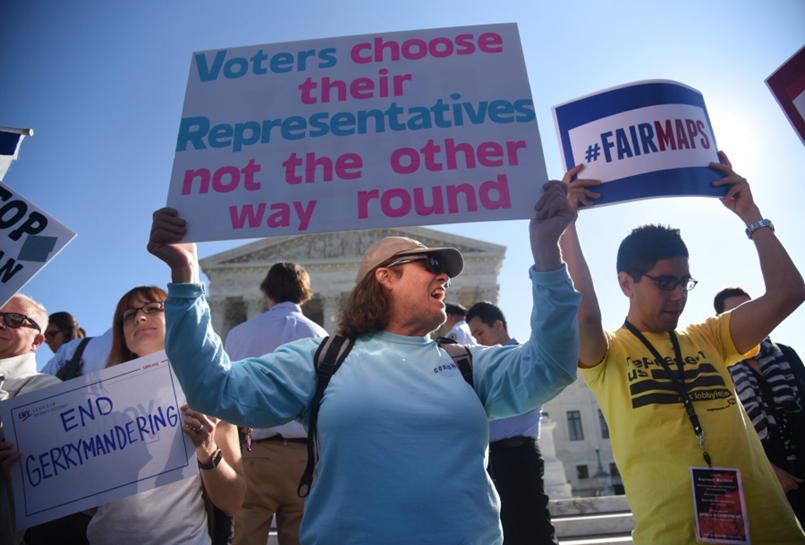
We, the American people, should be rightfully outraged that those who represent us are refusing to take action to prohibit or limit partisan gerrymandering. We, the people, are the ones who choose our representatives. We should reject the notion that those in office should instead choose their voters through gerrymandering. There is no reason for us to tolerate a practice that can’t be defended, and that not even 10% of Americans recognize as legitimate.
Political districts should be based much more heavily on existing political boundaries (cities and counties), and communities. Changing boundaries two or more times during a decade to pursue partisan control is absurd and undermines democracy. We want our elected representatives to find middle ground, work out differences, and do what’s best for all those in our district. It’s not about one political party gaining control and imposing its one-sided agenda on everyone else.
Thus, each of us should forcefully communicate with our elected representatives and candidates for both the US Congress and our state legislature. We should inform them that we insist that they support and pass laws to prohibit mid-decade redistricting by the state. This means a prohibition by federal law, and a prohibition by state statute.
If we are successful in this demand, this will put an end to the “redistricting arms race” that has been triggered by states pursuing mid-decade redistricting. Going forward, all states will no longer have this option. The prohibition needs to be placed on all states because as long as some states retain the option, other states will resist surrendering their option.
Over the long haul, redistricting needs to be taken out of the hands of political parties and state legislatures because they are inherently self-interested and partisan. Every one of us—Republican, Democrat, Independent, or other—will be more assured of having our votes count if nonpartisan independent commissions are responsible for redistricting.
Leave a Reply