Fourth in a series, “Rejecting the Politics of Division and Embracing Unity”
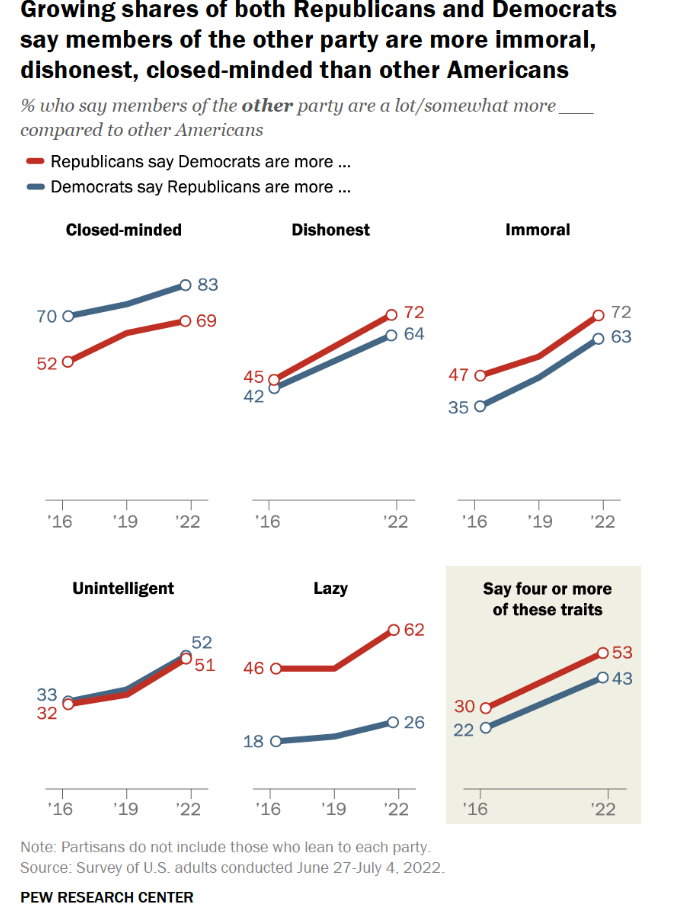
Looking at the graphic above, it’s clear that Democrats and Republicans have become increasingly polarized. Each party views the other as radical, out of touch, and unattuned to the needs of the American people. The parties view each other with increasing disdain because they disagree so strongly on policy matters.
On the other hand, when we look at polling on policies favored by Republicans and Democrats, we find many instances where members of the two parties agree. In fact, policies supported by substantial majorities of Americans are also frequently supported by majorities of both Democrats and Republicans. In other instances, a majority of Democrats or Republicans joins the position held by a majority of Americans. These polling results raise a paradox. How can it be that Democrats and Republicans frequently embrace policies supported by majorities of Americans, and yet continue to see each another as dishonest, unintelligent, closed-minded, immoral, and lazy?
In this post, the fourth in a series, I explore this paradox. I start by identifying instances where significant majorities of Americans—made up of Republicans, Democrats, and Independents—agree on specific policies or solutions. My intent is not to be exhaustive in this listing; rather, I want to demonstrate that instances agreement sare common.
Next, I attempt to diagnose why Democrats and Republicans view one another with increasing antipathy despite agreeing on so many policies. In particular, I examine what our elected officials, political parties, and their allies are doing to foment this disdain. Are Americans being manipulated into choosing sides and condemning the opposing party even though it is pursuing widely-supported policies? Also, is it legitimate to paint the opposing party as radical, corrupt, and out of touch simply because the policy it advocates doesn’t have majority support from your party?
Finally, I’ll examine what can be done to remedy the problem. What can we as individuals do?
There are dozens of policy solutions supported not only by a substantial majority of Americans, but also by a majority of both Democrats and Republicans, or a least a majority of one of the parties.
It didn’t take much time for me to find dozens of instances where at least a majority of Americans–be they Republican, Democrat, Independent, or whatever–agree on a specific policy solution. I was surprised to find so many instances where majorities of both parties, or at least a majority of one party, joined the majority of Americans.
I reiterate that this listing is not exhaustive. I simply want to document enough instances to demonstrate that this level of agreement is common. If you want to dig deeper to find more instances of agreement, see 100 Policies supported by majorities of Democrats and Republicans, YouGov, November 2022; and Finding common ground: 109 national policy proposals with bipartisan support, YouGov, August 16, 2024.
For ease of understanding, I’m breaking down my list of instances by subject matter.
Immigration policies embraced by at least a majority of Americans
- 63% of Americans (Economist/YouGov Jan 30-Feb 2, 2026) say that undocumented immigrants who have lived in the country for many years without committing any crimes should not be deported. This view is held by 92% of Democrats, 64% of Independents, and 35% of Republicans. Only 23% of respondents say these people should be deported, including 45% of Republicans.
- 86% of Americans (same survey) say that undocumented immigrants who commit serious crimes should be deported. This view is held by 82% of Democrats, 82% of Independents, and 94% of Republicans.
- 62% of Americans (same survey) say that undocumented immigrants who came to the US as children should not be deported. This view is held by 91% of Democrats, 64% of Independents, and 34% of Republicans. Only 22% say these people should be deported (including less than a majority (42%) of Republicans.
- 68% of Americans (same survey) say that undocumented immigrants who are married to US citizens should not be deported. This view is held by 88% of Democrats, 70% of Independents, and 47% of Republicans. Only 16% of respondents say these people should be deported (including 32% of Republicans).
- 58% of Americans (same survey) say that undocumented immigrants with children who are US citizens should not be deported. This view is held by 81% of Democrats, 61% of Independents, and 29% of Republicans. Only 26% of respondents (including 50% of Republicans) say these immigrants should be deported.
- 78% of Americans (Gallup July 11, 2025) support allowing immigrants living in the U.S. illegally the chance to become U.S. citizens if they meet certain requirements over a period of time. This view is held by 93% of Democrats, 79% of Independents, and 59% of Republicans.
- 58% of Americans (Economist/YouGov January 25, 2026) say current ICE tactics are “too forceful”, while only 10% say they are “not forceful enough” and 23% say they are “about right.” Of those saying ICE tactics are too forceful, 90% are Democrats, 79% are Independents, and 22% are Republicans.
Gun control policies embraced by at least a majority of Americans
- 55% of Americans (Economist/YouGov, August 1-4, 2025) support making gun laws stricter. This view was held by 84% of Democrats, 53% of Independents, and 31% of Republicans. Only 14% say gun laws should be less strict (including 21% of Republicans).
- 83% of Americans (same survey), favor requiring criminal and mental background checks for all those buying guns. This view is held by 87% of Democrats, 80% of Independents, and 82% of Republicans.
- 73% of Americans (same survey) favor creating red flag laws that allow courts to temporarily remove firearms that present a danger to self and others. This view is held by 87% of Democrats, 69% of Independents, and 65% of Republicans. Only 18% of respondents (including 26% of Republicans) oppose red flag laws.
- 60% of Americans (same survey) favor banning assault rifles. This view is held by 86% of Democrats, 57% of Independents, and 39% of Republicans. Only 31% of respondents (including 51% of Republicans) oppose banning assault rifles.
Climate change policies embraced by at least a majority of Americans
- 59% of Americans (Economist/YouGov Feb 13-16, 2026), agree the world’s climate is changing because of human activity. This view is held by 88% of Democrats, 58% of Independents, and 32% of Republicans. Some 22% of respondents (including 8% of Democrats, 17% of Independents, and 42% of Republicans) believe the world climate is changing, but NOT because of human activity.
- 57% of Americans (same survey) think the US should do more to address climate change. This view is held by 90% of Democrats, 58% of Independents, and 25% of Republicans.
- 64% of Americans (same survey) believe the US should be using more solar energy. This view is held by 82% of Democrats, 67% of Independents, and 44% of Republicans. Also 57% of Americans believe the US should be using more wind energy (including 79% of Democrats, 59% of Independents, and 33% of Republicans).
- 61% of Americans (YouGov January 28, 2025) support keeping federal clean energy tax credits. This view is held by 84% of Democrats, 61% of Independents, and 38% of Republicans. Only 18% of respondents (including 33% of Republicans) oppose keeping energy tax credits.
- 69% of Americans (Chicago Council on Global affairs/IPSOS) favor maintaining the US commitment to the Paris Agreement. This view is shared by 88% of Democrats, 67% of Independents, and 50% of Republicans
Abortion policies embraced by at least a majority of Americans
- 58% of Americans (Economist/YouGov, May 22-26, 2026) say abortion should always either be legal or legal with some restrictions (such as for minors or late-term abortions). This view is held by 87% of Democrats, 64% of Independents, and 25% of Republicans. 32% (including 59% of Republicans) said abortion should only be legal in special circumstances (e.g., life of mother in danger). Only 10% say abortion should always be illegal.
- 63% of Americans (Gallup, June 14, 2023) support mifepristone, the abortion pill, to be available in the United States as a prescription drug. This view is held by 86% of Democrats, 63% of Independents, and 41% of Republicans.
Taxes and government spending policies embraced by at least a majority of Americans
- 58% of Americans (Pew Research, March 19, 2025) say tax rates on household income over $400,000 should be raised. This view is held by 74% of Democrats/Lean Democrat, and 43% of Republicans/lean Republican. Also, 63% say taxes on large businesses and corporations should be raised; and this view is held by 81% of Democrats/lead Democrat, and 43% of Republicans/lean Republican.
- 72% of Americans (Economist/YouGov, Oct 31-Nov 3, 2025) favor raising taxes on billionaires, while only 15% oppose. 95% of Democrats, 75% of Independents, and 48% of Republicans favor raising taxes on billionaires.
- 71% of Americans (Economist/YouGov, May 22-26, 2026) say spending for Social Security should be increased by a lot or slightly. 78% of Democrats, 70% of Independents, and 68% of Republicans hold this view.
- 58% of Americans (same survey) say that spending for Medicaid should be increased a lot or slightly. 80% of Democrats, 60% of Independents, and 34% of Republicans hold this view.
- 66% of Americans (same survey) say that spending Medicare should be increased by a lot or slightly. 80% of Democrats, 67% of Independents, and 53% of Republicans hold this view.
- 51% of Americans (same survey) say spending for SNAPS (Supplemental Nutritional Assistance Program) should be increased by a lot or slightly. 77% of Democrats, 52% of Independents, and 28% of Republicans hold this view.
Anti-gerrymandering policies embraced by at least a majority of Americans
- 73% of Americans (Economist/YouGov May 22-26, 2026) say states drawing legislative districts that intentionally favor one political party is a major problem. This view is held by 89% of Democrats, 74% of Independents, and 57% of Republicans.
- 71% of Americans (Economist/YouGov, April 24-27, 2026) say that states should not be allowed to draw congressional districts in a way that favors one party over the other. 74% of Democrats, 70% of Independents, and 69% of Republicans hold this view.
Voting Policies embraced by at least a majority of Americans
- 84% of Americans (Gallup, October 2024) support requiring all voters to provide photo identification at their voting place in order to vote. 67% of Democrats, 84% of Independents, and 98% of Republicans hold this view.
- 83% of Americans (same poll) support requiring people who are registering to vote for the first time to provide proof of citizenship. 66% of Democrats, 84% of Independents, and 96% of Republicans hold this view.
- 76% of Americans (same poll) support early voting, which gives all voters the chance to cast their ballot prior to Election Day. 95% of Democrats, 76% of Independents, and 57% of Republicans hold this view.
- 60% of Americans (same poll) support automatic voter registration laws, where people are automatically registered to vote when they do business with the DMV or other state agencies. 79% of Democrats, 60% of Independents, and 43% of Republicans hold this view.
- 60% of Americans (same poll) support sending absentee ballot applications to all eligible voters prior to an election. 87% of Democrats, 63% of Independents, and 36% of Republicans hold this view.
Crime policies embraced by at least a majority of Americans
- 73% of Americans (Gallup, October 30, 2025) say parents should be held responsible when children use guns in crime. 77% of Democrats, 73% of Independents, and 71% of Republicans hold this view.
- 53% of Americans (same poll) support the death penalty. 81% of Republicans, 47% of Independents, and 32% of Democrats hold this view.
Why do Democrats and Republicans have growing antipathy toward one another when they have consensus on so many policies?
We citizens are generally content if our lawmakers enact policy solutions we favor and reject policies we oppose. Most of us also expect the political parties to work together to produce bipartisan solutions. We expect our government, a democracy, to pay attention to the will of the majority, including policies supported by a majority of Americans. Unfortunately, our expectations are frustrated in today’s America. The underlying reason is that political parties, their elected officials, their media allies, and their interest groups don’t exist to serve the will of the majority. They don’t exist to develop bipartisan solutions. Instead, the respective Republican and Democratic “political organizations” have a conflicting raison d’etre: to gain and maintain control of government and policymaking.
Each of the political organizations seeks to gain control and enact its policy agenda. This mission also entails blocking the other party on policies that are in conflict or inconsistent with the party’s agenda. Anything that enables the other party to claim success, become more popular, or gain control is anathema. Thus, when presented with a policy that is embraced by significant majorities of Americans, the political organizations don’t stand up and salute. If enacting such a policy involves compromise or advancing the other party’s agenda, the respective political organizations almost always ignore the will of the majority. The political organizations will move heaven and earth to compromise and maintain control within the party; but they are loathe to accommodate or promote the opposing party.
Finally, the interests of political organizations are served if we, the members of the respective parties, are angry at the other party, divided, and hopeless about the possibility of compromise. The narratives and communications of each political organization are crafted to generate antipathy towards the other party. Each wants its members believe the other party is extreme, out of touch, corrupt, untrustworthy, and impossible to deal with. And, sadly, we’ve taken the bait.
Both the Democratic and Republican political organizations usually refuse to act on policies supported by significant majorities of Americans, including policies supported by more than a majority of the party’s members, if the policy is not part of the party’s agenda, or if doing so would be seen as a “win” for the opposing party.
On immigration policies, we saw that 78% of Americans (including 93% of Democrats, 79% of independents, and 59% of Republicans) support allowing immigrants living in the U.S. illegally the chance to become U.S. citizens if they meet certain requirements over a period of time. Because this policy never made it into the Republican agenda, President Trump and the Republicans have no interest in pursuing it. Instead, the Republican political organization blames Democrats for open borders, an invasion of “illegal aliens,” and lax enforcement. Trump’s agenda calls for securing the borders and conducting the largest mass deportation in US history. And most of those deported, according to the party, are criminals. Thus, while a majority of Republicans support allowing some undocumented immigrants to stay, this policy is not consonant with the President’s agenda. Finally, the Republican political organization is not about to give Democrats a win on a policy favored by 93% of that party.
On gun control policies, we saw that 83% of Americans (including 87% of Democrats, 80% of Independents, and 82% of Republicans) favor requiring criminal and mental background checks for all those buying guns. Also, 73% of Americans (including 87% of Democrats, 69% of Independents, and 65% of Republicans) favor creating red flag laws that allow courts to temporarily remove firearms that present a danger to self and others. Republicans in Congress have blocked such proposals in the past. President Trump and Republicans do not want to go against the party platform protecting 2nd Amendment rights. Nor do they want to go against the gun lobby, which is a critical interest group for the Republican political organization. Finally, adopting these proposals would be seen as a “win” for Democrats.
On anti-gerrymandering policies, we saw that 71% of Americans (including 74% of Democrats, 70% of Independents, and 69% of Republicans) say that states should not be allowed to draw congressional districts in a way that favors one party over the other. President Trump asked various states to redraw their districts to create an advantage for Republicans in the upcoming 2026 and 2028 elections. Democrats have responded in kind. Both political organizations have turned a blind eye towards the majority will of their members. There is zero likelihood that federal legislation will pass to prohibit mid-decade redistricting and redistricting that creates a political advantage.
On voting policies, 84% of Americans (including 67% of Democrats, 84% of Independents, and 98% of Republicans) support requiring all voters to provide photo identification at their voting place in order to vote. Also, 83% of Americans (including 66% of Democrats, 84% of Independents, and 96% of Republicans support requiring people who are registering to vote for the first time to provide proof of citizenship. Finally, 76% of Americans (including 95% of Democrats, 76% of Independents, and 57% of Republicans) support early voting, which gives all voters the chance to cast their ballot prior to Election Day. Instead of negotiating a bipartisan proposal that incorporates these policies, the Republicans have drafted and moved their own proposal (the SAVE America Act). According to Democrats, this bill is constructed in a such way as to unfairly suppress voting. Republicans have been unwilling to allow for a bipartisan proposal; however, the lack the votes to pass the bill.
A political organization will always reject or block proposals supported by significant majorities of Americans if less than a majority of the party supports the proposal.
In cases where less than a majority of a party supports a policy backed by a substantial majority of Americans, the party will always reject or block any attempt adopt that policy. They do this because substantial majorities of the other party and/or Independents support the policy. Enacting the policy would be seen as a “win” for the other party.
In the previous section listing the consensus proposals, it was very often the case that a high percentage of Democrats and Independents combined with a moderate percentage of Republicans (i.e., less than a majority) to result in a proposal that was supported by a substantial majority of Americans. Thus, for instance 63% of Americans say that undocumented immigrants who have lived in the country for many years without committing any crimes should not be deported. This view is held by 92% of Democrats, 64% of Independents, and 35% of Republicans. In every one of these instances, Republicans killed or blocked these proposals. They did not introduce or support a single proposal where less than a majority of party members were in support. In numerous instances Democrats proposed legislation on policies supported by large percentages of Democrats and Independents. But all of these proposals failed because Republicans were not willing to lend any votes or consider compromise.
Political organizations in control of the White House and Congress control policy by forging compromise within the party, thereby securing the necessary votes for passage without having to negotiate or compromise with the other party.
At the federal level, we increasingly see Presidents and their political parties in control of Congress wanting to totally control policymaking from within the party. To illustrate, President Obama and the Democrats did this with the Affordable Care Act in 2010. President Trump and Republicans did this with the Tax Cut and Jobs Act of 2017. President Biden and Democrats did this with the American Rescue Plan Act in 2021. And President Trump and Republicans did this with the One Big Beautiful Bill Act in 2025. In every instance, the party in control refused to negotiate with the party out of control. Instead, the party in control negotiated within the party to forge necessary compromises to end up with enough votes to pass the legislation without a single vote from the other party. In this manner, the party in control was able to dictate the exact content of the legislation. It didn’t need to compromise with the other party in order to secure necessary votes.
By applying this strategy, the party in control can safely ignore any unwanted policy solution that is supported by a substantial majority of Americans. For example, let’s take the One Big Beautiful Bill Act and the policy solutions of increasing taxes on the wealthiest Americans and spending cuts to Medicare, Medicaid, and food assistance (SNAPS). Polling says that 58% of Americans say tax rates on household income over $400,000 should be raised. Also, 72% of Americans favor raising taxes on billionaires. Finally, substantial majorities of Americans favor increasing funding for Medicare, Medicaid, and SNAPS. And, more important only small percentages of Americans (10-14%) support cutting these programs.
The fiscally conservative faction of Republicans demanded spending cuts in order to make up for the costs of extending the tax cuts to all Americans, including the wealthy. The solution was to make substantial cuts to Medicare, Medicaid, and SNAPS. These cuts helped pay for the especially expensive cost of extending tax cuts for wealthy Americans and corporations. Republicans forged this compromise within the party, and Democrats were ignored. Also ignored were the sentiments of substantial majorities of Americans on these critical taxing and spending matters.
The party out of control obviously has very little leverage in pursuing policies that are favored by substantial majorities of Americans. It can’t pass legislation if it doesn’t have the votes, and it can’t pass legislation if the party in control refuses to negotiate.
The political organizations deflect attention from bipartisanship and the policy preferences of Americans by painting the opposing party as extreme, out of touch, corrupt, untrustworthy, and dangerous.
Instead of being willing to engage on policies supported by substantial majorities of Americans, political organizations deflect attention by vilifying the other party. The intent is to sew anger, disdain, and frustration. Both the Republican and Democratic political organizations do this. The Pew Research graphic shown at the beginning of the article suggest this has been a race to the bottom since President Trump was first elected in 2016. Vilifying the other party furthers primary objective of gaining and maintaining control of government. Working cooperatively on bipartisan solutions conflicts with this objective because the other party will get credit and be seen in a positive light.
Truth and proof of allegations are not essential to these vilifying communications. Both sides repeat lies, distortions, and unsubstantiated allegations. Here are some from Republicans:
- Climate change is a “hoax.”
- Democrats want to take away your guns.
- Democrats are going to raise your taxes.
- Democrats weaponize government.
- Democrats hate America.
- Democrats stole the 2020 election, and
- Democrats spew “fake news” and have control of the “lamestream media.”
And from Democrats we have:
- Trump and the Republicans only care about the wealthy.
- Trump and Republicans ruined the US economy.
- Trump is a dictator.
- MAGA is dangerous.
- Trump and Republicans are responsible for the out-of-control National Debt.
Too many of us believe these lies, distortions, and unsupported accusations. And the effect is very corrosive because it destroys trust in government, increases division, and dashes hope for the future.
The constant barrage of negative messaging from the political organizations has convinced most of us that the party we identify with is righteous, the other party is despicable, and that the only way forward is to impose our party’s agenda.
Virtually everything coming from the President, congressional representatives, appointees, and right and left-leaning media exalts one side and vilifies the other. The messaging is purposeful because it is intended to drive a wedge. The Pew Research graphic at the beginning of the article (supra) clearly shows the messaging campaign is successful. Substantial majorities of Americans view the other party and its members as closed-minded, dishonest, immoral, unintelligent, and lazy. Other polling shows the other party being viewed as out of control and dangerous. Because the other party and its leaders are so extreme, out of touch, corrupt, untrustworthy and dangerous, there is no point in dealing with them. They must be defeated. The party we identify with is righteous and must control. This is the only way forward.
We can thus resolve the paradox raised in this article. Most Americans have taken the bait coming from our political organizations. We see the other party and its members in a very negative light. Our views are reinforced through our curated media and social media news feeds. The fact that significant percentages of the other party are endorsing policies supported by significant majorities of Americans is simply not getting through to us. The political organizations have us right where they want us.
What can be done to promote more attention to policy solutions that are supported by substantial majorities of Americans?
The Democratic and Republican political organizations could care less about policy solutions supported by substantial majorities of Americans. Instead, they want to gain control of government and impose their respective policy agendas. This is antithetical to the principles of democracy and the will of the majority . Put simply, we should want our policymakers to show some deference to policy solutions that are supported by substantial majorities of Americans. Yes, they should also give consideration to advancing minority views. There should be a vigorous debate on both these matters. But It makes no sense to exclude policies backed by majorities of Americans simply because these policies haven’t made it into the agenda of the party that controls government. It makes no sense reject bipartisan cooperation on such policies because doing so could be seen as a “win” for the other party.
Let’s address how we can get our lawmakers to pay more attention to policy solutions that are supported by substantial majorities of Americans. How can we break the hold of the respective Democratic and Republican political organizations?
While increasing percentages of Americans have abandoned the Republican and Democratic parties and chosen to identify as Independents, this trend has had minimal effect in prompting lawmakers to pay more attention to policy solutions backed by majorities of Americans.
Over the past two decades, increasing percentages of Republicans and Democrats have left their party and now identify as independents. According to Gallup, in 2025, 45% of Americans consider themselves independents, while 27% identify as Republicans, and 27% identify as Democrats. Independents overwhelmingly identify as moderates. They trust Democrats on some issues, and trust Republicans on others. Independents also tend to view both parties as too extreme. Nevertheless, about half of Independents “lean Republican” and half “lean Democratic.”
The problem with this solution is that those identifying as Independents aren’t backed by a “political organization” anything akin to the Democratic and Republican political organizations. Policymaking at the federal level is still controlled by the Democratic and Republican parties. There is no Independent party that has its own platform, agenda, financing, and control over its elected members. In fact, millions of independents can’t even vote in congressional primary elections (15 states); and 22 states have closed presidential primaries.
If Independents were backed by a full-scale political organization akin to those of Republicans and Democrats, this could break the hold of those political organizations. If the party was viable and comprised even a fourth of Congress, it’s likely there would no longer be one-party control of the body. Compromise would be required.
But there are roadblocks to this solution. The 45% of Americans who identify as Independent lack any consensus on policy solutions and a party agenda. Is it even possible to forge an Independent party platform and agenda? Also, would those elected as Independents be willing to be bound by the platform and agenda? Could the new party secure enough financing and interest group support to be competitive with the Democratic and Republican operations? In short, creating a new and viable Independent party is far from a sure thing.
Each of us needs to decide where we stand: do we want our political organization to give more weight to policy solutions supported by substantial majorities of Americans; or are we content for our party to disregard the will of the majority whenever it serves the party’s interests?
Each of us needs to do some sole searching regarding two scenarios. First, suppose that 75% of Americans support policy solution X. 82% of the other party support X, and 70% of Independents support X. As to your party, only 30% support X. Do you want your party to disregard and oppose X, even though a majority of Americans support this policy solution? Or would you be agreeable to your party negotiating and accepting a compromise on this matter?
Second, suppose that 75% of your party supports policy solution Y. Only 30% of the other party supports Y, only 35% of Independents support Y, and only 40% of all Americans support Y. If your party gains control of government (e.g., the Presidency and Congress), do you want it to enact solution Y, even though this solution isn’t supported by a majority of Americans?
I’m not asking you to make iron-clad, no exceptions decision. I realize that you (and most Americans) have certain issues and solutions that you deeply care about. You sometimes find yourself in the minority regarding these views. I’m not saying that you and your party can’t push these issues and solutions because they aren’t supported by at least a majority of Americans. Rather, I’m saying the party shouldn’t categorically reject the views of the majority in every instance. I’m saying the policy preferences of substantial majorities of Americans should at least be on the table for discussion. I’m saying these preferences should be weighed, and perhaps integrated into the policy solution.
I’m hoping that most of you join me in concluding that our political organizations need to be more receptive to embracing policy solutions that are supported by substantial majorities of Americans. The will of the majority–policy solutions favored by significant majorities of Americans–always deserve consideration. They are a good starting point for discussion. It makes more sense to start with a broadly-supported policy than it does to start with a policy favored by a political party that lacks broad public support. It’s better to mold and adapt a widely-supported solution than it is to tinker with a proposal that lacks broad support. Building on the will of the majority promotes stability because more Americans accept and embrace the policy right out of the gate. When political organizations in power force their narrow solutions, it only invites the other party to so the same when it gains control.
Each of us needs to spread the word that there are many policy solutions that are supported by substantial majorities of Americans.
Thanks to our political organizations, most Americans believe we are hopelessly divided on virtually all policies. In fact, as my analysis demonstrates, there are dozens of important policies that are not only backed by solid majorities of Americans, but also by majorities of Republicans and/or Democrats. Most Americans will be pleasantly surprised to know there is so much agreement on so many important issues. Knowing that there is so much agreement is an important step toward rejecting the politics of division and embracing unity.
Each of us needs to communicate with our elected representatives and political party.
Write or tell your elected representatives that you expect them to pay attention to policy solutions that are supported by substantial majorities of Americans. Tell them you want them to work with the other party, particularly if it means advancing a policy solution that is favored by most Americans. Let them know of specific majority-backed policies that you’d like to see enacted. Recognize that they will face pressure from their leaders and their caucus; and ask how you can help. Tell them you don’t want to abandon the party, but that you will if nothing is done. Let them know your vote and fiscal support are at stake.
Write your national, state, and local political party organizations and let them know you want them to pay attention to policy solutions supported by substantial majorities of Americans. Tell them you won’t be contributing if they don’t change their stance. And, tell them you don’t want to leave the party, but you will if nothing is done.
Final Thoughts
The respective Democratic and Republican political organizations were created to enable political parties to gain control of government and enact their policy agendas. It serves this mission if the opposing party, its members, and its policy agenda are seen as corrupt, extreme, wrong and dangerous. Our parties purposely attempt to divide and polarize us through lies and distortions. This has got to stop.
Our political organizations don’t really care about widely-supported policy solutions unless those solutions are in the party’s agenda. In fact, they don’t want Americans to know that there are many policy solutions that enjoy strong support from both parties, as well as support from a substantial majority of Americans. Again, this has got to stop. Americans need to know we are more united than we have been led to believe.
There is no reason to be sanguine about our political organizations voluntarily choosing to pay more attention to widely-supported solutions. We are going to have to force them to change, using our votes, our campaign contributions, and our threats to leave the party. We have leverage and we have to use it.
If we don’t act, America’s future is bleak. It’s one of increasing polarization and division. The direction of our country will flip flop as the political parties come in and out of power. It’s time to put an end to this by demanding that our parties pay more attention to building upon policies that are embraced by substantial majorities of Americans.
Leave a Reply