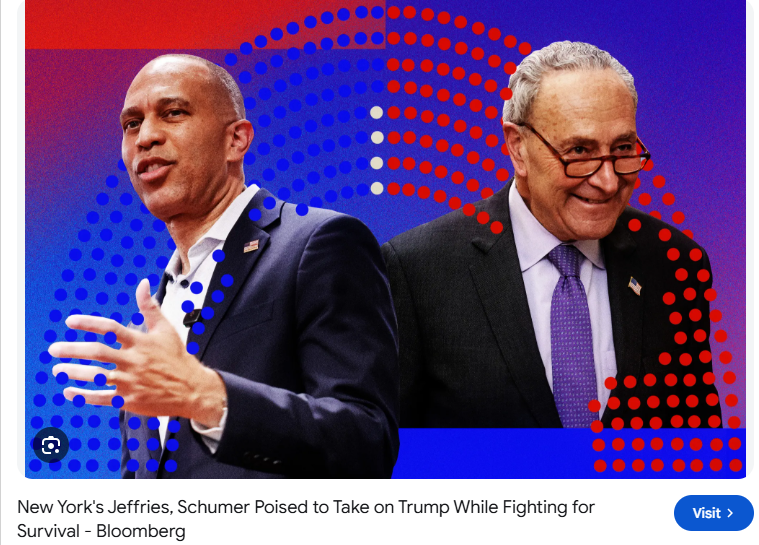
While there’s been extensive coverage of the midterm elections and the “Blue Tsunami,” less attention has been paid to how the Democrats will exercise power and how Trump is likely to respond to complete Democratic control of Congress.
Yes, we know about Trump’s veto power, using the filibuster to block legislation in the Senate, and continued executive orders. We also know that Democrats can block presidential appointees, and that they will be conducting extensive investigations and exercising oversight. We also know that Congress has the power of the purse. But here are some critical questions that still demand attention:
- How likely is it that progressive Democrats and Socialists will take over leadership of the House and Senate?
- What should Democrats concentrate on in terms of their policy agenda and priorities?
- What can we assess about how President Trump—in his current condition and mental state—will respond to a Democrat-controlled Congress?
- And, finally, how will things play out the remainder of Trump’s term, including whether Democrats will deliver on their promises?
In my view, these are profoundly important questions. The answers can make the difference between success and failure for Democrats. They also tell us a lot about how things are likely to play out the next two years. Let me share my answers and thinking.
Progressive Democrats and Socialists will neither take over leadership of the House and Senate nor exercise outsized roles.
Hakeem Jeffries, an “establishment Democrat,” is almost certain to be chosen as House Speaker. And Chuck Schumer, also an “establishment Democrat,” is likely to be chosen as Senate Majority Leader. These leaders planned and orchestrated the strategy that produced the historic midterm wins.
It’s also important to recognize that many more moderate and conservative leaning Democrats were just elected to Congress than progressives or socialists. Maybe the progressives and socialists received more attention and made more noise. But most of the new Democrat members of Congress beat Republicans in traditionally red districts and states. In leading their respective caucuses, Schumer and Jeffries will pay attention to this fact.
Thus, right off the bat, we’re very unlikely to see the Democrats tilting towards progressive or socialist policy solutions. Both Jeffries and Schumer will enjoy considerable wiggle room in forging consensus and exercising leadership. Jeffries will have around 35 to 40 votes to play with, and Schumer will have 5 to 7. Progressives and socialists aren’t likely to be able to force the party to accept positions that aren’t widely supported by the majority.
As to process, look for all newly elected Democrats to be welcomed to the discussion regarding policy priorities. Through dialogue and consensus building, leadership will determine the policy agenda and priorities. We can expect all members to adhere to these leadership positions. However, we can also expect that individual members from either the progressive or conservative wings of the party won’t be prevented from moving their own proposals. These bills, however, won’t be part of the leadership’s agenda unless adopted as such.
Democrats would be well advised to concentrate on the problems most Americans are concerned about; and they would also be well advised to pursue policy solutions that are supported by substantial majorities of Americans.
Public opinion polling consistently tells us that Americans are concerned about affordability, inflation, the war with Iran, tariffs, healthcare, corruption, and holding the Trump Administration accountable. Democrats should build their agenda around these priorities.
Early indications are that the Democrats plan on doing just that. We can expect proposals to bring an end to the war with Iran and curb Trump’s tariffs. Democrats will also attempt to restore cuts made by the One Big Beautiful Bill. This includes restoring healthcare subsidies and major cuts to Medicare, Medicaid, and SNAPS (food assistance). We could also see a proposal to increase the federal minimum wage.
Thus far, Democratic leadership seems to have gotten the message that it would be ill-advised to concentrate energy on impeaching the President. Progress on the affordability and economic agenda is more important. But this does not mean Democrats will ignore the matter of impeachment. Instead, they will hold hearings to focus on corruption and holding the Trump Administration accountable. Where corruption and Trump’s actions are found to cause economic hardship to Americans, Democrats will attempt to address the burden. And should investigation and oversight uncover serious criminal behavior, impeachment could eventually be pursued.
Finally, when fashioning policy solutions, Democrats would be well advised to stick to solutions that are supported by strong majorities of Americans. Republicans can hardly attack solutions as “radical,” “extreme,” “socialist,” or “communist” if substantial majorities of Americans support these solutions. Importantly, Americans have come to broadly support many policy solutions that were once considered “radical” and “extreme.” This includes increasing taxes on the wealthy; increasing funding for Social Security, Medicare, and Medicaid; tax credits for renewable energy; and affordable housing initiatives. Some of you may argue that Medicare for All should be in the mix, and I’ll address this issue later in the analysis. The basic litmus test, however, remains: for the next two years, Democratic leadership should focus on solutions that are widely supported by Americans.
The biggest “X factor” coming out of the midterm elections is how a deeply wounded President Trump will respond to a Democratically controlled Congress.
President Trump is in a world of hurt. He is increasingly in denial and out of touch with reality. We don’t know how he’s going to respond in the coming months because he is declining in real time. Let’s go back and look.
Less than two years ago Trump entered office with a strong electoral mandate and an aggressive agenda. He had the support of the people, his Republican Congress, and his many loyal appointees. He received plenty of external praise to validate his actions. He was powerful and in control.
Within a few months, his job approval numbers began to drop. Americans saw he wasn’t delivering on his promises. He went into denial, insisting the economy was great and inflation had been defeated. He said the polls were fake. Fortunately for him, the Republican Congress and his appointees were there to agree with him and support his actions.
As the midterms approached, Trump was confronted by the fact that even his Republican/MAGA base had eroded. Republicans in Congress began to say “no.” His job approval numbers were among the lowest ever for any President. His proclamations that the economy was great, inflation was defeated, and the Iran war was a victory were falling on deaf ears.
Trump thought the sheer force of his personality could win the day for Republicans. For several months he told voters to pretend that he was on the ballot. He described himself at packed rallies surrounded by adoring supporters who confirmed his belief that he was still popular and powerful.
But the midterms confronted him with crushing realities. Almost all of his hand-picked candidates lost. His efforts to gain additional seats through partisan gerrymandering largely failed. Across the nation voters chose Democrats. Republicans lost control of both chambers of Congress by large margins.
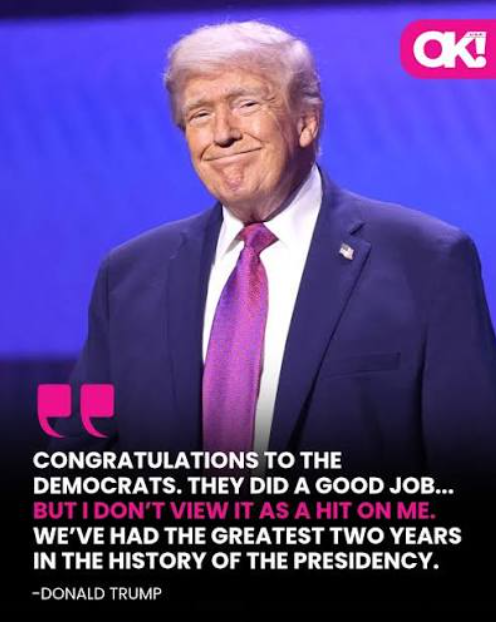
The President appears incapable of admitting or accepting this reality. Instead, he is in a complete state of denial and has lost touch with reality. Incredibly, he now says Republicans lost because he wasn’t on the ballot. He says the election wasn’t a hit on him; rather, it was the subpar Republican candidates. Voters simply didn’t transfer their love of Trump to the candidates.
Looking for someone to blame, he exploded at his Chief of Staff Susie Wiles, forcing her to resign. He is so divorced from reality that he even claimed credit for a stock market rally occurring the day after the election. And the very next day he blamed Democrats for an ensuing crash.
The President is a lame duck. Republican minorities no longer have the power to deliver for him. Worse, more and more Republicans refuse to do his bidding. He has lost his power to punish and reward his members for their behavior. Even his Vice President separated himself from Trump by blaming election losses on the war with Iran.
This brings us to the “X Factor”: How will President Trump, deeply wounded and in complete denial, respond to a Democratic Congress? I see three distinct scenarios:
- Trump will continue to claim achievements and success, insisting he is still in control. He will cast the Democrats as dangerous and look to block them at every opportunity. He won’t care how this behavior will affect Republican prospects for the Presidency and Congress in 2028. This is a scorched earth mentality that will lead to little progress on affordability, inflation, ending the war with Iran, or other concerns that brought voters to the polls.
- In a state of denial and increasing isolation, Trump could continue to deteriorate mentally and become unfit for office. A single serious event could be incapacitating. This will prompt Congress and/or his Cabinet to pursue removal via the 25th Amendment. Another alternative, should his behavior be criminal, is removal via impeachment.
- In his current state of denial and loss of touch with reality, Trump might be susceptible to taking credit for solutions that he had no part in creating. And it’s possible that he could even take credit for solutions that he and Republicans previously opposed. In this scenario, Trump’s need to see himself as a winner might delude him into visualizing himself as dealmaker bringing warring parties together to save the day. His belief doesn’t have to be rational. In fact, he’s repeatedly demonstrated he can take credit for things he didn’t do.
I predict President Trump will initially respond under scenario #1 (insisting he is still in charge and vetoing everything); but his need to be a winner and a hero will inevitably prompt him to take credit for solutions that he and Republicans previously opposed (scenario #3).
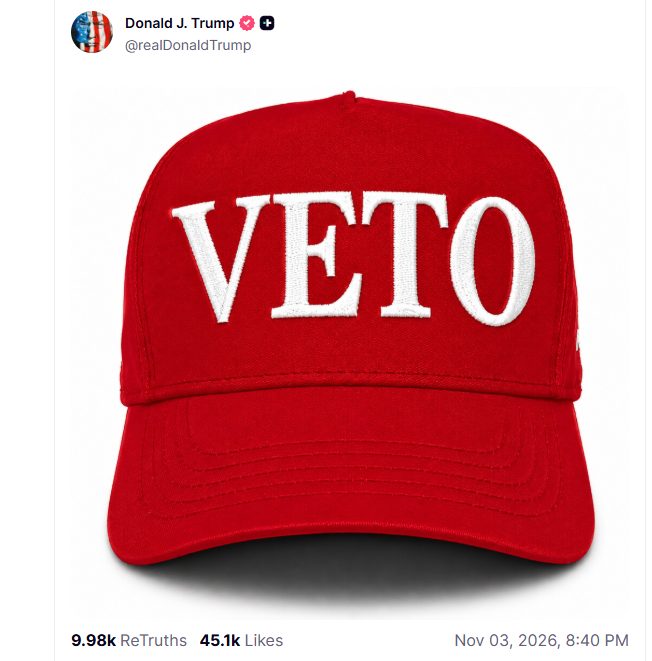
On election night, November 3, Trump posted a picture of a cap (see below) on Truth Social. A few days later he appointed Stephen Miller, the architect of some of Trump’s harshest policies, to replace Susie Wiles as Chief of Staff. These actions, by themselves, tell us all we need to know about how Trump plans to start his dealings with Democrats. But let me get to specifics and talk about the war with Iran and how Trump is likely to respond to the initial bill coming from Democrats.
In the coming weeks, it wouldn’t surprise me to see Trump remove or fire Pete Hegseth (Secretary of War), strike Iran, impose massive economic sanctions, and announce a military withdrawal. This would allow him to argue he definitively destroyed Iran’s nuclear capacity and left the country to either negotiate or perish from economic sanctions. This move would declaw Democrat efforts to contest the war, leaving Trump room to veto any legislation reaching his desk. And Pete Hegseth would be blamed for the botched war.
Democrats will come out of the gate in January with a package of changes to address affordability, the war with Iran, tariffs, healthcare and other matters. The legislation will pass the House and may even pass the Senate; but Trump will veto it. And Democrats won’t have the votes to override a veto. Trump will insist the legislation is radical, socialist, and fiscally irresponsible.
However, at some point in time, Trump will negotiate or invent some minuscule changes that he will say make all the difference. I believe he will give in on restoring healthcare subsidies and most of the cuts to Medicare, Medicaid and SNAPS. Republicans in Congress will howl, but he won’t care. He will say, irrationally, that he cut a winning deal with Democrats—a deal that is totally in line with everything he’s always advocated. And there may be more such deals before he’s done.
Many of you may be wondering, what about Medicare for All? Shouldn’t this be a major component of the Democrats’ agenda; and could Trump possibly be the hero on this? I don’t think so. First, while there is some polling that shows a majority of Americans support Medicare for All in concept, these surveys didn’t include information about how this reform would be paid for, including any new costs or taxes for Americans. Second, Republicans would surely filibuster a Medicare for All proposal in the Senate. Democrats would need some Republicans to support the proposal to secure the 60 votes needed for passage. And, if you’re wondering, Medicare for All can’t be accomplished using the Budget Reconciliation process, where a simple majority is sufficient. Finally, I can’t see Trump, even in his most irrational dealmaking thinking, ever embracing Medicare for All.
If Democrats are to push Medicare for All in the next two years, there first needs to be polling that shows clear and consistent majority support for a proposal that includes information about how it would be paid for and any new costs that Americans would bear. Otherwise, Trump and Republicans would love for Democrats to push this reform as a centerpiece so that it could be blocked or vetoed. It will be branded as an outrageously expensive and socialist action that Americans don’t want. Thus, in my view, Medicare for All is a reform that should be pursued when Democrats are successful in electing a President in 2028.
Despite Trump’s self-described “winning deals,” he will end his term with very low job approval and numerous failures; but there is also no assurance that the new Democrat controlled Congress will deliver on its promises.
Just as most Americans came to doubt Trump’s boasts about the economy, inflation, tariffs, and the war with Iran, we won’t believe his boasts about cutting winning deals with Democrats. Hearings and oversight by a Democratic Congress will further expose corruption within the Trump Administration and family. Budget deficits and the National Debt will have soared to record levels, especially after his “winning deals” with Democrats. Republican members of Congress will increasingly ignore or humor the lame duck president. And let’s not forget about the Epstein files.
Unfortunately for all the Americans who are suffering economically, it’s hard to predict how much relief Congress will actually be able to deliver. The war with Iran may not be over, as Congress does not have the unilateral authority to end it. Trump retains veto authority and has power to address “imminent threats.” Congress also can’t unilaterally end tariffs. Nor can Congress prevent the President from policy edicts made by way of executive order.
We simply don’t know whether and how much gas and diesel prices will drop. We don’t know about escalating grocery prices, heating and cooling costs, and healthcare premiums. Congress doesn’t have unilateral control over any of these items. The President and Republicans can prevent Democrats from delivering. Trump will likely then turn around and put the blame on Democrats.
In my view, however, I believe Americans have closed the door on President Trump. We will see that he blocked Democrats from delivering on their promises. And if Trump does make some “winning deals” we will see a failed President who deluded himself into thinking he was a hero.
The Trump era and the MAGA movement are most likely behind us. Americans are signaling that we’re done with the politics of division and blame. We want our policymakers to work together and solve problems. To do this, we’re going to have to choose the right kind of leaders. 2028 is only two years away, and this promises to be a messy and difficult period. May we not lose hope and continue to search for leaders who will bring us together.
Leave a Reply