
President Trump and Republicans warn that recent wins by “Democratic Socialists” are a sign the Democratic Party is being taken over by communists. Allegedly, these extreme candidates reject capitalism and want to turn the US into a socialist/communist country. At the same time, traditional Democrats (“Establishment Democrats”) fret that wins by Democratic Socialists alienate Independents and moderates who might otherwise vote against Trump and Republicans. The media hypes it as a “battle for the soul of the Democratic Party.” On one side, establishment Democrats cultivate “big tent” unity and pursue incremental change. On the other side, progressives and Democratic Socialists exhort major systemic reforms, a few of which are being characterized as socialist or communist. Trump and Republicans are exploiting this rift by contending Democratic Socialists are gaining the upper hand. It’s just a matter of time until the entire Democratic Party is converted to communism.
Anyone observing the debate knows that the terms “socialism” and “communism” are used interchangeably and loosely. Most Americans view both of these terms negatively. But beyond this there is little agreement or common understanding of what these terms actually mean. In addition, most of us have difficulty identifying which of the world’s countries are “capitalist”, “socialist”, or “communist.” Some of us see countries such as Sweden, Norway, Denmark and Finland as socialist. Others say these countries are free-market capitalist economies with large public safety nets.
Americans can’t have an intelligent discussion about the threat of socialism and communism if we don’t even have a common understanding of what these terms mean. And we can’t determine whether our current capitalist system is great or needs fixing until we compare it with those of other countries. Where does America stand in terms of the best governments and economic systems in the world? Where do we excel and where do we fall short in terms of our economy, our governance, the health and welfare of our citizens, and our individual freedoms? Do capitalist systems such as ours tend to be the best? Or are socialist and communist systems delivering stronger economies and a greater quality of life? And, are most countries exclusively capitalist, socialist, or communist; or do most countries have a blend of capitalism and socialism/communism? These are questions we need to answer to determine whether socialism/communism is indeed a threat, or whether elements of these systems might be beneficial for America.
In this post I’ll start by defining capitalism, socialism, and communism. I’ll then turn to what four different think tanks identify as the best countries in the world based on such indicators as strength of economy, governance, health and welfare of citizens, and individual freedoms. Of the countries most often making the top 15 on all these lists, I’ll then assess the degree to which they are capitalist, socialist, or communist. I’ll next turn to the United States, discussing where we fall on these lists, especially where we lag. Finally, I’ll address the fear mongering regarding Democrat-imposed socialism and communism. It’s a fabricated threat that hinders America from considering how to be a better country with an improved quality of life.
Here are basic definitions of capitalism, socialism and communism.
Capitalism is an socioeconomic and political system in which wealth (aka “capital”) is owned by individuals for their personal benefit. Capitalism is based on private ownership of the means of production and on individual economic freedom. Most of the means of production, such as factories, land and businesses, is owned by private individuals and not by the government. Prices and goods are set by free market competition and consumer demand, with little interference by the government.
Socialism is a socioeconomic and political system where the people, either directly or through the government, own the means of production and the major parts of the economy. This typically includes large industries, utilities, and services like education, health care, and welfare. Socialists do not, however, believe that all private property must be eliminated. Wealth is shared through taxes and social programs to reduce the gap between rich and poor. The goal is equal opportunity and meeting the basic needs of all the people. Socialism calls for wealth and income to be shared more equally among people. The goal is to narrow, but not totally eliminate, the gap between the rich and the poor. It’s the government’s responsibility to redistribute wealth to make society more fair and just.
Communism is a socioeconomic and political system where the government or the public owns all property, land, and the means of production. A central authority plans and controls the entire economy with little to no role for private business. The goal is total economic equality and the elimination of social classes. In essence, communism is socialism on steroids. There is no private sector, individuals don’t hold property, and the central government controls everything.
Most of the world’s countries are blends of capitalism and socialism, with few being classified as communist.
In practice, most countries in the world aren’t purely capitalist, socialist, or communist. Rather, most countries have some blend of these systems. In particular, many countries have blends of capitalism and socialism, with capitalism being predominant. The United States and several countries in Europe are typical examples. These countries have extensive private sectors and market-based economies; but they also have very large public safety nets. Other than the US, examples include Switzerland, Austria, Germany, France, Ireland, and the United Kingdom.
As to countries that are predominantly socialist and communist, there are very few. China, Cuba, Laos, North Korea, and Vietnam are considered predominantly communist countries. Countries that are considered primarily socialist, with modest capitalism, include Venezuela, Portugal, and India.
Finally, there are several countries where experts differ as to whether they should be classified as predominantly capitalist or predominantly socialist. These countries include Sweden, Finland, Norway, and Denmark.
What are the world’s best countries according to an array of think tanks?
Rather than debate the merits and evils of capitalism, socialism, communism, an alternate approach is to focus on what are the world’s best countries. That is, let’s identify those countries that have great economies, fair and efficient governments, ample individual freedoms, excellent education, and an array of programs to serve the health and welfare needs of citizens. We aren’t looking to see whether these countries are communist, socialist, or capitalist. Rather, we’re simply trying to identify the countries that are widely seen as well run and delivering a high quality of life. Further, to bolster the legitimacy of this search, we should consider rankings from multiple sources.
For this analysis, I chose four prominent and highly-respected think tanks/organizations that publish annual rankings of the world’s best countries. They are:
- World Atlas 25 Best Governments in the World (2026)
- Chandler 2026 Good Government Index
- World Economics 2026 Governance Index, and
- US News and World Report, Best Countries 2026
Each of these think tanks/organizations develop their rankings using numerous indicators, criteria or metrics that are refined over time. If you’re interested, click on the links above and you can explore the indicators and methodology that go into developing each of these lists.
For ease of understanding, I created a table that lists the top 15 countries (2026) for each of these four rankings:
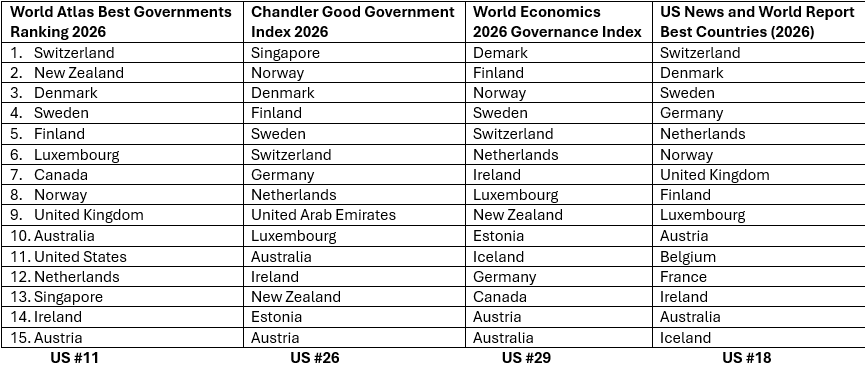
As you can see, the United States only made one top-15 ranking (World Atlas, #11), and was the 18th best country in US News and World Report rankings. Ten countries were in the top-15 on all four lists: Switzerland, Denmark, Sweden, Finland, Luxembourg, Norway, Australia, Netherlands, Ireland, and Austria. Two countries, Germany and New Zealand, made three of the top-15 lists. Together, this adds up to a dozen countries that consistently rank as the best overall and best governed countries in the world. We’ll concentrate our analysis on these countries, and start by examining the extent to which these countries are capitalist, socialist, or communist.
Not one of the top 12 countries is communist; instead, all 12 countries are predominantly capitalist, with varying degrees of socialism.
Since not a single communist country made any of the best countries lists, why would any country aspire to embrace communism? Indeed, there is no reason to believe that America could be improved as a country if it moved in the direction of communism.
But what about the 12 countries that consistently rate the best? Aren’t some of them socialist, as opposed to capitalist? In particular, aren’t Sweden, Finland, Norway, and Denmark predominantly socialist countries? The answer is no. All 12 of the best countries are predominantly capitalist, free-market economies that have varying degrees of socialism. Let’s explore.
Some analysts argue that countries like Sweden, Finland, Norway, and Denmark are predominantly socialist, while retaining a lesser degree of capitalism. For this to be true, it would need to be shown that the government (all the people) owns most of the means of production and the economy. It would also need to be shown that property ownership and economic freedom of individual citizens and private sector businesses is restricted. This is not the case in these Scandinavian countries, where the private sector and individuals continue to own the means of production.
Another way to discern whether countries are primarily capitalist or primarily socialist is to see where they stand in terms of “economic freedom.” This variable measures the extent to which individuals and the private sector control their own labor and property, with minimal interference from government. The Heritage Foundation, a prominent US conservative think tank, annually publishes an Index of Economic Freedom and ranks the world’s countries. Here is its definition of “economic freedom”:
“Economic freedom is the fundamental right of every human to control his or her own labor and property. In an economically free society, individuals are free to work, produce, consume, and invest in any way they please. In economically free societies, governments allow labor, capital, and goods to move freely, and refrain from coercion or constraint of liberty beyond the extent necessary to protect and maintain liberty itself.”
Heritage Foundation, definition of economic freedom
Here’s the 2026 Index of Economic Freedom from the Heritage Foundation that shows the top-ranked countries that allow individuals and the private sector to control to the maximum extent:
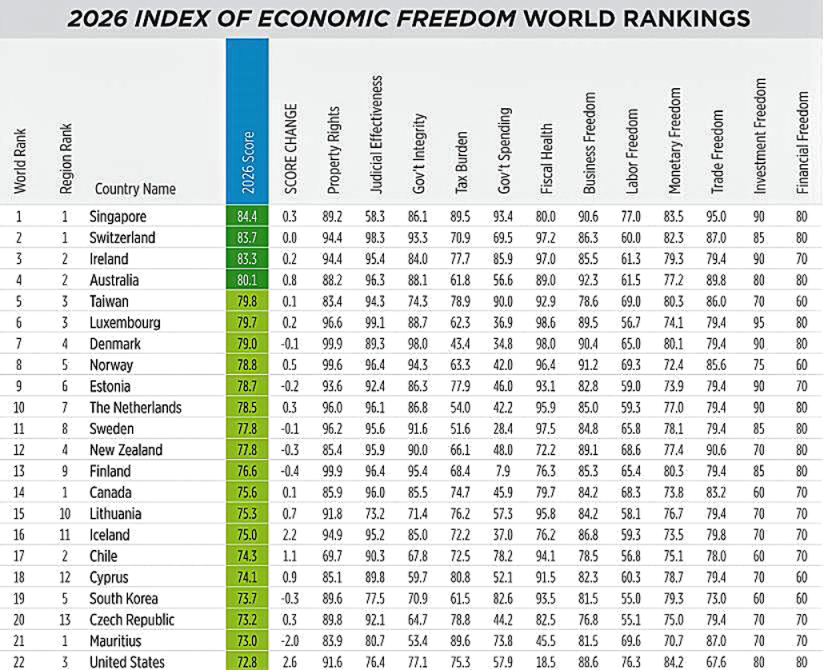
As you can see, Sweden, Finland, Denmark, and Norway–the so called “socialist” countries–have very high scores for economic freedom. And so do most of the other countries on our top-12 list, including Switzerland, Ireland, Australia, Luxembourg, Netherlands, and New Zealand. All of these countries score better on economic freedom than the United States, which comes in at 22. This tells us that all of the countries on our list are predominantly capitalist.
It’s a myth that countries are purely capitalist or socialist, or that they change overnight; instead, most successful countries remain rooted in capitalism, while incorporating and modifying elements of socialism over time.
While the US is a largely capitalist system, we have added several socialist-style programs over the years. We started with a postal service and public education. But since the 1930’s have expanded to include Social Security, Medicare, unemployment benefits, and institutions like credit unions and worker cooperatives. Most countries in the world have evolved in a similar manner, albeit at different speeds. In particular, the countries making up our top-12 list have maintained their capitalist roots while expanding socialist programs to provide an extensive safety net. They have narrowed the gap between the rich and the poor. The fact that all these highly successful countries opted to provide universal health care does not make them socialist. Rather, they remain capitalist countries with free-market economies, private ownership of the means of production, and strong individual freedoms.
Knowing where America lags in terms of the various indicators helps us identify where we should concentrate to become a better country with a higher quality of life.
I took a dive into the hundreds of indicators used by the four indexes. Here is where the United States falls significantly short on specific indicators:
The US News and World Report Best Countries Index uses 100 indicators grouped into 24 subcategories, and 8 primary performance pillars. Overall, the US ranked 18th. However, it ranked 41st in the pillar of civic health, primarily driven by low rankings on social cohesion, public safety, and public trust. On the pillar of infrastructure, the US ranked 39th, driven by lower rankings in digital connectivity, broadband speed and internet access. On the pillar of health, the US ranked 33rd, despite massive healthcare spending. The ranking was brought down because of weaker public health outcomes compared to other developed nations.
The World Atlas Best Governments Index uses the Legatum Prosperity Index. While the US ranked 17th overall, it ranked 42nd in terms of health and physical well being, 36th in terms of civil peace, 28th on of freedom of dissent, 37th on integration of families, and 34th on integration of society.
The Chandler Good Government Index uses 35 indicators grouped under 7 “pillars”. While the US ranked 26th in the Chandler Index, it ranked 36th in the pillar of “strong institutions,” struggling specifically with coordination (49th) and implementation (95th). It ranked 66th in the pillar of “financial stewardship,” struggling specifically with the lack of a budget surplus (125th) and spending efficiency (124th). Finally, under the pillar of “helping people rise” the US ranked 50th, struggling specifically with health (110th), satisfaction with public services (82nd), personal safety (71st), income distribution (82nd), nondiscrimination (98th), and price stability (37th).
The World Economics Government Index uses four sub-indexes. On the overall index, the US scored 73.3, which placed us 29th in the world. As to the four sub-indexes, the US scored 67.1 on corruption levels, and 61.8 on press freedom.
Here are my initial impressions of what these indicators tell us about the United States. Compared to the best countries in the world, the United States appears to be struggling with respect to health care, low social cohesion, public safety, and management of our federal budget (spending and debt). These initial conclusions are tempered by the fact that the United States is a huge country, with a population that dwarfs all other countries that made the top-15 lists. Change for us is always hard and complicated. Further, the political climate in the United States is extremely hyper-partisan. It’s telling that our consideration of universal health care is shot down as socialist and communist without even recognizing that the best countries in the world, as well as their citizens, embrace this policy
Significant majorities of Americans actually support policies that Trump and Republicans are decrying as Democrat-imposed socialism and communism.
A recent Economist/YouGov poll (June 26-29) asked, do you support or oppose a national health plan in which all Americans get their health insurance from the federal government, and private health insurance companies are eliminated? In response, 52% said they supported this move, and only 30% said they opposed.
Here are some other results from the Economist/YouGov poll above:
- 54% said they supported the federal government covering the cost of college tuition for all students, while only 34% opposed.
- 57% said they supported the federal government building pubic housing, while only 24% opposed.
- 68% said Social Security spending should be increased a lot or slightly, while only 4% supported a decrease in spending.
- 65% said Medicare spending should be increased a lot or slightly, while only 6% supported a decrease in spending.
- 53% said Medicaid spending should be increased a lot or slightly, while only 12% supported a decrease.
- 55% said federal spending for housing assistance should be increased a lot or slightly, while only 17% supported a decrease.
And here some other results from a January 2026, Economist/YouGov poll and a February 2026 Economist/YouGov poll:
- 80% said the rich have too much power, while only 8% said this was not the case.
- 80% said that the gap between the rich and the poor was a very big problem or somewhat of a big problem, while only 20% said it was not a problem or only a slight problem.
- 59% said government should pursue policies to reduce the wealth gap, while only 21% said it should not.
- 62% said that taxes are much too low or somewhat too low for billionaires, while only 7% said taxes on billionaires are too high.
- 57% said the US should do more to address climate change, while 32% said we should do less or make no change.
- 64% said the US should be using more solar energy, while only 9% said less.
- 57% said the US should be using more wind energy, while only 17% said less.
Clearly, Americans strongly support policies that would strengthen the social safety net, reduce the gap between the rich and the poor, move toward universal health care, protect the environment, and expand public housing. All of these moves are consistent with moves made by countries that now top the world’s best countries rankings. And, more importantly, it isn’t the radical socialist and communist Democrats who are coming into office and forcing their will on a resistant pubic. Instead, Americans appear to be ready to embrace policies that will strengthen us as a country and improve our quality of life.
There is absolutely no basis for arguing that Democrats and the Democratic Party embrace the extreme policy positions of the Democratic Socialists of America, an organization that is neither a political party nor affiliated with the Democratic Party.
The Democratic Socialists of America (DSA) is a relatively small organization that is neither a political party nor in any way affiliated with Democratic Party. The platform of the DSA and some of its policy positions are radical. For instance, the DSA platform calls for the the means of production and major parts of the economy to be shifted to the control of the people (government). There is also a call to abolish the US Senate and revamp the House of Representatives, which would then choose the President and appoint justices of the Supreme Court. Another recommendation coming from DSA is to abolish ICE. And, at least one DSA member running for office talked about canceling Thanksgiving.
These policies and positions of the DSA and their candidates have nothing to do the platform and policies of the Democratic Party. Since the DSA is not a political party, when DSA members or advocates run for office, they must choose to run as Democrats, Republicans, or Independents. Most choose to run as Democrats, and state election laws protect their right to make this choice. The Democratic Party has no authority to ban candidates. There is thus no basis for arguing that the Democratic Party is embracing the entire platform and policy positions of the DSA simply because a DSA member chooses to run as a Democrat.
It is an especially illogical leap to paint all Democrats and the Democratic Party as supporting the most extreme positions of the DSA. The platform of the Democratic Party doesn’t say a word about abolishing the US Senate, revamping the House of Representatives, or having the House choose the President and Supreme Court justices. Nor does the platform call for shifting the means of production to the control of the government and taking it away from individuals.
If you take the roughly 260 members of Congress who are Democrats (212 House Reps, and 45 Senators), I dare you to find even a handful who support the extreme positions of the DSA mentioned above. Instead, Congressional Democrats are talking about addressing the affordability crisis, improving the economy, considering Universal Health Care, taxing the rich, addressing climate change, and developing a responsible social safety net. These are issues that large majorities of Americans want addressed. These are issues that, if addressed, can improve America’s standing as one of the best countries in the world.
Final Thoughts
Democrats and the Democratic Party are not turning socialist and communist. The United States is not in danger of becoming a communist country, or even a socialist country. Instead, if we examine the best countries in the world, we find that they embrace capitalism. They are free-market economies with the means of production held by individuals and not the government. These countries have embraced some elements of socialism, as has the United States. America lags those countries when it comes to some of these elements. But in recent years, substantial majorities of Americans are now supporting these policies. A better future demands that we fully consider, debate, and possibly adopt these policies. It’s a mistake to reject them out of hand as country-destroying socialism and communism imposed by Democrats.
Leave a Reply