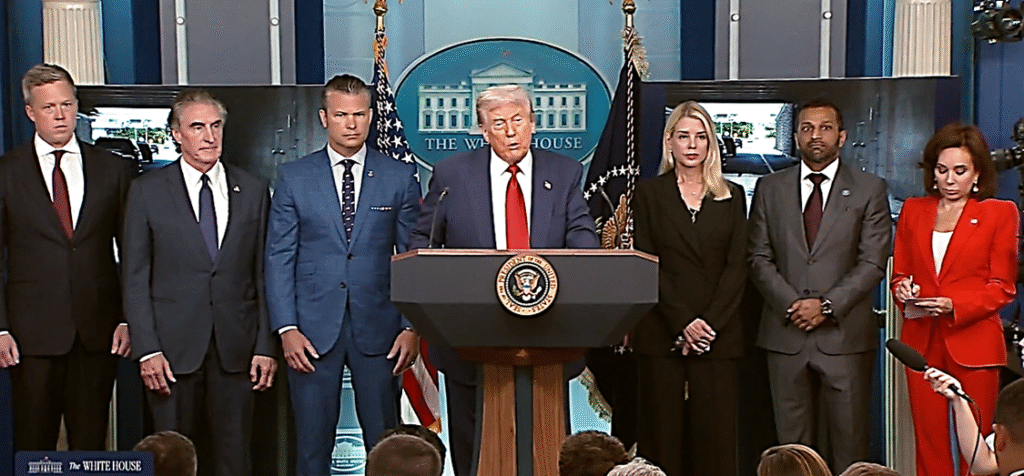
On August 11, President Trump invoked emergency authority to deploy some 800 members of the Washington DC National Guard to crack down on “rampant crime” in the nation’s capital (USA Today, August 11). To ensure widespread publicity, he announced the highly unusual action at a major press conference. Here are a few of his key comments:
“I’m announcing a historic action to rescue our nation’s capital from crime, bloodshed, bedlam and squalor and worse.”
He went on to declare that Washington DC has been “taken over by violent gangs and bloodthirsty criminals” and “drugged out maniacs and homeless people”.
“It’s becoming a situation of complete and total lawlessness.”
“This is liberation day in DC, and we’re going to take our capital back.”
BBC, August 12, 2025, “Trump deploys National Guard to Washington DC and pledges crime crackdown”
Washington DC Mayor Muriel Bowser, a Democrat, immediately denied that crime was out of control in the city. She cited statistics showing that crime was actually in decline. While she characterized the deployment as an “authoritarian push,” she nonetheless attempted to coordinate and cooperate with the Trump Administration. Along with other city officials, Bowser maintained that the deployment was neither necessary nor legal. And subsequently, on September 4, Washington, DC Attorney General Brian Schwalb, filed a lawsuit challenging the deployment as an illegal use of the military for domestic law enforcement.
As an attorney, I was initially drawn to evaluating Trump’s legal authority with respect to various recent deployments of the National Guard. Going back to June, Trump sent the National Guard to Los Angeles–against the will of California Governor Newsom and Los Angeles officials–to quell protests against ICE raids and immigration enforcement. On June 15 on Truth Social, President Trump condemned “Radical Left Democrats” and “Democrat power centers” for not only thwarting immigration enforcement, but also destroying cities. He particularly emphasized that “crime-ridden and deadly inner cities” would be turned around and made safe.
These and other recent National Guard deployments by President Trump involve the application and interpretation of several key laws. First, the Posse Comitatus Act (18 U.S.C, Section 1385) forbids the U.S. military–including federal armed forces and National Guard troops–from taking part in civilian law enforcement (also described as “primary law enforcement”). Second, under Section 12406 of Title 10, the President can deploy the National Guard into federal service when the county is under an invasion, a rebellion or danger of rebellion, or the President is unable with the “regular forces to execute the laws of the United States.” Again, however, the Guard cannot exercise primary law enforcement. It is still subject to the Posse Comitatus Act. Third, exceptions to Posse Comitatus can be found in the Insurrection Act (see Sections 251 through 255 in Title 10 of the United States Code). Essentially, if any of these exceptions apply, the President can call in the National Guard and/or military, without needing the permission of the state or local entity. And, importantly, the National Guard or military can take part in civilian law enforcement. If the Insurrection Act is not invoked by the President (or invoked illegally), the role of the National Guard and/or military is much more limited. Troops can be used to protect federal employees, protect federal property, assist federal employees in enforcing federal laws, and assist local law enforcement. But they can’t make arrests and exercise primary law enforcement.
Aside from the formidable complexities of applying these laws, there remains the critical question of whether deploying the National Guard to fight crime is a worthy solution, one that is cost-efficient and effective. That is, assuming we meet all the legal tests, are the costs of calling in the troops reasonable? And does the Guard’s presence actually solve the problem it is being called upon to address?
For this article I decided to set aside all the legal issues, most of which are currently being litigated in the federal courts. Instead, I want to focus on whether calling in the National Guard to help fight crime is a worthy solution. In addition, I will address what could be done to make this option the most cost-efficient and effective solution possible. I’ll proceed by asking and answering a series of questions.
1. How much is it costing the federal government for the National Guard’s presence in Washington DC; and how does this cost compare with the amount spent by Washington DC for police and public safety?
USA Today reported on September 17 that Trump’s deployment of the Washington DC National Guard is projected to cost taxpayers $201 million, or more than $1.8 million a day, according to internal budget information reviewed by USA Today. The article goes on to say that during the period of August 11 through September 17 (37 days), the DC National Guard spent more than $45 million on the deployment of some 800 guardsmen. This involves $18.8 million going toward operations and $26.6 million toward pay and allowances for soldiers. Thus, the daily cost for this portion of the deployment is about $1.2 million per day ($45 million divided by 37).
The estimate of $201 million is based on the deployment lasting until November 30, when it is scheduled to wrap up. The estimated cost of $1.8 million per day is based on this 111-day deployment (August 11 through November 30) and an estimated total cost of $201 million. The Pentagon maintains that it will not know the total cost of the mission until it concludes.
Importantly, the price tag of $201 million for does not include the cost of deploying more than 1,300 additional National Guardsmen from other states that are now assisting at the Capital. These states include Louisiana, Mississippi, Ohio, Tennessee, South Carolina, and West Virginia. As of Oct. 1, there were just short of 2,200 National Guard members in D.C.
For fiscal year (FY) 2023, the Metropolitan Police Department (MPD) in Washington, DC had a budget of approximately $526.1 million. A different source from the Vera Institute estimates the overall policing budget for D.C. at about $655.4 million. This figure is larger because it includes various local, state, and federal funding sources. Some 3,200 officers per day are on patrol.
If we take the larger figure ($655 million), the cost per day for MPD law enforcement/public safety is just shy of $1.8 million per day ($655 million divided by 365).
This means that the expenditures for law enforcement essentially doubled on account of the National Guard deployment. And the number of personnel on patrol also increased by almost 70% (3,200 MPD officers plus 2,200 members of the National Guard). More important, it means that the federal government is spending at least $201 million for this 111-day deployment of the National Guard to Washington DC.
2. What are the National Guard troops in Washington DC authorized to do, and what have the troops actually been doing?
President Trump did not invoke the Insurrection Act to authorize National Guard troops to exercise primary law enforcement. This means troops are authorized to provide support to civilian law enforcement rather than act independently. Examples include traffic control, security checkpoints, and other logistical tasks. In a broader scope, troops can be used to protect federal employees, protect federal property, assist federal employees in enforcing federal laws, and assist local law enforcement. But they can’t make arrests and exercise primary law enforcement.
As to what the National Guard troops are actually doing, here is a quote from USA Today that, in turn, quotes from an update sent out by the National Guard:
“Those troops have ‘cleared 1,015 bags of trash, spread 744 cubic yards of mulch, removed five truckloads of plant waste, cleared 6.7 miles of roadway, and painted 270 feet of fencing,’ according to the update.”
However, as I extended my research on this question, I found additional functions being performed by the Guard. They patrol key public areas and assist the DC Metropolitan Police Department with crowd management and security. They have also been stationed at Metro stations and other busy locations to deter crime. They have cleared homeless encampments (about 50) from parks and roadways. Guard members have also packaged food for local food banks and assisted with revitalizing community centers. Finally, a portion of the Guard has been authorized to carry weapons for law enforcement duties.
3. What has happened regarding crime in Washington DC since Trump deployed the National Guard; and what are the implications regarding crime after the deployment ends?
Both Reuters and CNN have published analyses that show crime has gone down in Washington DC since the deployment of the Guard. However, most of the declines are modest. The analyses note that determining the exact cause of the declines is complicated by the fact that crime was already trending down in DC. Causation is also complicated due to the fact that crime rates are volatile, going up and down considerably on a month-to-month basis. This makes it difficult to assess whether the Guard’s presence was actually driving the changes.
The volatility in crime rates is graphically depicted in the charts below:
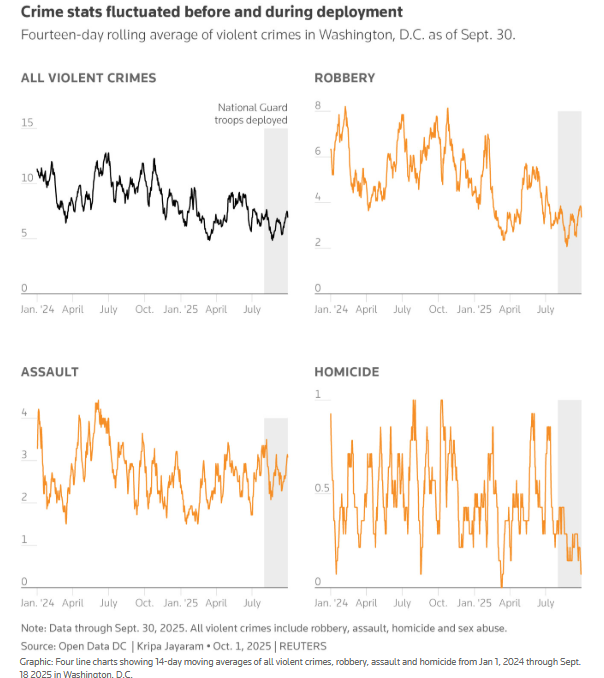
Given all these circumstances, Reuters is cautious about declaring the National Guard’s presence was responsible for the decline. Here is it’s key conclusion:
“A Reuters review of public safety records and interviews with four experts on crime suggest that it is premature to draw sweeping conclusions about the impact of Trump’s deployments. While some types of crime – especially gun offenses – have become less frequent since Trump ordered troops into the city, overall violent crime hasn’t changed that much.”
Reuters, “Did Trump’s crime crackdown in Washington work? It’s complicated”, October 6, 2025.
With this caveat, here are some statistics reported by CNN based public data released by the MPD. In the first three weeks of the National Guard deployment, reported violent crime incidents dropped by 10% from the previous three-week period, while reported property crime incidents fell by 25%. There were three homicides in the first three weeks of the deployment, compared to eight in the previous three weeks. Incidents of burglary and theft from automobiles dropped by more than 40%, while motor vehicle theft was down about 35% and robbery was down about 19%. CNN also noted that its numbers were, “based on the preliminary data and could change over time, as some crimes take longer to be entered into the department’s database.”
Clearly, with 5,400 personnel on duty as opposed to the usual 3,200, the police “law enforcement presence” in Washington DC was greatly enhanced. Experts such as Jim Burch, President of the National Policing Institute, suggest the increased law enforcement visibility had a short-term deterrent effect on criminals.
“Any city in America with a 50% increase in their officers is going to be able to have some kind of impact on public safety. But that’s not reality. That’s not the fiscal reality.”
Jim Burch, President of the National Policing Institute, as quoted in NPR, October 2, 2025
Finally, it’s questionable whether the drop in crime will persist after the National Guard deployment ends. Nancy La Vigne, a criminal justice researcher and dean of the School of Criminal Justice at Rutgers University, is skeptical. She argues the drop will likely be an “artificial suppression of crime.” An article in The Hill concluded,
“Even if Trump is right that Washington, D.C., is now ‘a safe city,’ what’s to prevent the nation’s capital from returning to ‘crime, bloodshed, bedlam, squalor and worse’ the moment the troops return home?
In conclusion, it’s fair to say that the National Guard’s presence in Washington DC is driving at least some of the decline in crime rates. But the falling crime rates can also be attributed to monthly variability in crime rates as well as the long-term decline in crime rates over the past 30 years. And, most important, there is no evidence or reason to conclude that the drop in crime will persist in the months and years after the Guard’s deployment ends.
Trump’s deployment of the National Guard to fight crime in Washington DC is not a worthy, cost-efficient and effective solution; but there are steps he can take to enable future deployments of the National Guard to effectively fight crime in the nation’s cities.
The deployment of the National Guard to Washington DC was not cost-effective. Daily costs for the federal government were as expensive as the daily local law enforcement costs. But the deployed troops did not exercise primary law enforcement and instead did a lot of work not related to law enforcement. Expanding such deployments to other cities on a more regular basis would require billions in new federal spending.
Also, the deployment was not an effective solution to Washington DC’s crime problem. Though the city was swarmed with troops, they were limited in fighting crime and often worked instead on unrelated tasks. While beautification projects, clearing homeless camps, trash pickups, painting fences, and spreading mulch have some value, these activities weren’t directly related to Trump’s emergency mission to fight out-of-control crime. The presence of the troops did appear to have some influence in combating crime, but this conclusion is not yet proven. Finally, and most important, this short-term deployment is unlikely to produce a durable decline in crime rates.
While the deployment was neither a cost-efficient nor effective solution to combating crime in our nation’s cities, it was a success in terms of President Trump’s political agenda. He claimed victory in bringing down crime rates in Washington DC and promised to expand the effort to other American cities (Democrat-run, of course). He vindicated his narratives that Democrats are the cause of high crime in our nation’s cities, and that he, Trump, was making America’s cities safe again.
Steps to legitimate the deployment of the National Guard to help fight crime in America’s cities
I’m betting that the vast majority of Americans do not support deploying the National Guard in order to advance a political agenda. Instead, if we are to deploy the Guard to help fight crime, it should actually help solve that problem, and it should be done in a cost-efficient way. Thus, if President Trump is serious about fighting crime in America’s cities, he needs to lay off the political subterfuge and concentrate on the task at hand. I do believe he has a path forward, and here are my recommendations.
1. Deploy to cities that actually have the highest crime rates, with rates trending higher, and without regard to political party in charge of the city.
Washington DC is not even in the top ten Americans cities with the highest crime rates. Its crime rates have been trending down for many years. President Trump chose it because it was a Democrat-controlled city that he could politically attack as being out of control on crime.
If the Administration’s concern is about fighting out-of-control crime in cities it needs to demonstrate that it is only deploying the National Guard to cities with the worst crime problems. Since deployments require “emergency” conditions, the Administration should concentrate on high-crime cities where crime is getting worse. Finally, the political party in charge of the city should be irrelevant. The basis for deployment should be strictly based on crime statistics or requests for help.
2. Deploy to cities that either request assistance, or to cities where the Administration first consults with regarding the deployment.
Using the National Guard to help fight crime is best achieved through a cooperative and coordinated effort with local law enforcement. Also, long-standing Republican stances favoring local control and limiting the role of the federal government are advanced when cities and states actually need and ask for assistance from the federal government. While the federal government can offer and encourage cites to ask for help, in most circumstances state and local government should have the final say.
President Trump unilaterally deployed the National Guard to Washington DC. He didn’t first consult with local officials and attempt to work out a cooperative and coordinated effort. Forcing National Guard troops on a city against its will ignores the importance of cooperation and coordination.
At times the President may conclude a deployment is necessary and authorized under federal law, but the city (local government) or state may nonetheless resist. Rather than acting unilaterally, the Administration should still first consult in an attempt to coordinate and cooperate. This is not to argue that federal law should be changed to require prior consultation. Rather, the “best practice” should be to try to work out the nature and scope of the deployment in a cooperative manner.
3. If a deployment is to involve “primary law enforcement” responsibilities for National Guard troops, the troops involved must be trained in law enforcement.
Law enforcement is complex and requires individuals who are trained. For example, some of the complexities are conditions for detaining individuals, arrest procedures, restraint protocols, search and seizure laws, use of deadly force, use of body cameras, crowd control, de-escalation tactics, use of chemical dispersants, community policing, and a host of other requirements.
Authorizing National Guard troops to exercise all these complex responsibilities without training invites disaster. If the Administration seeks to deploy troops with law enforcement responsibility, it needs to ensure that these individuals are properly trained. This will necessarily involve additional cost to the federal government.
Final thoughts
The framework of our Constitution dictates that law enforcement is primarily a local and state responsibility. The federal government can exercise law enforcement to carry out its legal responsibilities, to protect federal property, to protect federal employees, and to act in specified emergencies. When the President acts to deploy the National Guard, it must be for these legitimate purposes. Deploying the Guard as a subterfuge to advance a political agenda is simply not legitimate. The problem is only compounded when this solution is neither cost-efficient nor effective. Our democracy is strengthened when the federal government works cooperatively with state and national governments to assure deployments of the National Guard are executed in a mission-specific and coordinated manner.
Leave a Reply