
The One Big Beautiful Bill Act, signed into law on July 4, 2025, provided almost $30 billion to enable ICE to hire and train at least 10,000 new agents by the end of the year. The surge was necessary to meet the demands of increased enforcement, including arrests and deportations targeted to reach one million per year. The daunting challenge facing ICE was to hire and train all these agents in just over five months.
The Trump Administration devised a multi-part plan to meet this challenge:
- A $100 million recruitment campaign was launched. It targeted gun rights supporters, military enthusiasts, former law enforcement officers, those with military experience, and others. The campaign was designed as a “wartime recruitment strategy” seeking “qualified patriots.”
- Age requirements for applicants were adjusted to drop the minimum age to 18 (previously 21), Also, the previous maximum age caps (37 and 40) were eliminated.
- A signing bonus of $50,000 was offered, along with $60,000 in student loan repayments or loan forgiveness options.
- Training for ICE agents was reduced from 22 weeks to 8 weeks or 47 days.
The Department of Homeland Security (DHS) recently proclaimed that its effort “shattered expectations” by producing “an additional 12,000 ICE officers and agents on the ground across the country” in less than a year. It pulled off a “120% manpower increase.”
The DHS press release further crowed that over 220,000 applications were received. Further, “ICE was able to exceed its hiring surge target while maintaining rigorous standards for training and readiness.”
I decided to take a deeper look at the Trump Administration’s self-proclaimed success in surging its immigration enforcement workforce. Did it actually pull off this surge without compromising the training and effectiveness of these new employees? Let me share what I found.
It is questionable that ICE met the hiring surge while still “maintaining rigorous standards for training and readiness.”
Prior to shortening the ICE agent training program to 8 weeks (47 days), ICE agents were required to attend 22 weeks of training. This basic training, conducted at the Federal Law Enforcement Training Center (FLETC) in Glynco, Georgia, included three major components. First, there was a 56-day Criminal Investigator Training Program (CITP). This segment involved criminal case management, physical evidence, surveillance, tactical training and vehicle handling skills. Second there was basic and advanced training in firearms that involved the “proficient application and justifiable use of a firearm.” Finally, there was a 63-day program in Immigration and Customs Enforcement Deportation Integrated (ICED). This segment included detention procedures, immigration and naturalization laws, defensive tactics, arrest techniques, baton techniques, and driver techniques.
It’s difficult to conceive how a training program could be reduced by two-thirds without reducing the training and readiness of ICE agents. A recent analysis from Brookings discusses how the ICE expansion outpaced accountability. Here’s a quote from its findings.
“The previously required 5 weeks of Spanish language training were removed, and agents are being told to rely on mobile apps for translation. Instead of a focus on understanding the Immigration and Nationality Act, trainees are engaging in more tactical and operational drills. Instead of a 4-week in-person training, police officers being deputized to work with ICE are now only required to do a 40-hour online course.”
Brookings, January 26, 2026
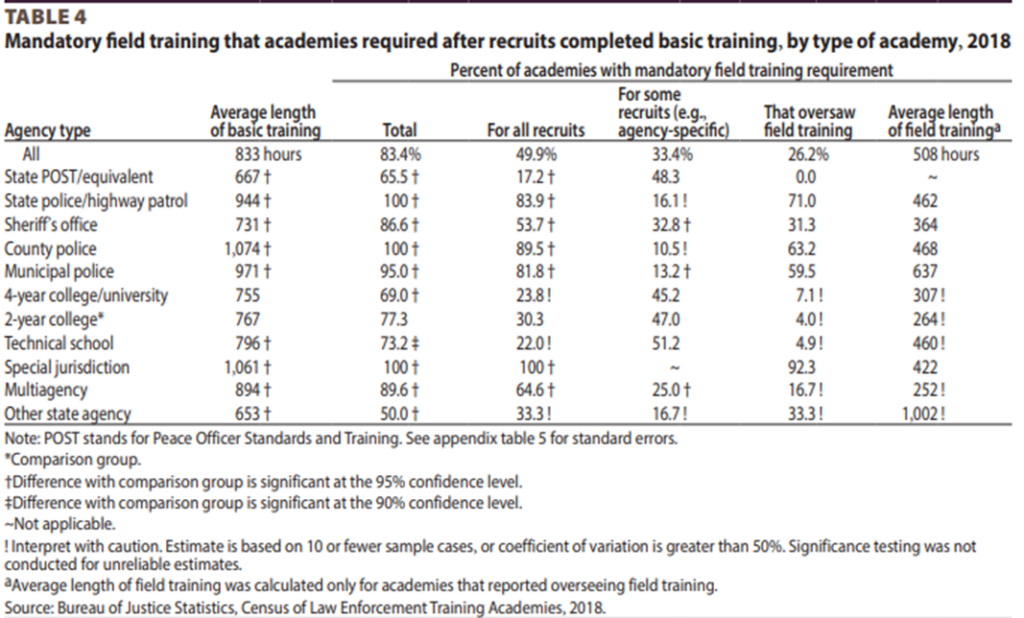
For additional perspective, we can consider training programs for other law enforcement activities in the United States. In this country we have a wide range of law enforcement academies, with trainings of various durations. The average length is 833 hours, which takes around five months to complete. But this isn’t all. In addition, most jurisdictions have field training requirements that average around 500 hours. Take a look at the table below and think about how much ICE agents will be prepared with just 47 hours of training.
Finally, given the speed and magnitude of the hiring surge, it’s likely that at least some applicants slipped through without proper vetting. NBC News reports on how recruits showed up for training without proper vetting. Some had criminal backgrounds, some had failed drug tests, and some were unable to meet physical or academic requirements.
It is premature to conclude that the 47-hour training program for ICE agents is sufficient and won’t lead to problems down the road.
In just the past few months, we have 12,000 new ICE agents who are starting their assignments around the country. It will take some time before we can assess whether these individuals are performing their duties competently and appropriately. It’s premature to declare that their training was rigorous and complete. And it’s premature to declare that the new agents are performing their duties competently and appropriately.
Odds are that the extensively-shortened training for ICE agents will have consequences down the road. It’s hard to believe that 47 hours of training can replace 22 weeks of training without any deficits in preparation. At minimum, these 12,000 hires should be flagged for attention and have their performance monitored.
In addition, given conflicting views regarding the backgrounds and qualifications of those hired, it’s appropriate to flag them for attention and monitor their performance.
In light of the recruitment targets and strategies specified in the nationwide search, we can assume that many of those hired have prior military or law enforcement experience, strongly support 2nd Amendment rights, and are gung ho about enforcing Trump’s immigration policies and agenda. Some Democrats and liberals have raised questions whether hires with these backgrounds will carry out their duties competently, evenhandedly, and appropriately. On the other hand, most Republicans and conservatives view these backgrounds as ideal for the work involved. In my view, it is inappropriate to prejudge whether individuals from these backgrounds will or won’t perform their responsibilities competently, evenhandedly, and appropriately.
However, it is appropriate to flag these new hires for attention and monitor their performance. Monitoring ensures that these hires are performing their duties appropriately, regardless of their backgrounds. In an alternative universe, I’m betting most Republicans would be concerned if Democrats decided to hire 12,000 new ICE agents by recruiting from immigrant rights organizations, the ACLU, and liberal colleges and universities. What matters is that the new hires, regardless of background, must be held accountable to perform their duties competently, evenhandedly, and appropriately. While we shouldn’t prejudge whether they will or won’t do so, we should monitor their performance and hold them accountable if they don’t perform properly.
It is therefore appropriate that Congressman Jamie Raskin called upon DHS and DOJ to disclose the names of convicted January 6, 2021 insurrectionists hired by the agencies. It’s important to know how many convicted insurrectionists have been hired as ICE agents. While these individuals may have been hired legally, it’s appropriate to flag these hires for attention. And, it’s appropriate to monitor their performance to ensure they perform competently, evenhandedly, and appropriately.
Final Thoughts
The Trump Administration has a bad habit of declaring victory and ignoring the potential negative consequences of its actions. It’s massive campaign to hire and train at least 10,000 ICE agents is yet another example. It is both irresponsible and premature to declare that 12,000 agents were hired while “maintaining rigorous standards for training and readiness.” It is also premature to conclude that 47 hours of training is ample and won’t lead to problems down the road. In addition, given the recruitment targets and strategies that were applied, it’s appropriate to flag these hires for attention and monitor their performance.
I’m certain my conclusions will be seen as arbitrary and harsh by some. Unfortunately, the Trump Administration does not have a good track record when it comes to lying, denying, and stretching the truth. More stringent accountability is necessary given the dubious track record.
We know, for instance, that most of those being arrested and deported are not violent criminals (“the worst of the worst”). We know that most protestors are peaceful, and not “domestic terrorists” or “assassins.” A substantial majority of Americans distrust declarations that ICE agents properly used deadly force. Our eyes are telling us otherwise. Declarations are made before there has even been an investigation. In fact, we can’t even believe that ICE successfully hired 12,000 new agents. It turns out the official federal database says the agency hired 7,114 employees and lost 1,746 since January 2025.
Sadly, we can no longer have confidence in the Trump Administration’s assurances. We can’t simply accept that it’s hiring of 12,000 new ICE agents was a spectacular success and that these agents will perform competently and accountably. Instead, the performance of these individuals must be monitored, and the Trump Administration must be held accountable for any malfeasance on their part.
Leave a Reply