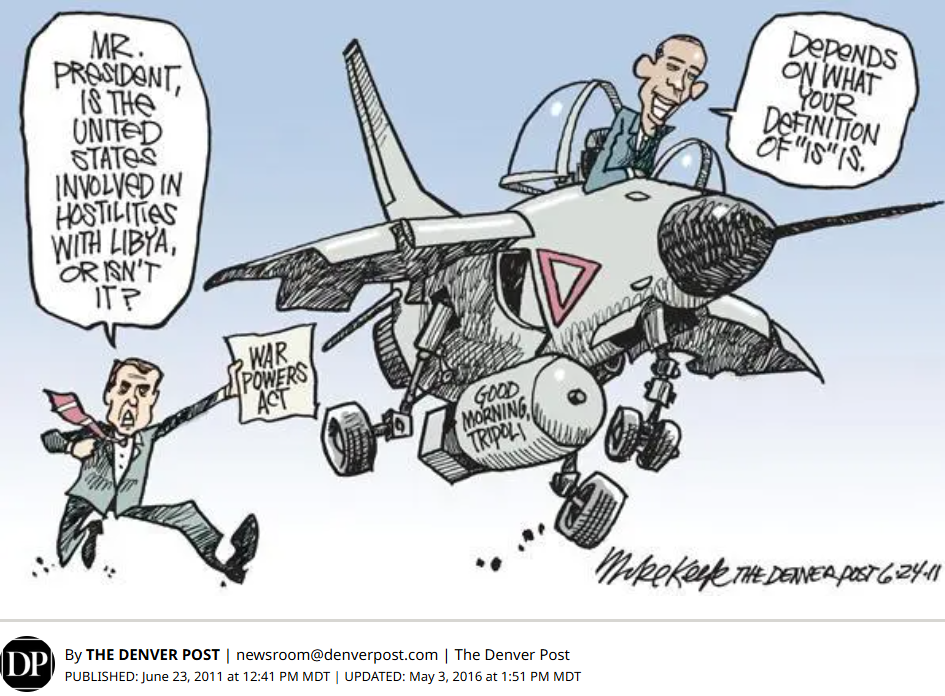
Going back decades, practically every US President has been challenged when initiating military force to address foreign policy objectives. When the Commander in Chief is a Democrat, Republicans howl that that President violated the Constitution because the degree of force used is tantamount to war. And it’s Congress—not the President—with the power to declare war. And when the President is a Republican, it’s the Democrats who cry out.
While politicians howl and Americans choose sides on the matter, Presidents are rarely found to be in violation of law regarding the initiation of hostilities. We have law on the subject—the War Powers Act (WPA)—but it doesn’t seem to have any teeth. This is curious because the hostilities are often extensive and indefinite in duration. It looks like war, as opposed to a limited strike of a few specific targets over a few days. It’s also curious because presidents are using military force to achieve objectives that aren’t clearly related to an imminent threat. Regime change is one such example. Changing a country’s leaders or government could be meritorious in the long run. But this objective may lack the urgency of an imminent threat. We are left scratching our heads because the President appears to be unilaterally going war without an imminent threat and without the approval of Congress.
With President Trump’s initiation of “major combat operations in Iran” (that he also characterized as “massive and ongoing”), the issue is before us once again. I have researched the matter and believe the President technically complied with the WPA, just as other presidents have done in the past.
Rather than solely focus on President Trump’s military intervention in Iran, I decided to look at the underlying law (the WPA) and the Constitution. I wanted to search for the principles or reasons these policies were adopted. I then could these principles to the current military intervention in Iran.
After doing so, I conclude we are giving our presidents too much authority to unilaterally initiate what is tantamount to war. We are giving them too much authority to act without proof of imminent threats. I conclude by offering a proposal on how Presidents and Congress should behave differently in the future.
Let’s begin with the four principles that I found.
1. The use of military force against a foreign nation—whether pursuant to a declaration of war by Congress or an action of the President—is inherently risky and unpredictable.
Going to war or initiating military strikes is inherently a risky and unpredictable undertaking. When we strike a foreign country, we don’t know how it will respond. It could strike back with all out aggression, escalating warfare way beyond what we struck it with. Or it could respond with proportionate force and call for talks and diplomacy. The country could hit US military bases in the region and focus on killing military personnel. Or it could hit civilian targets such as hotels, businesses, and even vital desalination plants. The attacked country could also resort to terrorist activity in the US mainland. It could attempt to assassinate our President and our political leaders. Or it could choose to disrupt US economic activity at home and abroad, such as snarling the world’s oil supply.
Another complication regarding military strikes is that we don’t know for certain about the country’s military capabilities. Yes, we have intelligence regarding its troops and stores of weapons; but these assessments could be inaccurate. We may believe we can destroy its stores of weapons, but they may have been moved and protected from attack.
In addition, we don’t know whether other countries will join the attacked nation as an ally. Some countries could view the US intervention as wrong or belligerent. Others could feel threatened, wondering whether they will be next. We don’t know whether other countries will lend their weapons and troops to the cause.
Finally, we don’t know what will happen once hostilities end. Will the government collapse? Who will control? Will there be fights and civil war to gain control? How will the country recover? Will there be further violence and resistance? If our attack takes out its leaders and seriously damages its infrastructure, new leaders and money will be required. What’s our role in making this happen?
2. Because the use of military force is so risky and unpredictable, and because the consequences can be so dire, the framers of our Constitution rejected the idea of putting this power into the hands of one person.
The framers’ intent is cogently stated in a historical document of the House of Representatives:
“The framers of the Constitution—reluctant to concentrate too much influence in the hands of too few—denied the office of the President the authority to go to war unilaterally. If America was going to survive as a republic, they reasoned, declarations of war required careful debate in open forums among the public’s representatives.”
United States House of Representatives: History, Art & Archives
What may be intended as a limited, targeted, and short-term use of military force can easily morph into not only a war, but a “forever war.” America has a sad history of these forever wars. They all started as limited and short-term military interventions. The costs of these wars—in dollars and American blood—were far beyond what was ever contemplated.
Accordingly, it’s best if there is a thorough and broad-based discussion about the necessity and merits of going to war. Except in the case of emergencies and imminent threats, one person shouldn’t have the unilateral authority to make this decision.
3. While power to declare war belongs with Congress, the President must have the authority to respond to imminent threats; accordingly, the President and Congress should cooperate and coordinate regarding the initiation of military force against foreign countries.
Federal law (the War Powers Resolution or WPR) requires a President to notify and consult with Congress before commencing military action against a foreign country. Before the President orders U.S. forces into hostilities abroad, the WPR directs that Congress first be consulted “in every possible instance.” The WPR also requires that the President report to Congress within 48 hours of deploying forces if Congress hasn’t declared war or otherwise authorized the action.
This policy makes sense in that a limited and surgical military intervention can easily morph into a broader conflict that amounts to “war.” In addition, the policy protects against secret and unilateral action by the President that amounts to war.
Indeed, when we look at the text of the War Powers Resolution, it’s clear that going to war should involve the “collective judgment” of Congress and the President:
“SEC. 2. (a) It is the purpose of this joint resolution to fulfill the intent of the framers of the Constitution of the United States and insure that the collective judgement of both the Congress and the President (emphasis added) will apply to the introduction of United States Armed Forces into hostilities, or into situations where imminent involvement in hostilities is clearly indicated by the circumstances, and to the continued use of such forces in hostilities or in such situations.”
The nature of the consultation between the President and Congress varies depending on the purpose and scope of the President’s military intervention. For instance, if a President is responding to a direct attack on the United States, its territory, or its armed forces, simple notice of the response should suffice. Similarly, if there is an imminent threat to the United States, and the President undertakes a targeted, limited, and surgical intervention, a notice and briefing regarding planned actions will suffice. And this notice can be given confidentially to designated representatives of Congress (known as the “Gang of Eight”).
On the other hand, if the President wants to initiate broad-scale military actions that are long-term or indefinite in duration, the President should “consult” with Congress rather than simply notify it. Extensive commitments of US forces for periods of months or indefinite duration amount to “full scale war” that requires action by Congress. This action could be a declaration of war or an Authorization for Use of Military Force (AUMF). We should expect the President and Congress to engage in serious discussions regarding the nature and scope of the military action. Ensuring that the President justifies the imminent threat, has a plan and timetable for the intervention, and has a plan for the aftermath of hostilities are steps that meet the “collective judgement” standard set forth in law. Again, this consultation can occur through the “Gang of Eight.”
4. On matters of regime change—where a President initiates military action to kill or remove leaders or otherwise change the government of a country—the President should either have prior authorization from Congress (legislation authorizing the use of military forces, or AUMF) or at least consult with Congress before taking such action.
Killing or forcibly removing leaders of a foreign country is risky and uncertain. We don’t know how the country’s government and economy are going to operate in the aftermath. Will the leaders who replace them do our bidding or move in a different direction? How will the country’s citizens respond to our actions to kill or remove their leaders and create a government favorable to the US? Will there be civil war and unrest? Will the US need to maintain some sort of military presence to enforce order and ensure the new government responds to US interests? How will damage to infrastructure, communities, and the economy be addressed?
The gravity of the potential consequences demand that a President not act unilaterally in using military force to secure regime change in a foreign country. Despite stated intentions, regime change can go off the rails and require extensive resources, including an ongoing military presence. Congress and the President need to work in close coordination to determine the necessity of regime change and the resources required for it to succeed on an ongoing basis. Again, the collective judgement standard seems to require this close coordination and consultation.
If we examine President Trump’s use of military force in Iran, he technically complied with law by informing and briefing Congress regarding his actions; but he did not consult with Congress to develop a “collective judgement” regarding the use of force and the wisdom of regime change.
President Trump, in his words, initiated “major combat operations in Iran” (that he also described as “massive and ongoing”). Neither he nor his Administration specified a limited scope or duration for the operations. He took out the country’s leader and many others for the purpose of regime change. He has called for “unconditional surrender” and insists on being involved with choosing the new leader.
In initiating these massive and ongoing military combat operations aimed at regime change, the President “notified” Congress and briefed it regarding the operations. But the President did not consult or otherwise seek “collective judgement” regarding the open-ended use of military force. Nor did he consult with Congress regarding the wisdom and necessity of regime change.
In fact, the President and Administration have been unclear about the necessity for using major military force. Initially, Trump said Iran was just weeks or days away from having a nuclear weapon that could be used against the US. The Pentagon said there was no evidence of this threat. Later it was argued that Israel was going to attack Iran, and that Iran was certain to attack the US in response. The US thus was compelled to join Israel in striking first. Trump later said the reason for acting was that Iran was at a weak point, and the time was ripe for regime change. Accordingly, he killed the 86 year-old leader and most of those in line to succeed him. To date, there is no evidence that he provided Congress with a detailed plan and timeline for securing regime change.
Final thoughts
There’s an old saying, “What’s good for the goose is good for the gander.” Republicans in Congress have sided with President Trump to support his attack on Iran and seek regime change. But at some point, a Democrat will be in the White House. Suppose this Democrat unilaterally initiates “massive and ongoing military combat operations” to bring about regime change in some foreign country. This time it will be a Democrat who takes our country into war without Congressional approval. Republicans will howl, but the lawyers will say the President technically complied with the law. And this will continue to happen whenever any President in the future undertakes major military action.
In the long run, it’s appropriate that Congress be the entity with the power to declare war. It’s also necessary and appropriate for the President to initiate military force in the face of imminent threats. When the President does so, especially with respect to matters such as regime change, he or she should strive to reach a “collective judgement” with Congress instead of acting unilaterally. This standard assures that Congress’ power to declare war has meaning, and won’t be ignored as it has many times in recent decades.
Leave a Reply