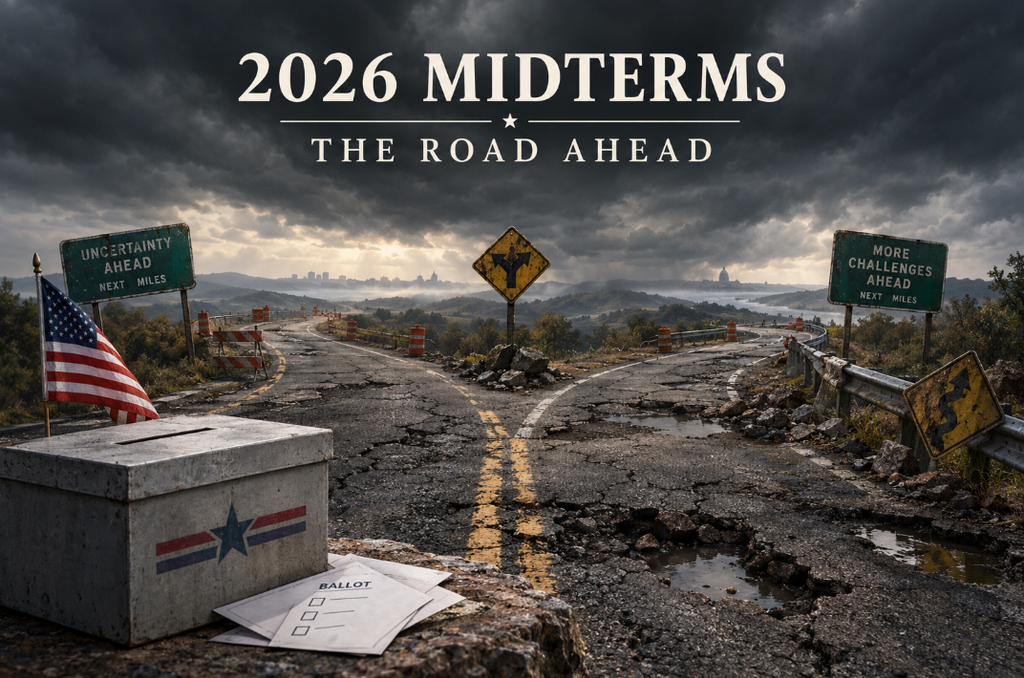
Most politically active Americans can’t wait for the upcoming midterms. Democrats and those opposed to Trump’s policies hope for a Congress that can finally hold the President accountable. Winning even one chamber will be a cause for celebration. On the other hand, Republicans and the MAGA base are fighting to retain control of both the House and Senate. They know losing will stall or end Trump’s agenda. And they know winning will give the President two more years of power. Both sides are anxious about the results, knowing that so much is at stake.
While I too agree that the midterms will be hugely consequential, I don’t agree that the party that prevails should be singing “Happy Days Are Here Again”. In fact, regardless of which side wins, the politics of division and blame will continue to be the order of the day. A win by Democrats is not likely to produce significant policy victories that advance party platform. And, even if Republicans retain control of both the House and Senate, they will face an uphill fight in advancing the President’s agenda. Overall, regardless of the outcome, the road ahead is going to be rough and uncertain for our country.
To lay out my thinking, I’ll start with the election itself and the likelihood that Trump will contest the results. If he does, what will this mean for the country? Next, I’ll break out the three possible scenarios for election outcomes (Democrats capture the House, Democrats capture both the House and Senate, and Republicans retain control of both chambers). I’ll tap my thirty years of teaching and writing on federal politics and the national government to predict what is likely to happen with each scenario.
If Democrats win control of the House, or both the House and Senate, it is extremely likely that President Trump will contest the election results.
At this late stage, most pollsters and political pundits are predicting that the Democrats are likely to capture at least one chamber of Congress, most likely the House. Thus, a threshold question is the likelihood that President Trump will contest the election results of Democratic victories in the House and Senate. What is likely to be the nature and extent of these challenges, and what they will mean for the country?
For well over a year now, President Trump has been setting the stage for contesting the upcoming midterms. He says the only way Democrats win is if they cheat. He claims they cheat with mail-in voting and voting by illegal immigrants. He and Republicans pushed legislation to prevent alleged abuses, warning it would be a disaster if their bill did not pass. Since the legislation failed, Trump directed the US Postal Service to adopt regulations restricting the delivery of mail-in ballots. He has also floated various unprecedented actions such as invoking the Insurrection Act, declaring Martial Law, seizing voting materials, and deploying the military and federal authorities to polling places.
Should the Democrats win one or both houses of Congress, there’s absolutely no reason to believe the President will shrug his shoulders and accept the results as legitimate. This is simply not in his DNA. I am not alone in this conclusion. Most political pundits believe Trump will contest the results.
I won’t speculate on all the draconian strategies or actions the President might pursue. I am fairly confident, however, that all the possible actions and strategies have been identified, studied, and prepared for. I’m also reasonably confident that the President will not ultimately prevail. But getting to this point is likely to be a trying time for our country.
Thus, if Democrats gain control of the House and/or Senate, we should expect a difficult and uncertain period for our country. At minimum, the President will succeed in sowing doubt regarding the integrity of elections. As with his loss in the 2020 election, Trump will never admit or concede that the 2026 midterms were legitimate. He will end his presidency insisting that Democrats cheated and Republicans won. And, from this point on, he will insist that his policies were always right. It was Democrats who ruined America.
Many Republicans and the MAGA faithful are likely to rally to Trump’s election denial. I can’t predict how it will play out, but it’s likely to be a disruptive and uncertain period for our country. Our democracy will be tested. Again, I am far from alone in this prediction.
What will happen if Democrats capture control of the House of Representatives, but the Republicans retain control of the Senate?
- Democrats will be able to exercise oversight and accountability regarding the President’s/Administration’s actions. They can launch investigations in the House. They can subpoena witnesses and hold hearings to put the spotlight on abuses by Trump and his Administration. Look for a focus on how the President’s policies are hurting Americans (affordability, health care costs, inflation) while the rich keep getting richer. We can expect hearings on the war with Iran. There will also be a focus on the financial dealings of the President, his family, and his rich friends. Finally, there will be a focus on illegal actions taken by the President.
- Also look for the House (Democrats) to put the spotlight on Trump’s mental and physical fitness for office. They will monitor his condition and be outspoken about any decline in the President’s performance.
- Trump and Republicans will be unable to pass legislation with only Republican votes. Democrats can block any legislation because they control the House. This effectively halts Trump’s domestic legislative agenda.
- On the other hand, Democrats will also be unable to pass legislation without Republican votes in the Senate and the President’s approval. Trump will continue to be able to veto legislation. Thus, capturing one chamber of Congress does not green light the Democratic agenda.
- President Trump will continue to be aggressive in interpreting, testing, and defying the law. We can expect more executive orders that challenge existing laws or dictate policy on matters reserved to Congress.
- Democrats will be able to demand compromises and concessions in return for votes necessary to pass legislation. They can impose extreme conditions and hold out for major concessions. Or they can work in a bipartisan manner to find middle ground compromise. Look for some of both. Because Trump has always vilified Democrats and favors unilateral action, look for him to continue to do this. If there are compromises, look for Trump to claim credit.
- Democrats could institute impeachment proceedings and could impeach Trump. However, it is extremely unlikely that two-thirds of the Senate would vote to convict the President. The likely scenario is that Democrats will prioritize working on major issues: affordability, helping those who are struggling, strengthening the economy, resolving the War with Iran, climate change, etc. If the President takes blatant and extreme illegal actions, look for Democrats to institute impeachment proceedings.
- Look for Trump and Republicans to put pressure on one or more of the conservative Supreme Court Justices to retire. Clarence Thomas is 78 and Samuel Alito is 76. With Republican control of the Senate, Trump could nominate and the Senate could confirm much younger conservative justices who could serve for decades.
- Overall, the likely outcome of this scenario is continued finger-pointing and blame for the final two years of Trump’s term. Each party will say the other has ruined America and hurt the American people. It isn’t likely that any major bipartisan reform legislation will be enacted. On balance, Democrats will be able to hold the President and Republicans in check; but don’t expect much progress on the Democratic agenda.
What will happen if Democrats capture control of both the House of Representatives and the Senate?
- Trump will proclaim this as a historic vindication of his leadership and policies. Midterms almost always serve as a referendum on the sitting president, and the party in power almost always suffers losses. Trump will claim a mandate to keep doing what he has been doing.
- Trump and Republicans will continue to be able to pass selected legislation via the Budget Reconciliation process (i.e., with only 51 votes in the Senate). Democrats will continue to be able to block most legislation because of the filibuster (60 votes are needed to overcome a filibuster in the Senate).
- President Trump will continue to be aggressive in interpreting, testing, and defying the law. We can expect more executive orders that challenge existing laws or dictate policy on matters reserved to Congress.
- President Trump will continue to become increasingly frail, erratic, unintelligible, and mentally unfit for office. There is growing video and photographic evidence showing decline: word salad utterances, falling asleep in meetings, fits of anger, and other irrational behaviors. It’s highly unlikely that these behaviors will suddenly reverse or improve as Trump gets older (he’ll turn 81 in June 2027). On the other hand, it’s highly unlikely that Republicans or his Cabinet would take steps to have him removed from office.
- With mounting evidence of mental and physical decline, and with the reality of being in the final two years of his second term, Trump will start to be treated as a “lame duck.” It is likely that more Republican members of Congress will contest or refuse to support some of his policies and actions. Republican leadership will be tested in keeping their majorities together on controversial legislation. While Trump and Republicans might be able to get through 2027, maintaining control will be more difficult in 2028. As the President runs out of sticks and carrots, more Republican members of Congress are likely to break away. Their focus will turn to their own political survival and the 2028 presidential election.
No matter which election scenario plays out, each side is likely to end up disappointed and frustrated because of unrealistic expectations and a preoccupation with hyper-partisan politics.
If Democrats capture one or both chambers of Congress, they’re still far from control of the government. Trump and Republicans can still block the Democrats’ policy agenda. The President can still issue executive orders. Gridlock is likely to be the order of the day; and those who voted for Democrats are likely to become impatient about the lack of progress. Yes, Democrats will be able to hold the President accountable and check some of his behaviors. But no, Democrat control will not produce transformational change. It is unrealistic to think so.
Republicans also stand to be disappointed and frustrated, no matter which scenario plays out. Even if they retain control of both chambers Congress, they’ll be led by an unpopular, aging, and increasingly erratic President in his “lame duck” years. Democrats will still be able to block Republicans on most legislation. Under the more likely scenarios of Democrat control of one or both chambers, Republicans face even more disappointment and frustration. Democrats will be able to block all Republican legislation and exact demands in return for votes on necessary legislation.
Americans in general are also likely to feel disappointed and frustrated. We’ll witness constant finger-pointing and blame that leads to gridlock on matters that require action. The hopeful expectations that drove us to the voting booth will be dashed. Our faith in democracy is going to be further shaken by Trump’s challenge of the election results.
Going forward, we need to be clear-eyed about the bumpy and uncertain road ahead; we need to make choices about how we practice politics and prepare for 2028 and beyond.
In all likelihood, America will be in for a rough ride when Trump attempts to overturn the election results. We citizens need to start preparing ourselves for this eventuality.
We also need to start thinking about the future. Do we want to elect officials who divide us by demonizing and blaming the other side? Do we want to believe our party is always right and that our goal should be to gain control of government and impose our agenda? Or do we want our elected officials to work with the other side to find common ground and reconcile differences?
The midterm elections and Trump’s final two years can serve as an inflection point. Are we ready to be done with leaders who villainize and reject the other side, using whatever means necessary to impose their will? Or do want more of the same for 2028 and beyond?
The next six months or so is going to leave Americans fired up. Some of us are going to be madder than ever and insist on gaining control, imposing our will, and putting the other party in its place. Others, I hope most of us, will decide we’re done with the politics of division. We never again want to go through another Trump, be that person a Republican or a Democrat. We want to heal America and get back to solving problems by finding common ground and resolving differences. Elections should be about finding people who can do this versus finding people who use division and blame to impose their will.
Brace yourself, my friends. We’re going to go through a rough patch. Most of us are going to feel disappointed and frustrated. Be patient and think about the long haul. The future is much brighter if we can put the politics of division and blame in the rear view mirror.
Leave a Reply