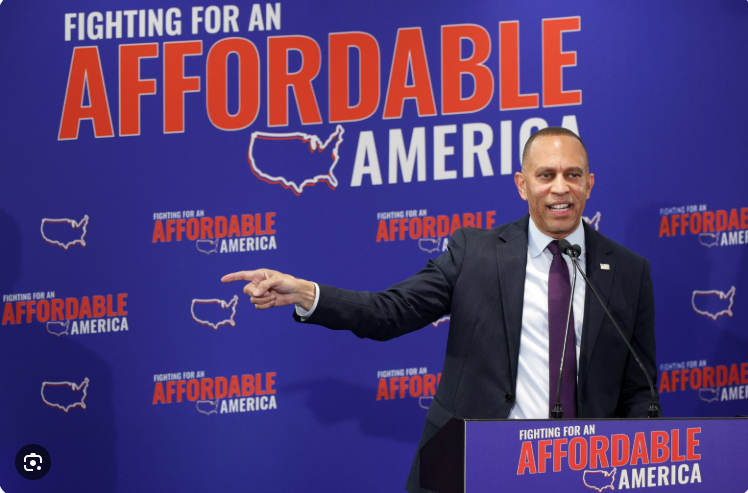
On November 3rd you voted in historic numbers to rebuke President Trump and the Republican-controlled Congress. The President failed to keep his promises to defeat inflation, lower prices, keep America out of war, and make the country great again. You liked the Democrats’ focus on affordability. Already they have hit the ground running with workgroups on housing, gas and utilities, groceries and goods, caregiving, and healthcare.
Many of you have been struggling financially for years. Two-thirds of you live paycheck to paycheck. 45% of you carry a balance on your credit cards, currently averaging $6,678. Sadly, 63% of you say it would be “impossible”, “very difficult”, or “somewhat difficult” to pay an unexpected $1,000 expense. Just under half of you say it is difficult to afford health care costs or afford health insurance; and many of you avoid filling prescriptions. Struggling to make ends meet has put you under a great deal of stress.
Democrats got the message. You’re beleaguered, and you urgently need relief. Unfortunately, for reasons beyond the control of Democrats, immediate relief may not be forthcoming. It’s important to take some time to understand the formidable roadblocks Democrats face in delivering for you. In particular, you need to be aware of the perilous fiscal conditions that Trump and Republicans have saddled the country with. Yes, Democrats have also contributed to fiscal problems. But recent actions by Trump and Republicans are what most threaten relief on affordability.
At the very time Democrats are trying to deliver relief on affordability, annual Budget deficits under Trump are routinely in the range of $2 trillion; and this means major spending for relief will require tax increases.
Put simply, in order to deliver on affordability, the federal government must commit to major spending that includes restoring previous cuts and creating new programs. Regrettably, Trump and Republicans have mishandled the country’s finances. Any new spending by Democrats will either require tax increases or even more irresponsible deficit spending.
Let me give you some statistics to document this sobering reality:
- For the fiscal year that just ended on September 30 (FY 2026), the Federal Budget was out of balance by $1.992 trillion. We spent almost $2 trillion more than we collected in revenue.
- For FY 2027, the deficit is projected to be $1.89 trillion (Congressional Budget Office), with $7.77 trillion in spending and $5.89 trillion in revenue. Any new spending by Democrats to address the affordability agenda will add to this deficit.
- As of November 19, the total National Debt is $40.67 trillion. Every year the federal government must pay interest on this debt, just as you pay interest on your credit card debt. For FY 2026, the government paid $1.4 trillion in interest costs, which was about 14% of all federal spending for that year.
You get the picture. Before Democrats even propose a penny of additional spending, this year’s Federal Budget is already projected to be $1.9 trillion in the red.
The Committee for a Responsible Federal Budget just released a study estimating the Democrats’ “First 100 Days” agenda could cost more than $4 trillion over a 10-year period (2027-2037). This spending only involves restoring cuts made by the One Big Beautiful Bill. Trillions more would be required if Democrats propose to phase in Medicare for All.
Because the country is so deep in debt, Democrats will have no choice but to propose significant tax increases. For example, it’s probable that they will propose repealing both the tax cuts for high earners (over $400,000) and the corporate tax cuts.
President Trump is almost certain to veto any legislation that includes major tax increases; and he will blame Democrats for irresponsible spending and raising taxes on Americans.
Let’s say Democrats propose major tax increases in order to fund their affordability initiatives. Do you think President Trump will sign this legislation? You’re right, the answer is no. And overriding his veto will require a two-thirds vote, which Democrats don’t have. The President and Republicans will blame Democrats for irresponsible spending and major tax increases. Responsibility for the obscene National Debt and the $2 trillion Budget deficits in recent years will be pinned on Democrats. Thus, there’s a real likelihood that cuts to Medicaid, healthcare subsidies, and SNAP benefits will not be restored—at least in the short run.
With time, however, you will enjoy some relief on affordability; inflation is likely to come down (especially gas prices), and previous spending cuts are likely to be restored.
To secure passage of their proposals, Democrats will probably have to resort to shutting down federal government and blocking all spending. These extreme actions will likely be necessary to force Trump and Republicans to agree to restore the cuts made by the One Big Beautiful Bill. Democrats will then be blamed for shutting down the government, irresponsible spending, driving up the National Debt, and raising taxes on Americans.
Meanwhile, in December, and probably again in January, the Federal Reserve is poised to raise interest rates. Congress is powerless to control this decision. The Fed’s action will increase the interest rates you pay on your credit cards and loans. Over time, however, these interest rate hikes will reduce inflation. And, over time, the Fed will eventually lower interest rates.
As to the war with Iran, Democrats can exert some control over spending and continuing the war. But the President retains authority to act in the case of “imminent threats.” We don’t know how soon or whether the Strait of Hormuz will reopen. In short, Democrats won’t likely be able to deliver an immediate end to the war and a sharp drop in gas prices. Over time, however, gas prices should return to recent historic levels (e.g., $3.00 to $3.50 per gallon).
Because relief on affordability is likely to be unpredictable, uneven, and late in arriving, it’s important to remain keenly aware of who is responsible for these conditions; ultimately you will need to decide whether you want to entrust a Democratic President and Congress with full power to address affordability.
I tell you all this because it’s essential that you take all these roadblocks into consideration when assessing the efforts of Democrats to address affordability. If Democrats fight with one another and fumble the ball, you should definitely hold them accountable. But you shouldn’t blame them when it’s impossible to overcome a Trump veto. Instead, when Trump and Republicans attempt to derail the efforts of Democrats, it’s appropriate to blame them, not Democrats.
You’ve been treading water for years and urgently need a helping hand. Unfortunately, chances are Trump and Republicans will be working overtime to block any major spending and policy initiatives to address affordability. Only modest relief is likely to be delivered in 2027, and prospects for 2028 aren’t much better.
My message to Americans is to stay the course and keep sight of an all-important question: Do you want to entrust Democrats with the full power to deliver their affordability agenda by electing a Democrat President in 2028; or do you believe a Republican President working with a Democratic Congress will be better able to deliver? If all the Republicans do for the next two years is block and blame Democrats, I suggest you have your answer.
Leave a Reply