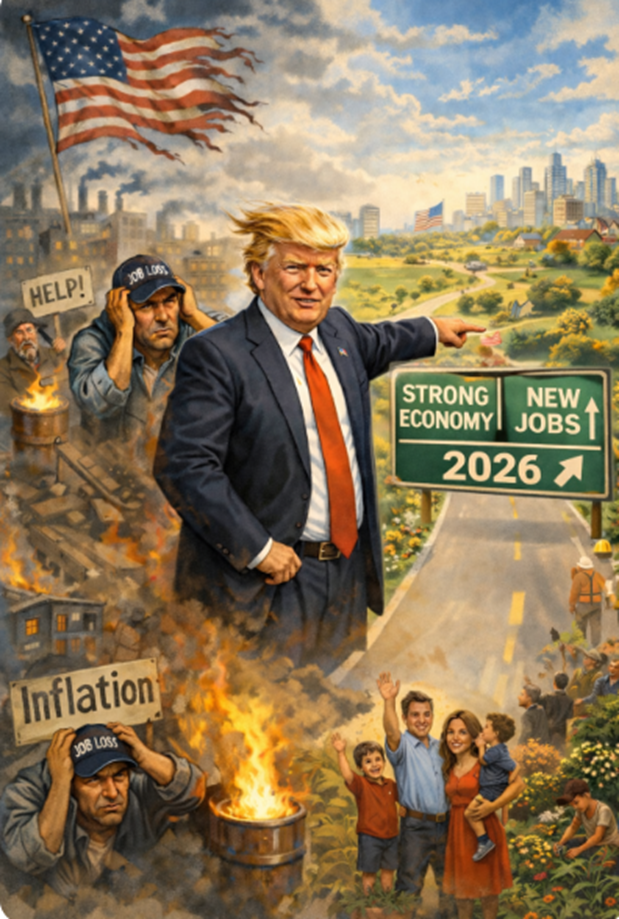
Looking back on 2025, President Trump had a mix of successes and setbacks that ended up taking a toll on his job approval and leaving Americans divided over his leadership. It was a bumpy ride for both the President and the country.
Regardless of partisan leanings, most of us are anxious about what’s in store for 2026. It’s a crucial year because of the November 3rd midterm elections. The political behavior of those running for re-election will be increasingly influenced as we approach this date. Also, it’s obvious that the fate of Trump’s remaining time in office will be largely dependent on whether Republicans retain control of Congress. Finally, in the big picture, many of us continue to worry about the anger, division and gridlock in American politics. Will this dysfunction get worse in 2026? Or is there a chance we might come together and solve problems for the greater good?
Predicting the future is notoriously difficult, but I decided to give it a go. I’ll start by assessing Trump’s first year, primarily using the metric of his changing job approval numbers. I’ll next assess recent events affecting his ability to control Congress—and especially the Republican majority. Next, I’ll move to 2026, where many Republican members will face mounting conflict between remaining loyal to the President and fighting for political survival. Will the President prevail? Or, given what we’ve learned from 2025, is it more likely he will remain unpopular, no longer be able to control Congress, and become a lame duck president? And, if this happens, will our country remain badly divided? Or, might we finally break free of hyper-partisan politics?
2025 was a bumpy ride for both Trump and the country, as the President suffered a hit on his approval ratings.
It’s no secret that President Trump became widely unpopular since starting his second term. Gallup showed a 47% job approval rating in January 2025, and a 36% approval rating in late November. This is the worst decline for any President in the first year of a term. If you dig deeper, The Economist/YouGov polls track how Trump’s job approval declined with respect to every major demographic, including Republicans and conservatives. Even more revealing, Trump’s approval percentages have clearly shifted away from “strongly approve” and towards “somewhat approve” or “no opinion/unsure.”
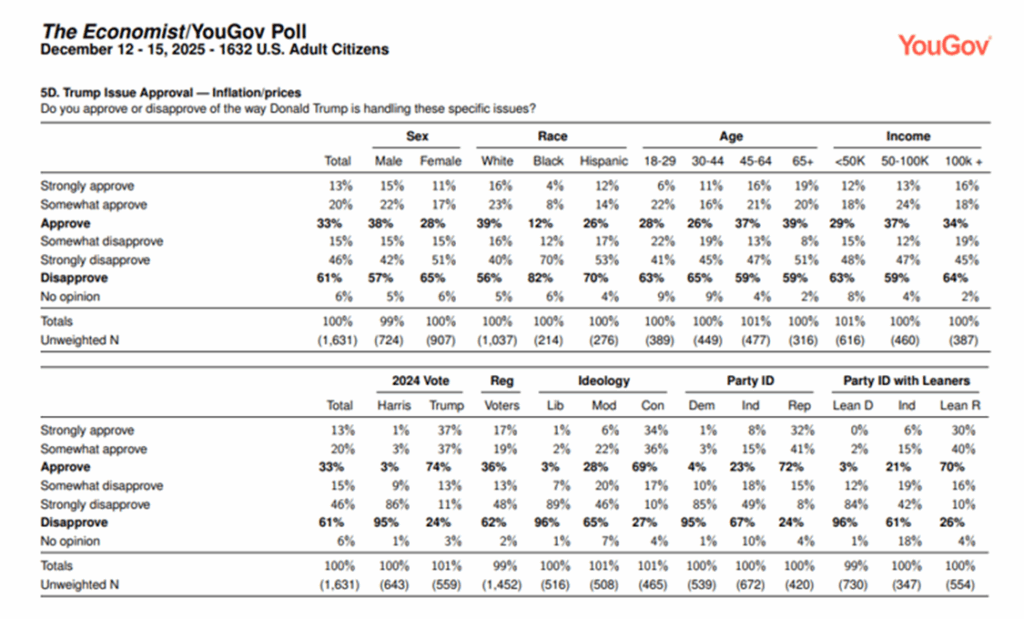
Trump’s low approval numbers are driven by several reasons. First, and perhaps foremost, Americans are unhappy with his handling of the economy, especially inflation and prices. In January he had a positive rating. Forty-five percent approved (28% “strongly”), and 39% disapproved of his handling of inflation and prices. Among Republicans, 84% approved (59% strongly), and only 4% disapproved (The Economist/YouGov). By December, the President was seriously underwater. Below I display the The Economist/YouGov crosstabs for December 12-15. As you can see, only 33% of Americans now approve of his handling of inflation and prices (and only 13% “strongly”), while 61% of Americans disapprove. Among Republicans, approval slipped to 72%, with only 32% strongly approving, and 41% somewhat approving. And disapproval among Republicans jumped from 4% in January to 24% in December.
If we dig deeper into weekly Economist/YouGov weekly surveys and other polling results, we can discern other reasons for Trump’s declining poll numbers. Increasing percentages of Americans have concerns regarding his temperament, age, mental fitness for office, honesty, and basic character. Fits of anger, word salad utterances, falling asleep in meetings, sexist and racist insults, and late-night unhinged Truth Social rants are all taking a toll. His involvement with Jeffrey Epstein and possible participation in despicable conduct is yet another factor.
Finally, Americans also appear to be tiring of Trump’s brash leadership style. He constantly takes action, seizes power and bullies his point of view. His playbook is essentially the politics of blame and division on steroids. Let me recount his key strategies:
- Every problem is always someone else’s fault; and those causing the problem are evil, corrupt and un-American. They are to be feared and hated.
- Trump alone can fix the problem, and he is never wrong.
- Trump is extremely aggressive in taking executive action, even if it means usurping the role of Congress or challenging the judiciary. He tests and stretches the law to the maximum.
- Any time Trump is accused of wrongdoing or crime, it’s a “witch hunt” or a “weaponization” of government against him.
- Trump takes credit for positive developments, whether he caused them or not.
- Trump makes up numbers to prove his points, and more often simply repeats assertions without providing any evidence. The public will eventually believe what he is saying if he keeps repeating his message.
- When results don’t turn out as promised, it’s always someone else’s fault.
- Every attempt to challenge his assertions is “fake news” or a “hoax.” And, whenever possible, he suppresses contradictory or conflicting information
Within recent weeks Trump is applying this playbook in an effort to convince Americans that the economy is doing great, that inflation has been tamed, and that prices are coming down rapidly. He blames Biden for creating the problem and insists that he is making great progress. Numerous polls indicate that Americans are not buying his pitch. In fact, they are angered (see Politico, “Trump is selling a strong economy. Voters aren’t buying it.”; and MSN, “Americans Aren’t Buying Trump’s Economic Agenda. The Numbers Prove It.“).
While Trump enjoyed near universal support from congressional and state Republicans for most of 2025, some began to break ranks with him during the latter months of the year.
Congressional and state Republicans gave near universal deference to Trump for most of 2025. Congressional Republicans stayed together to support the President’s broad-based tariffs, despite usurping a responsibility assigned to Congress. They also stayed together to deliver on Trump’s landmark “One Big Beautiful Bill.” They tolerated spending reductions adopted by DOGE (Department of Government Efficiency) that usurped Congress’ spending authority. They didn’t resist Trump’s efforts to freeze spending on appropriations made by Congress. For most of 2025, House Speaker Mike Johnson and Senate Leader John Thune universally praised the President for his leadership and delivered on his priorities.
By August, however, some Republicans began to break ranks with Trump. Almost all supported the full release of the Epstein files. Some expressed concerns about the legality of the boat strikes off the coast of Venezuela. Some questioned Trump’s foreign policy with respect to Russia, Israel and Venezuela, including the terms of a peace agreement between Russia and Ukraine. Some questioned Trump’s actions to implement widespread tariffs. Some questioned Trump’s initiative to provide $2,000 tariff dividend checks. Many questioned and opposed Trump’s effort to end the filibuster in the Senate. And, importantly, many questioned Trump and Republican leadership being unwilling to extend Affordable Care Act subsidies that expire at the end of December. None of these questions have gone away, and members continue to be willing to break ranks with the President.
For most of the year, states controlled by Republicans cooperated with Trump and did his bidding on matters such as immigration enforcement, tariffs, and redistricting (gerrymandering) of congressional seats. By November, however, the Republican-controlled Indiana Legislature refused to go along with Trump’s demand for a mid-decade gerrymander.
While increasing numbers of congressional Republicans were willing to break ranks with Trump, others simply decided to quit Congress. According to Axios, as of December 1, 26 Republican members of the House of Representatives have announced their departures. Vox characterizes the Republican exodus as “quitting in droves.” The reasons are many and varied, but at least some are related to toxic partisan politics, pressure to remain loyal to Trump, and inability to survive politically. Members face “no win” situations in that voting with Trump and leadership goes against their constituents and could result in electoral defeat. But voting against Trump will cause members to the “primaried,” with Trump and leadership supporting a different Republican candidate. In addition, many fear retaliation in various forms.
Early in 2026, there are a series of events, deadlines, decisions, and conditions that will significantly test Trump’s success, public opinion regarding his performance, and the willingness of congressional Republicans to do his bidding.
2026 will start off with a bang. Early in January, the US Supreme Court is expected to rule on the legality of Trump’s tariffs. Should it strike them down, as many legal experts predict, this will be a major blow for Trump. Should his authority be upheld, the President will be compelled to defend the inflationary effect of tariffs. Many economists conclude the full inflationary effect of tariffs is yet to be felt. If inflation increases in the new year, this will be a problem for the President.
With the Affordable Care Act (ACA) subsidies expiring on December 31, 2025, millions of Americans are facing sky-high increases in their health care premiums. If Trump and the Republican-controlled Congress don’t work with Democrats for some sort of compromise, they will likely be blamed. Dealing with this matter is a political survival issue for many congressional Republicans. Trump faces a major challenge in keeping Republicans on the same page regarding this problem.
Beyond the ACA subsidies, major federal funding decisions must be adopted by January 30, 2026. Congress agreed to end the recent 43-day government shutdown by extending funding at current levels until the new deadline date of January 30th. If funding agreements aren’t reached, we face another government shutdown. Each side will blame the other, but with Republicans in control of the White House and Congress, the President is likely to be blamed by more Americans. It’s also likely that a number of Republicans will break ranks with the President and Republican leadership on some key funding decisions.
Another major challenge coming in early January is the release of the Jeffrey Epstein files as required by newly-enacted federal law. While the Department of Justice (DOJ) did release a portion of the files by the deadline date of December 19th, the release was not complete. Also, many files were heavily redacted without explanation. The vast majority of Republicans support the full release of records and voted for the bill to require the release. It is thus highly likely that the release of the files will be a controversial topic early in the year. If the DOJ and Trump are seen as withholding or manipulating disclosure, this will be a problem for the President. Also, we could see some Republicans going after the DOJ on this matter.
Early in 2026, we will also gain more clarity regarding the magnitude of economic headwinds. Job growth stalled during the last several months of 2025, and the unemployment rate moved to a four-year high. While Trump, Republicans, and some economists insist these numbers are going to rebound, many economists think the situation will get worse. The same is true of inflation, which has been running in the range of 2.7% to 3%, and remains above the preferred rate of 2%. If job growth continues to stall, unemployment continues to creep up, and inflation isn’t tamed, this will be a problem for Trump. Other headwinds that could likely be a challenge include the continuing decline in Consumer Sentiment, and the large increase in credit card debt and delinquencies.
With each passing month in 2026, increasing numbers of congressional Republicans will become concerned about their political survival in the November midterm elections.
Being an election year, congressional Republicans seeking re-election are going to be closely monitoring their polling data. They are going to be increasingly reluctant to remain loyal to the President/leadership if doing so jeopardizes their chances of re-election. As polling data indicates their leads evaporating, many will become unwilling to support proposals that are either opposed by their constituents or that do harm to them. Members know that if they can survive re-election in 2026, Trump will be irrelevant in November 2028 because his term is ending. Inevitably, members are likely to choose political survival. As 2026 unfolds, we can thus expect more and more congressional Republicans to break ranks with Trump.
In 2026, concerns about the President’s mental fitness, temperament, age, aberrant behavior, effectiveness, and persuasivenss are likely to increase.
Physicians, mental health professionals, Democrats, and even many Republicans are sounding the alarm about Trump. They have called attention to Trump’s declining mental and physical abilities, his waning energy, his unpresidential outbursts and insults, and his incoherent and rambling presentations. If you compare video of Trump in his first term to recent video, he is not the same person. In 2026 and beyond, he is not going to magically rebound to become eloquent, sharp, presidential, energetic, and effective. Many, myself included, are also concerned about a sudden mental or physical breakdown that incapacitates the President.
Hopefully, the President will escape serious mental or physical incapacity and serve the remainder of his term. But it’s undeniable that we will continue to witness word salad and rambling presentations, outbursts and insults, unpresidential behavior, falling asleep in meetings, mental lapses, and other concerning behaviors. The question becomes how effective and persuasive the President is going to be in carrying out his duties and implementing his agenda. Will he be up to the task in a year where he faces some of the biggest challenges of his presidency?
Conclusion: 2026 is almost certain to be a very bad year for Trump and an unpredictable year for the country.
Summarizing the foregoing analysis, here’s what’s in store for President Trump in 2026:
- President Trump will continue to suffer low approval ratings, including an erosion in support from Republicans.
- Increasing numbers of congressional Republicans will break ranks with the President during the year, meaning he and the Republican leadership will no longer be able to control Congress via en bloc voting.
- Economic headwinds (including continued high inflation and prices, slow job growth, and an increasing unemployment rate) will make it virtually impossible for the President to convince Americans that the economy is great and he is doing a good job.
- The US Supreme Court will restrict Trump’s authority to adopt comprehensive tariffs; but he will not admit defeat and will instead pursue other legal avenues for tariff authority.
- Democrats will capture control of the House of Representatives in the November midterm elections, giving them the power to block Republican proposals, hold hearings, and exercise oversight over Trump (including his aggressive executive actions).
- President Trump will continue to show signs of mental and physical decline, and these lapses will deter from his ability to win the day with his leadership style.
- Throughout the entirety of 2026, Trump will continue to apply all the strategies of his brash leadership style. He will continue to insist he is doing a great job, that Democrats are evil and to blame, and that he is right on everything. Increasingly, the President will be seen as “flailing away” with these strategies.
- By January of 2027, when the next Congress is seated, Trump will be seen as a lame duck president. He, however, will continue to flail away until the end of his term.
And what about what’s in store for the country? My analysis says that 2026 will be an unpredictable year for our country. Here’s why:
- It’s difficult to predict how severe the economic headwinds will be in 2026. Will there be widespread unemployment, job loss, higher inflation rates, and greater economic hardship for Americans? Or will inflation rates remain just slightly high, with modest job growth and unemployment not worsening? It’s safe to conclude that economic headwinds won’t magically disappear; rather, we just don’t know whether they will be modest or severe.
- It’s difficult to predict the extent to which congressional Republicans will break ranks with Trump and Republican leadership. It’s possible that Trump and Republican leadership can keep those breaking ranks to a minimum. This means there will be just a few instances where bipartisan deals are struck against Trump’s wishes. But it’s more likely that large numbers of Republicans will defect, sensing that Trump is unpopular and weakened, and that there is safety in numbers. If this is the case, it could open up bipartisan cooperation to legislate on common interests.
- In 2026, Americans will almost certainly continue to feel divided, angry, and exhausted by hyper-partisan politics. However, polling consistently reveals that we are tired of feeling this way and want our policymakers to find middle ground, behave civilly towards one another, and solve problems for the good of the country. Unfortunately, Trump is not going to change his strategies of division, anger, and blame. And Democrats aren’t going to change as long as Trump is in power.
- Nonetheless, I am hopeful Americans may be poised to rebel against hyper-partisan politics in 2026. For decades we have watched Democrat and Republican lawmakers blame and demonize one another using the dysfunctional politics of division. The experience with Trump and his ultra-divisive leadership style may be lead us to reach a tipping point. A substantial majority of Americans may be feeling “never again” when it comes to electing the next President and congressional representatives. Thus, in 2026 we may finally be ready to break from the politics of blame, division, lies, hate, and fear. I’m certainly ready to do this. Are you?
Leave a Reply