
of the “worst of the worst” in immigration enforcement.
President Trump and key members of his Administration continue to insist they are going after the “worst of the worst” when it comes immigration enforcement. After all, this narrative serves as the foundation or linchpin for widescale ICE arrests, detentions, and deportations.
On the other hand, a wide range of media outlets and other organizations are pushing back. They are offering analysis and data to prove most of those arrested, detained, and deported do not have prior criminal convictions or criminal records. Polling consistently shows that Americans are widely supportive of arresting and deporting violent criminals. But we have concerns–enough to drive us to the streets in protest–when we see tens of thousands of migrants without criminal convictions being rounded up and brutally treated by masked ICE agents.
I decided to do a deep dive on these conflicting narratives to see if I could get at the truth. First, I went back in time to identify the specific data on the criminality of undocumented immigrants that has been collected and reported for decades. I then examined whether the Trump Administration continues to report such data. And, if not, what methodology and data is it using to prove it is going after the worst of the worst? Next, I examined efforts by media outlets and other organizations to validate the Administration’s assertions. What are they finding regarding the criminality of those arrested, detained, and deported? I then draw conclusions. Has the Administration been deceitful? Do Americans no longer trust the Administration because of its actions? And what can Americans do to hold the Administration accountable?
I present the results of my deep dive in nine major findings.
1. Prior to Trump’s second term, and going back at least two decades, three federal agencies—Immigration and Customs Enforcement (ICE), the Department of Homeland Security (DHS), and Customs and Border Protection (CBP)—regularly published and updated statistics regarding the criminality of those arrested, detained, and deported.
I researched and taught on the subject of undocumented immigration for over twenty years. Accordingly, I am very familiar with the specific criminal background data regarding migrants who are apprehended, detained, and deported. Here’s a summary of what was routinely available before Trump’s second term:
- The Immigration and Customs Enforcement (ICE) website (see ICE Enforcement and Removal Operations Statistics) published and regularly updated data on the arrest, detention, and removal of undocumented immigrants. ICE’s jurisdiction focuses on those who are already in the country illegally, as opposed to those who are apprehended while trying to enter the country illegally, who generally fall under the jurisdiction of CPB. With respect to ICE arrests, data were broken out so you could see the number with criminal convictions, the number with pending criminal charges, and the number with no convictions or pending charges. With respect to those held in detention, data were broken out so you could see the number with criminal convictions; the number with pending criminal charges; and the number with no criminal convictions or pending charges, but who had violated immigration laws. With respect to removals (deportation), data were broken out so you could see the number with criminal convictions; the number with pending criminal charges; and those without convictions or criminal charges but who had only violated immigration laws.
- The Department of Homeland Security (DHS) annually published a “Yearbook of Immigration Statistics” that had an entire section devoted to enforcement actions. Included was a table entitled, “Noncitizen Removal by Criminal Status and Region and Country of Nationality.” The data were broken out by “criminal” and “non-criminal.” Importantly, only those with a prior criminal conviction were counted as “criminal.”
- The US Customs and Border Protection (CPB) website (see CPB Enforcement Statistics) published and regularly updated data on the arrest of individuals with criminal convictions or those wanted by law enforcement. CPB jurisdiction focuses on those apprehended at the border or attempting to enter the country illegally. CPB data allowed you to drill down and get data on the type of conviction (e.g., battery, domestic violence, DUI, Homicide, illegal weapons, sex offenses, and illegal entry or re-entry).
2. Since the beginning of Trump’s second term, his Administration has published very little official data and statistics regarding the criminal backgrounds of those who are arrested, detained, and deported/removed.
I went to the website of Immigration and Customs Enforcement (ICE) to look for official data and statistical updates on those arrested, detained and deported since Trump took office in January 2025. Pictured below is what I saw:
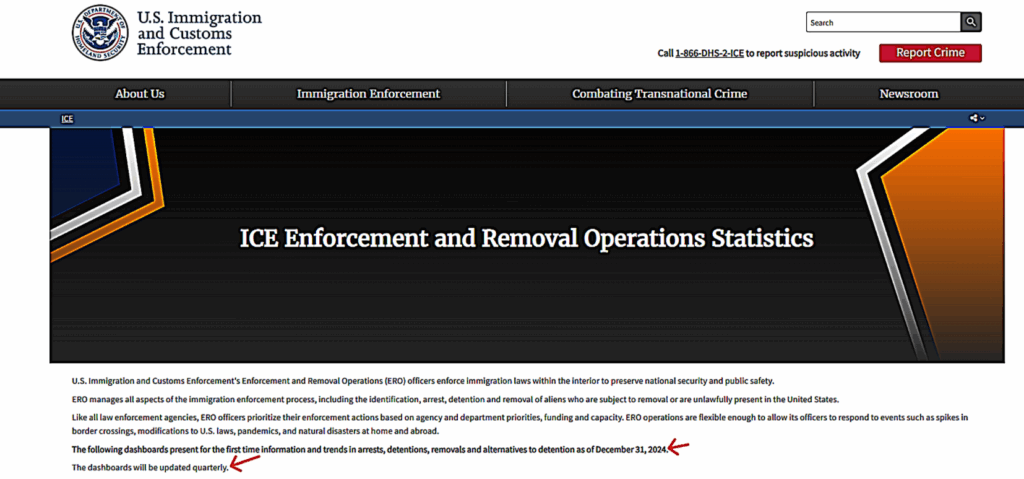
If you can read the fine print, the data and statistics are “as of December 31, 2024” (which was at the end of the Biden Administration). It also says the “dashboards will be updated quarterly.” For the entirety of 2025 and up to January 2026, there have been no updates.
I then went to the website of the Department of Homeland Security (DHS) and looked for the latest version of the Yearbook of Immigration Statistics. Here is what I saw:

As you can see, there is no information available regarding the removal (deportation) of immigrants by “criminal” or “non-criminal” status. We are promised, “Download coming soon” with respect to the 2024 and 2023 Yearbooks. And, there is no information regarding 2025, which ran from October 1, 2024 through September 30, 2025.
As to CPB, however, there is current data, up to December 2025. Thus, there’s good information as to whether those apprehended at the border have criminal convictions or charges against them. Interestingly, the numbers of those with criminal convictions are small—fewer than 13,000 in FY 2025, and fewer than 2,400 so far in FY 2026. The low numbers are probably due to the fact that the border is effectively closed, and very few people are attempting to enter the country illegally.
In summary, before Trump came into office in January, it was possible to go to these three websites and get specific and current data enabling us to assess whether those arrested, detained, and deported were the “worst of the worst.” We had current numbers for those with criminal convictions, those with pending charges, and those with no criminal records. We didn’t always have information on the type of criminal convictions, but at least we knew the numbers of those with convictions.
3. Instead of publishing and updating the detailed criminality data as in years past, the White House and DHS are issuing press releases and fact sheets that support the Administration’s “worst of the worst” narrative.
In lieu of publishing and regularly updating official data, I found various press releases issued by the DHS, the White House, and other Administration sources. Some of these highlight the arrest and deportation of specific individuals who committed terrible crimes. Thus, the Administration is attempting to prove its point by using “anecdotal” evidence, which is known for being weak and unreliable.
Also, some press releases and fact sheets use “internal DHS data” to argue that significant percentages of those arrested, detained, and deported are convicted criminals or have criminal charges against them. For instance, one DHS release stated, “70% of illegal aliens arrested by ICE have criminal records.”
The trouble with “internal DHS data” is that this is evidence specifically selected and tailored by DHS to prove a point. Rather than making all of the data and evidence available, the agency picks specific data points, characterizing and repackaging them as necessary to support a narrative. Thus, in saying, “70% of illegal aliens arrested by ICE have criminal records,” the press release omits data regarding the types of crimes these individuals are convicted of. Nor does the press release specify the percentages of those convicted of crimes versus the percentages of those charged with a crime. Thus, it’s impossible to assess whether DHS’s 70% figure is comprised mostly of those convicted of violent crimes, or mostly of individuals convicted of minor criminal offenses. It’s also impossible to determine the numbers and percentages of those charged with minor criminal offenses, or charged with immigration offenses.
4. Despite the Administration’s withholding of historically-provided data, and despite its failure to substantiate press releases and fact sheets with specific data, media outlets and other organizations are providing credible evidence to rebut the Administration’s claims.
A recent CBS News article cited “internal DHS data” in reporting the Administration’s assertions that some 73,000 people were being held in detention, and that 47% of these detainees had criminal charges or convictions. Because the author of the article did not have access to all the data regarding criminality, she could not validate these assertions. Instead, here is what she reported:
“The internal DHS data indicates roughly 47% — or about 34,000 — of ICE’s detainees had criminal charges or convictions in the U.S. The numbers do not include details on the severity of the criminal records, which can range from felonies and other serious crimes, to misdemeanors and immigration-related offenses.”
Camilo Montoya-Galvez, CBS News, January 16, 2026
The Transactional Records Access Clearinghouse (TRAC) is a data gathering, data research, and data distribution organization regarding several federal functions, including immigration. TRAC Immigration is a website that publishes and regularly updates data on illegal immigration, including the criminality of those arrested, detained, and removed (deported). Below I quote the summaries I found on this site:
“Immigration and Customs Enforcement held 65,735 in ICE detention according to data current as of November 30, 2025. 48,377 out of 65,735—or 73.6% held in ICE detention have no criminal conviction according to data current as of November 30, 2025. Many of those convicted committed only minor offenses, including traffic violations.”
Trac Immigration Website, visited January 20, 2026
While TRAC attempts to collect specific data regarding criminal convictions from the federal government (Freedom of Information Act requests), ICE and DHS sometimes withhold detailed data. Litigation has been filed to secure this data. Currently, however, TRAC is limited in providing specific data regarding criminal convictions. Thus we still don’t know how many are convicted for serious crimes (e.g., murder, rape, mayhem, drug trafficking), versus lesser offenses (e.g., traffic violations).
The same problem is true of “criminal charges.” We don’t know how many of those arrested and detained by ICE have serious versus minor criminal charges against them. We don’t know whether ICE is counting those with minor criminal charges (e.g., traffic violations, petty theft, or immigration violations) to get to its statistic that 47% of detainees have criminal convictions or charges against them.
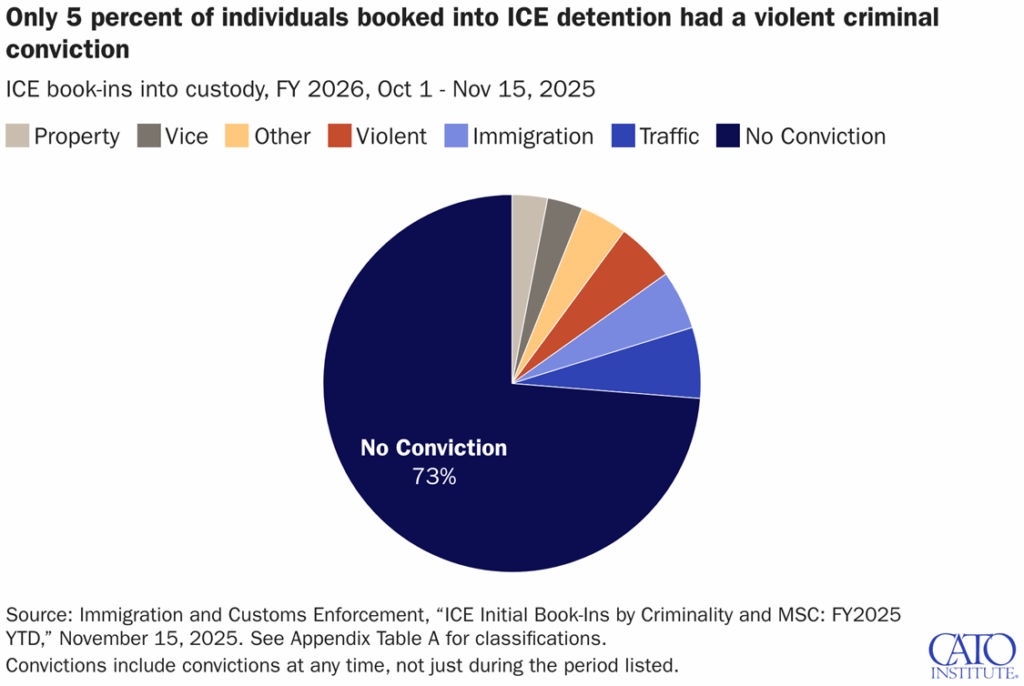
Nonetheless, at least three organizations, the CATO Institute, the American Immigration Council, and UC Berkeley have recently published research showing that the vast majority of those arrested and detained by ICE don’t have violent criminal convictions; and most don’t have any criminal record.
Here is a key graphic from the CATO Institute’s report:
The American Immigration Council, in an extensive report published in January 2026, provides two additional insights. First, from January through the end of November 2025, the percentage of people in ICE detention without a criminal record rose from 6% (January) to 41% (November). Second, during 2025, the numbers shot up for all three categories: those with prior convictions, those with criminal charges, and those with no convictions. The graphic below depicts this surge for all three categories. And, importantly, those without convictions show the greatest increase.
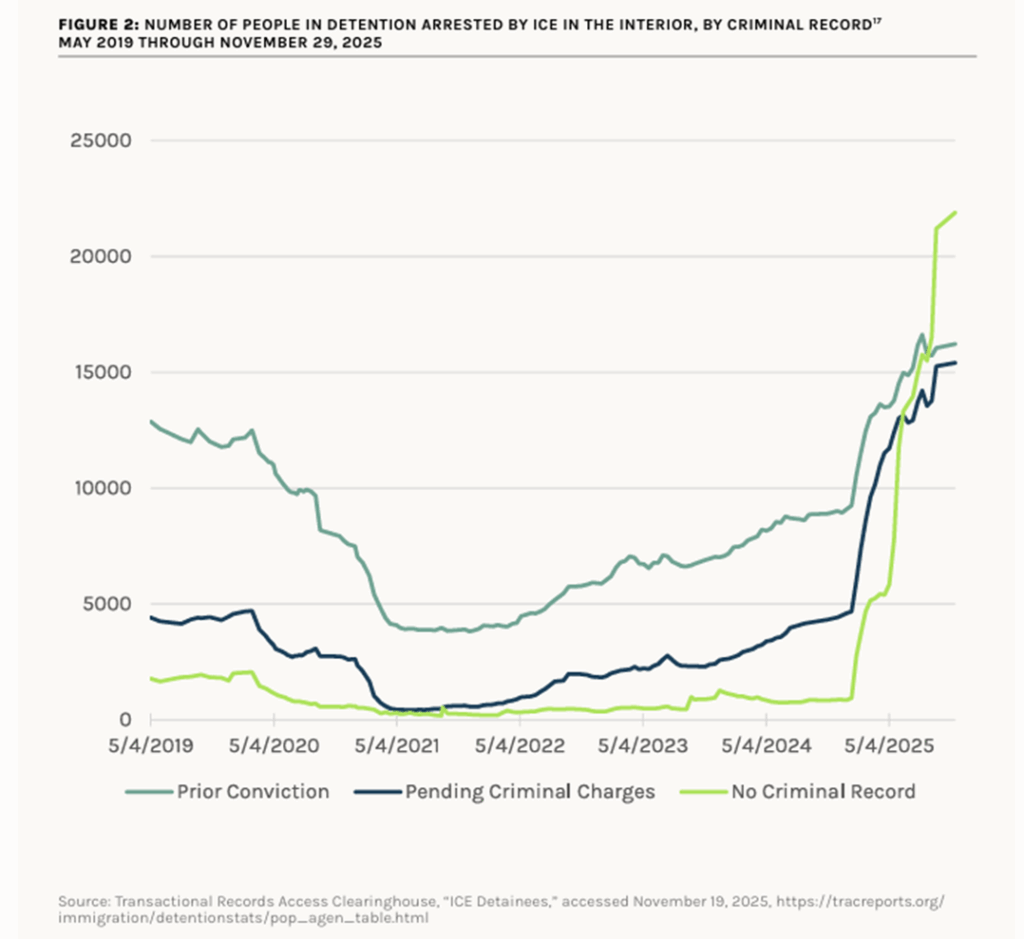
The report goes on to document that during 2025, “average daily arrests” of those without criminal convictions shot up in June, and then again in the September through October timeframe. Until June, there were typically around 100 arrests per day as to those without criminal convictions. The number shot up to over 550 per day in June, and hovered around 500 per day in September and October. Clearly, the huge new numbers of those without criminal convictions contradicts the assertion that the Administration is only going after the worst of the worst.
Finally, a separate study from UC Berkeley, Immigration Enforcement in the First Nine Months of the Second Trump Administration, reaches the same conclusions described above in the American Immigration Council’s report. The Berkeley study particularly focuses on the changes in the two major methods of making ICE arrests, “custody transfers” and “street arrests.” Historically, most ICE arrests have come via transfers from jails or prisons, where a person who has committed a crime is transferred to ICE custody. With the second Trump Administration, “street arrests” began to skyrocket. ICE is using “roving patrols” and “workplace raids” to arrest those in the country illegally. The study found that in the first nine months of 2025, custodial transfers doubled and street arrests increased by ten times. Further, arrests of those without criminal convictions increased by seven times. Arrests of those convicted of nonviolent crimes doubled, while arrests of those convicted of violent crimes only went up 30%
5. Other actions by the Trump Administration not only contradict the narrative that it is going after the worst of the worst, but also explain the huge increase in the arrest, detention, and removal of those without criminal convictions or serious criminal charges.
On May 21, 2025, key members of the Trump Administration (White House Deputy Chief of Staff Stephen Miller and Secretary of Homeland Security Krisi Noem) set a new quota of 3,000 arrests per day toward achieving Trump Administration’s immigration agenda. This target was triple the number of daily arrests achieved during the first few months of the Administration. It was announced at a meeting of key ICE officials in Washington DC, with Miller berating these officials for a lack of progress in making arrests.
Assuming the Trump Administration is actually focusing on the worst of the worst, how feasible is it that that there could be over one million such individuals (3,000 per day times 365 days) that could be rounded up in any given year? If you look at the statistics on undocumented immigrants living in the US, you’ll see that there are around 14 million, 6.3 million of which are under 18. About four-fifths of the undocumented have lived in the US for more than five years, and 45% have lived in the US for more than 20 years. It’s hard to fathom that huge percentages of those under 18, and huge percentages those who have been in the US for many years, are hardened criminals.
Further, the Trump Administration claims that as of January 2026, 2.2 million of the undocumented have “self deported.” Thus, another 2.2 million can be subtracted from the 14 million “illegal aliens” in the country at the start of Trump’s term. This is 2.2 million individuals that don’t have to be rounded up via ICE enforcement. These individuals aren’t leaving the country because they are hardened and dangerous criminals. Rather, they’re leaving because they have lost their jobs, they have been subject to racism, and because they live in fear.
In short, the only feasible way of achieving 3,000 ICE arrests per day is to expand the net to include those without criminal convictions and those without serious criminal charges. And, this is exactly what happened in June, as well as in September, October, and each month new data is available.
6. Sizable majorities of Americans: don’t believe Trump’s claim that immigration enforcement is focused on the worst of the worst, don’t believe that children and migrants living in the country for a long time without a criminal conviction should be deported, and increasingly disapprove of Trump’s handling of immigration.
CBS News/YouGov poll, January 14-16, found that 56% of Americans believe that Trump is prioritizing people who aren’t dangerous criminals for deportation. Only 44% believe he is prioritizing dangerous criminals. In just two months, there has been a four-point increase in those who believe he’s prioritizing those who aren’t dangerous criminals.
A June 6-9 The Economist/YouGov poll found that 61% of Americans believe that people who have lived in the United States for many years without committing any crimes should not be deported. Only 24% of Americans thought such people should be deported, while 15% were unsure. The same poll found that 61% of Americans believe that people who came to the US as children should not be deported. Thus, while Americans are solidly behind deporting violent criminals (87%), they are also solidly behind letting children and those in the country a long time without committing crimes being allowed to stay. Finally, as to those who have committed nonviolent crimes, Americans are split, with 47% favoring deportation, 34% saying they should not be deported, and 19% unsure.
Also, during 2025, Trump’s approval percentage on his handling of immigration went from positive to negative, according to the Economist/YouGov polls. In February 2025, 51% approved and 40% disapproved; but in January 2026, only 43% approved and 53% disapproved.
7. The Trump Administration has irreparably lost the trust of the American people due to its worst of the worst charade, its inhumane and dangerous actions in carrying out enforcement, and its refusal to provide transparency and accountability regarding its actions.
The American people are certainly supportive of arresting and removing undocumented immigrants who are dangerous criminals. But we have doubts when we see or hear of ICE agents rounding up day laborers at Home Depot, arresting parents dropping off their kids at school, or arresting migrants going to their immigration court hearings. We have doubts when we view statistics that huge percentages of those being arrested, detained, and deported don’t have criminal convictions or criminal backgrounds.
We also have doubts when we see or hear of ICE agents moving about in roving patrols and arresting US citizens because of their skin color or accent. Yes, we’re okay with arresting protestors who are engaging in violence, damaging property, or preventing federal agents from carrying out their responsibilities. But we’re not okay with pushing protestors to the ground, spraying them with chemical irritants, and beating them up simply because they are yelling at ICE agents or taking video of enforcement activities. And we’re definitely not okay with seeing videos of people being shot and killed by ICE or CBP agents when it’s far from clear that lethal force was necessary.
Finally, and perhaps most important, we’re not okay with the Trump Administration declaring, prior to a thorough and neutral investigation, that the use of deadly force was justified. We’re not okay with prejudgments that those shot were “domestic terrorists,” or “assassins,” or violent individuals who had “intent to massacre.” We’re not okay with prejudgment, especially when it’s coupled with declarations that local law enforcement will be excluded from the investigation. We cannot fathom how an Administration that has prejudged the situation could possibly conduct a credible investigation. It is flatly irresponsible for the Administration to make declarations about culpability when it doesn’t have all the facts and hasn’t conducted an investigation. To do so irreparably harms the people’s trust in the Trump Administration.
8. President Trump’s recent actions (reassigning enforcement responsibilities in Minneapolis, calling for a full and fair investigation of the recent fatal shooting by ICE officers, and declaring his intent to “de-escalate” enforcement) are more likely an attempt to mitigate a harsh backlash rather than an attempt to restore trust in his leadership.
In recent days, President Trump removed and reassigned Gregory Bovino, the Border Patrol officer who has been heading up ICE enforcement in many American cities. Trump noted, “You know, Bovino’s very good but he’s a pretty out there kind of a guy, and in some cases that’s good, maybe it wasn’t good here.”
He brought in his “Border Czar” Tom Homan, to head up operations. Homan is seen by some as more level-headed.
Trump also attempted to change the narrative regarding an investigation into ICE shootings. He said there would be a full, honest, and honorable investigation into the death of protestor Alex Pretti. In the same breath, the President faulted Pretti for carrying a gun, something he was legally authorized and licensed to do. In committing to an investigation, Trump didn’t disavow prior preemptive declarations made Administration officials that the use of deadly force was justified. Nor did he disavow their prior statements that the Administration would control the investigation without participation from state and local law enforcement. Finally, the President did not apologize or accept responsibility for any of the actions and statements made by his appointees.
At this point in time, Trump’s recent actions are more likely an attempt to respond to a strong backlash rather than an effort to regain the trust of the American people. Regaining trust requires acknowledging mistakes, apologizing, and taking corrective action. In recent days, there is significant dissent inside the Trump Administration regarding ICE enforcement and the need for a full investigation. Also, several Republican members of Congress have voiced strong concerns about ICE enforcement and the need for a full and objective investigation. Even conservative news media outlets are raising questions and concerns.
In the past, President Trump has not hesitated to throw Administration officials under the bus by blaming them for problems. The fact is, however, that Trump owns the problems. He sold Americans on the narrative that the country was overrun with dangerous and vicious illegal aliens who threatened our lives and safety. He promised to get tough and deport at least one million in his first year. He promised deportations would be focused on the “worst of the worst.” He appointed the officials to carry out his agenda. And he, in countless public statements and Truth Social posts, blamed Democrats and their paid protestors for fomenting violence and standing in the way of righteous ICE enforcement. He created the rhetoric of “domestic terrorists” and “left-wing lunatics” that ICE agents had to meet with strong force and aggression. He ordered thousands of ICE agents into powder keg situations. And thousands of citizens turned out to protest because of his lies about going after the worst of the worst. Consequently, removing or demoting key officials only serves as window dressing. The President is ultimately responsible.
9. Going forward, Americans should demand a full and objective investigation into the shooting deaths in Minneapolis; a release all the Administration’s data regarding the criminality (or lack thereof) of those arrested, detained, and deported; and Congressional oversight to ensure these actions are taken.
Americans can no longer trust the President and his Administration when comes to immigration enforcement and deporting the worst of the worst. It was never the case that there were millions of dangerous criminal illegal aliens who roamed our streets and threatened our lives. Most of those in detention do not have criminal convictions. The Administration is hiding the facts from us. It refuses to provide data that will prove the vast majority of those arrested and detained are not dangerous criminals. Trump and his Administration also refuse to accept responsibility for illegal tactics in immigration enforcement. They refuse to accept responsibility for admitting mistakes, and instead prejudge matters before investigations have even been started.
Through all these actions, Trump and his Administration have lost the trust of the American people. Nearly three-fifths (57%) of Americans view Trump as not honest and trustworthy. While MAGA Republicans may continue to trust the President, less than a third (32%) of Americans view him as honest and trustworthy. And, because the President appears unwilling to rebuild trust by acknowledging mistakes, accepting responsibility, and communicating honestly, this loss of trust is likely irreparable.
Unfortunately, there’s very little we citizens can do to directly force the President and his Administration to change its ways. His actions in the short run may give the impression he is responding. But unless Trump accepts responsibility and admits mistakes, he is tweaking his narratives to respond to a backlash rather than changing his ways.
On the other hand, congressional Republicans may be inclined to join in efforts to hold the President accountable via Congressional oversight. Put simply, more Republican members of Congress may be willing to be vocal and supportive of the need for investigations of the shootings. After all, their political survival may be at stake in upcoming November midterms. The same may be true about inappropriate ICE tactics and exposing the reality that the majority of those arrested and detained do not have criminal convictions.
Consequently, if your state has US Senators who are Republicans, or if your federal congressional district representative is a Republican, inform these members that you will not vote or contribute to them if they don’t support complete and impartial investigations into the shooting deaths. Further, demand that there be transparency in terms of the criminality of those being arrested, detained, and deported. You are okay with deporting those who are actually violent criminals, but you have concerns about ICE tactics and resent being lied to about the criminality of those being targeted for arrest and deportation.
In my experience, since Donald Trump took office in 2025, I have never been so concerned about what is happening in our country. I urge you to get involved by informing others and taking action. The breach of trust regarding immigration enforcement is one such worthy cause.
Leave a Reply