Political pundits commenting on the November 4 midterm elections almost universally agree that Americans are dissatisfied with Trump’s efforts to bring down high prices and inflation. Despite his many promises for “day one” results, and despite his repeated claims of success, most voters aren’t feeling it. Alas, the surge in the percentage of Americans living paycheck to paycheck proves we aren’t imagining things.
True to form, the President’s response to the midterm shellacking was to double down. In recent weeks he has gone on the offensive to insist the economy is thriving, inflation is in check, and prices are way down. In fact, he’s saying that cost-of-living concerns are little more than a Democratic talking point. Their new narratives on “affordability” are simply a “con job.” All the polls citing negative numbers regarding Trump’s performance are fake. Multiple times a day he makes statements and cites statistics that simply aren’t true. He still apparently believes that a forceful information campaign can convince us that that our struggles are imaginary. We simply don’t yet fully appreciate all his great work on the economy.
Thus far, Trump’s Republican colleagues in Congress are going along with him. They dismiss the big election losses and insist there’s no problem with GOP policies or Trump’s leadership. They join Trump in asserting that Republican party is the party of affordability.
Early polling results indicate Trump’s aggressive information campaign is not persuading Americans, and could actually backfire.
A Marquette University Law School Poll (Nov. 5-12) found 75% of Americans say the prices of groceries have gone up over the last six months, and 12% say they have gone down (13% say prices have remained about the same). When asked about Trump’s policies, 60% of Americans think the policies will increase inflation, while 27% believe they will decrease inflation (and 13% think they will have no effect).
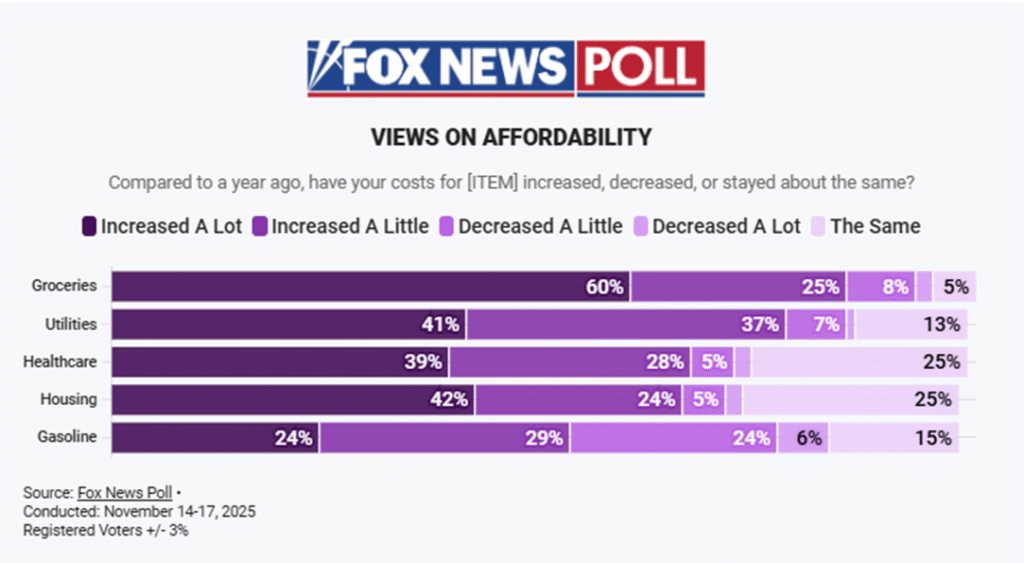
A Fox News poll (Nov. 14-17) found that 85% of respondents said grocery prices are higher than a year ago, with 60% saying they’ve “increased a lot.” Substantial majorities also said the prices of utilities (78%), healthcare (67%) and housing (66%) were up, as you can see from the graph below. Even majorities of Republicans agree with Democrats and Independents that prices have gone up.
While it’s clear that most Americans aren’t buying Trump’s happy talk about prices, inflation, and the economy, his campaign could actually be doing him more harm than good. Joe Biden’s job approval numbers dropped when he spent so much time telling us how good the economy was and how much inflation had come down. Statistics on job growth, improvements in the gross domestic product (GDP), and drops in the consumer price index (CPI) didn’t do anything for Americans who were struggling with high grocery and gas prices. Biden was viewed as being out of touch with their plight. And the same thing could be happening to Trump as he continues with his campaign of happy talk.
Trump’s plummeting approval numbers on economic matters since entering office indicate Americans were already skeptical of his claims of success before he started his latest information campaign.
Coming into office, an Economist/YouGov poll of January 26-28 found that 45% approved of Trump’s handling of inflation and prices, while 39% disapproved, and 16% had no opinion. On his handling of jobs and the economy, 49% approved, while 37% disapproved, and 14% had no opinion. His approval numbers on these two issues were thus in positive territory.
Ten months later, an Economist/YouGov poll of Oct 31-Nov 3 reported that only 31% approved of Trump’s handling of inflation and prices, while 64% disapproved, and 5% had no opinion. On his handling of jobs and the economy, only 38% approved, while 56% disapproved, and 5% had no opinion. He is now considerably underwater on approval. Specifically, in just ten months, Trump’s approval on inflation and prices dropped by 14 points (45 to 31), and disapproval increased by 25 points (39 to 64). On jobs and the economy, Trump’s approval dropped by 7 points (45 to 38), and disapproval increased by 19 points (37-56).
During this entire period the President relentlessly claimed that inflation had been defeated, that prices had dropped, and that the economy and job growth were stronger than ever. The fact that the President’s approval numbers dropped so significantly—especially on his handling of inflation and prices—tells us that increasing majorities of Americans weren’t buying his assertions about prices and inflation.
Trump’s current information campaign is even more unhinged and audacious than before, as he contrives outright lies, misinformation, and unfounded claims in an aggressive attempt to tell us how great things are.
Let’s examine a couple of many examples of how unhinged and audacious Trump’s information campaign is. First, here’s a recent post on Truth Social:
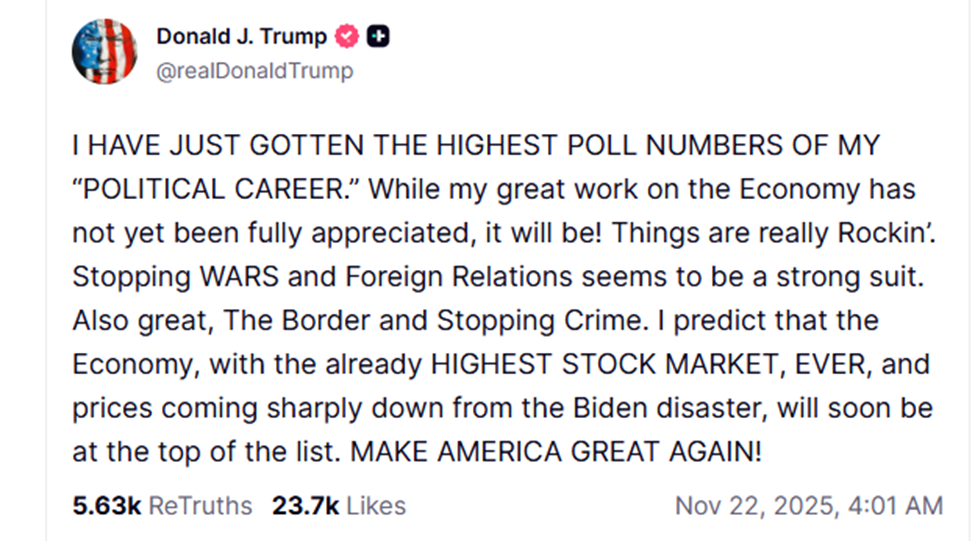
Nowhere does he cite any poll, nor does one exist. Real Clear Politics, a right-leaning political news outlet, tracks all the major polls regarding Trump’s job approval. Not a single one of these 10-15 polls shows Trump with high poll numbers, including the highest of his career. In fact, every one of these polls show him underwater in terms of job approval.
Prices have not come down sharply over the past year—the last few months of the Biden Administration, and the first ten months under Trump. If you want to talk about gas prices, go to Gas Buddy or the US Energy Information Administration and look at average gas prices over the past year. Prices have not come down; instead, they have remained in the same range as the last several months of the Biden Administration. It’s not valid for Trump to cite “wholesale” prices, as that’s not what us consumers pay. Also, a gas station in Louisiana selling gas for $2.15 a gallon says nothing about what eveyone else in the country is paying.
And if you want to talk about food prices, go to FRED (Federal Reserve of St. Louis) and look at prices for “food at home.” This gives you information on monthly inflation changes for a market basket of grocery items. Again, you can hone in on prices during the last part of the Biden Administration and Trump’s ten months. You’ll see that prices have not come down.
Yes, the stock market has done well, at least for now. But 87% to 93% of stocks are owned by the wealthiest top 10% of Americans. The bottom 90% of us only own 10% of the stocks; and the bottom half of us only own 1% of stocks. Under Biden, the stock market reached several all-time highs and performed well. This helped our retirement accounts, but it didn’t do much to help us with high prices and inflation. The same is true with respect to Trump.
As a second example, here is a statement issued by White House Press Secretary Karoline Leavitt:
“The September jobs report more than doubled market expectations — adding 119,000 new jobs to the American economy. In stark contrast to the disastrous Biden economy, almost all of these new jobs were in the private sector and went to American-born workers instead of illegal aliens. Wages for workers are continuing to rise, a reversal of the Biden years where private sector wages declined by about $3,000 because of the Democrats’ inflation crisis. This strong report is more proof that President Trump’s pro-growth, America First agenda is already making great progress, and it will continue to deliver positive results for American families and businesses.”
Karoline Leavitt, White House Press Secretary
It’s true that the September jobs report more than doubled expectations, but this is because most economists were predicting a dismal jobs report for September. Let’s look at FRED data on new jobs going back three years (see below) to see why this was the case and how wrong and misleading Leavitt’s statement is.
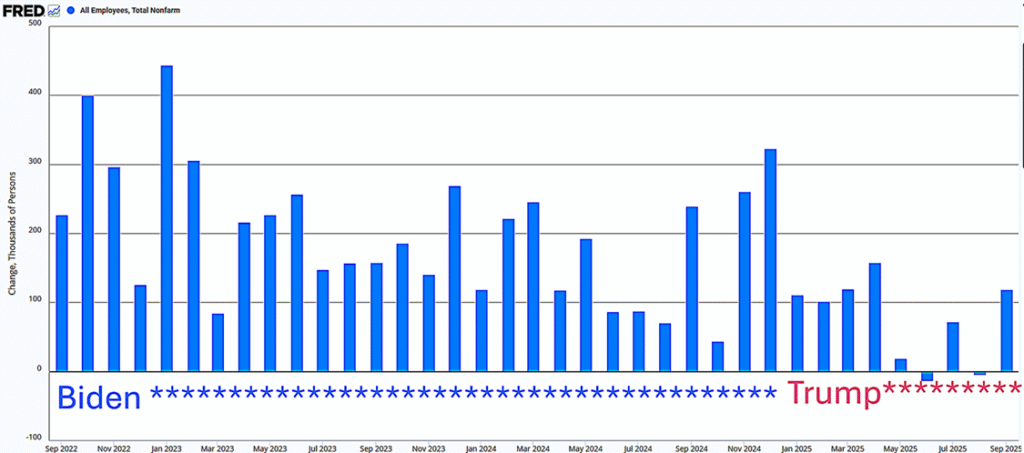
As you can plainly see, monthly job growth has been modest since Trump came into office in January. Biden had many months where new jobs exceeded 200,000, and sometimes exceeded 300,000. On the other hand, new jobs under Trump are hovering around 100,000. Job growth was tiny in May, negative in June, about 75,000 in July, and negative in August. Given this trend, it’s easy to see why economists only expected around 50,000 new jobs in September. The 119,000 number for that month was indeed double what was expected; but this number is hardly a triumph. New jobs numbers during Biden’s term tower over Trump’s. Leavitt lies when she implies Biden’s numbers were disastrous.
Leavitt also makes a big deal about these new jobs going to American-born workers rather than “illegal aliens.” The trouble is, the statics she cites are “foreign born” workers, rather than “illegal aliens.” This is blatantly misleading, as at least three-fourths of foreign born workers are in the country legally She makes it appear that there was a huge swing in American born workers. For contrast, let me display FRED data going back to September 2023, showing the numbers of native born and foreign born workers in America. Not quite the huge swing she paints, is it?
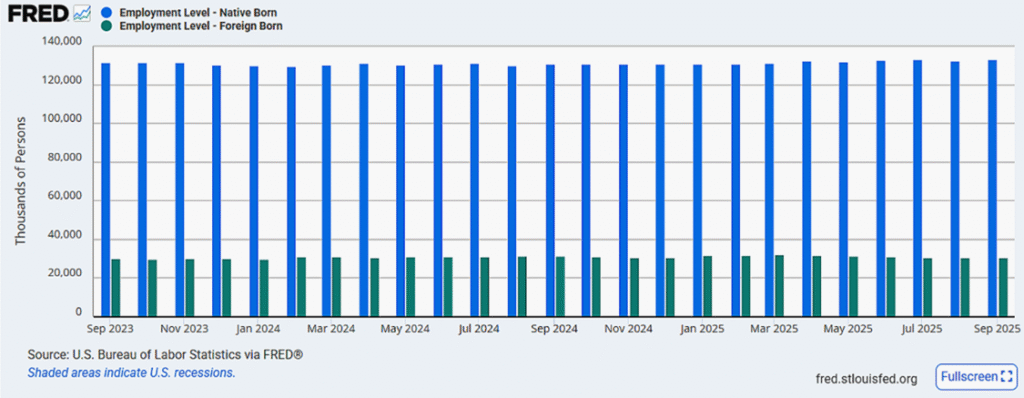
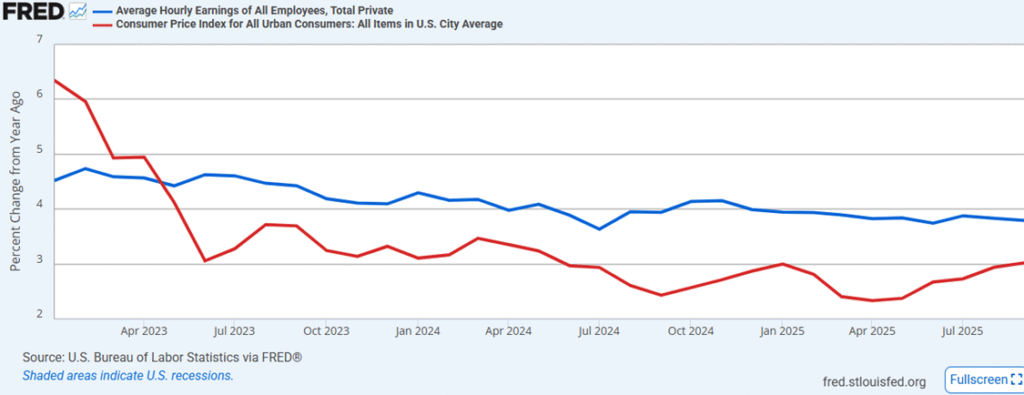
Finally, Leavitt makes a big deal of the fact that under Trump “real wages” have taken off. That is, workers now have pay levels that considerably exceed the rate of inflation. Workers are thus doing far better than when Biden was in office.
Below I’m showing FRED data on the percent change in average hourly earnings compared to the rate of inflation (CPI). As you can plainly see, since around May of 2023—more than 2.5 years—wages have gone up more than the rate of inflation. Without saying so, Leavitt apparently cherry picks a period time during Biden’s term when wage gains lagged inflation (e.g., summer of 2022). But it’s very misleading to imply this was the case for Biden’s entire term.
These two examples show the range of strategies Trump is using make his case. Most of the words coming directly from him (e.g., statements and Truth Social posts) are either outright lies or unfounded claims. Statements from his Cabinet members and media representatives, on the other hand, tend to cite misleading or deceptive evidence to support their points.
The net result is the same, however. Most of us simply aren’t feeling it when we hear Trump and team crow about record job numbers, prices for groceries and gas dropping fast, and how wages are exceeding inflation. When we go to the grocery store, buy gas, and attempt to balance our check books, our lived experience tells us the President hasn’t delivered on his promises. And, in fact, the more he keeps telling us otherwise, the more irritated and angry we become toward him.
So long as prices and inflation don’t actually come down—and it is almost certain that they won’t—Trump’s information campaign is destined to fail.
Public opinion polls (e.g., The Economist/YouGov) tell us that the most important issue for Americans is inflation and prices. This was true during Biden’s term. It got Trump elected, and has been the case every week since he took office. Biden tried to tell voters he was making great progress on inflation, prices, and the economy, but Americans weren’t having it. Trump won because he promised to beat inflation and lower prices. He hasn’t delivered on these promises. And we’re not having it when he tells us everything is great and we just don’t yet fully appreciate all his great work. The only thing that will make us feel better is for inflation and prices to actually go down.
Trump painted himself into a corner in promising zero inflation and lower prices. It’s a daunting challenge to bring the rate of inflation to 2% (the Fed’s preferred rate) and stabilize prices. But it’s an impossible challenge to bring the rate of inflation to zero (0.0%) and actually bring prices down. Voters loved his promises to bring back $2 gas and groceries at pre-pandemic prices. But Trump was never going to be able to deliver on these promises. Instead, he’s declaring victory when prices stabilize, instead of continuing to go up. The problem is that inflation is still running above the 2% preferred limit. Energy bills, grocery prices, health care costs and many other expenses are still going up.
Tariffs are having an inflationary effect. The job market is showing signs of stress, as job numbers are declining and the unemployment rate is creeping up. Americans aren’t going to feel good about prices going down if it takes a recession to get there. In short, Trump has no way of winning on inflation and prices.
Trump is done, and Americans in the future should be wary of supporting presidential candidates and political parties who make impossible-to-keep promises regarding inflation and prices.
If you go to the Gallup Presidential Approval Center and look back decades to job approval numbers of various presidents, you’ll see they rarely overcome low approval ratings. In fact, the tendency is for job approval ratings to decline over the period of a 4-year term. Modest upticks in approval ratings are possible; but absent a huge external unifying event (e.g., the terrorist attacks of 9-11), presidents are usually stuck when their job approval numbers decline.
In my view, Trump took advantage of voters who were struggling to make ends meet by making promises that he knew, or should have known, would be impossible to keep. He won the election based on these promises. He is now suffering the consequences of not delivering on them. The cautionary tale for him is that his presidency is essentially done. He is a lame duck.
And the cautionary tale for Americans is that we should be very wary of presidential candidates and political parties when they make promises regarding inflation and prices. In the long run, we need to have a more sophisticated understanding of the economy and how inflation and prices work. In the short run, we should be suspicious of any candidate who promises to roll back prices well below current levels or to bring inflation to zero. Let’s vow to never get suckered again.
Leave a Reply