In November of 2024, your candidate Donald Trump won the popular vote by 2.3 million votes (77.3 million to 75 million) and scored a decisive 312 to 226 victory in the Electoral College. I’m betting you celebrated his “landslide” victory and viewed it as a “powerful mandate” for his agenda.
The outcome signaled a repudiation of Joe Biden’s presidency and failed leadership by Democrats. You joined a significant majority of Americans in declaring you were fed up with inflation, high prices, and a struggling economy. You were also fed up with Biden’s open border policies that allowed millions of “illegal aliens” to invade the country. You had no confidence in “sleepy Joe Biden.” He couldn’t complete a coherent sentence. And he stammered and stumbled daily, appearing mentally unfit to serve as President.
It was a new day, one full of hope and high expectations. Confident in Trump’s decisive leadership style, you looked forward to the end of inflation and prices coming down “on day one.” You looked forward to a secure border. The dangerous invasion of illegal immigrants would finally be dealt with via the largest mass deportation in US history. Along with these priorities, President Trump offered an extensive agenda to “Make America Great Again.” Given his strong electoral victory and Republican control of both houses of Congress, you had to be feeling good.
Just over a year into his presidency, most of you who voted for Trump continue to support him and believe he is doing a great job. You find yourself angry and bewildered about detractors—especially Democrats and the mainstream media—who relentlessly attack, resist, and thwart his leadership.
On the other hand—and this is something that most of you who voted for Trump do not want to hear—support for the President has significantly eroded since he took office. Put simply, the mandate he once had for his political agenda is gone. Again, I understand that many of you reject this assertion out of hand. However, I would like to offer my evidence for those of you open to discussion. I would also like to address how we might move forward together as Americans.
Let’s go back to January of 2025, when Trump took office. Let’s examine how support for his leadership and policies has eroded since then. We’ll examine four different polls to ensure fairness and objectivity. We’ll also explore the nature and extent of this erosion in support. Then I’ll close by addressing how we might move forward in unity.
The Economist/YouGov Poll, President Trump Job Approval, January 2025 versus January 2026
The Economist/YouGov poll conducts weekly surveys, often including polling on Trump’s job approval. Let’s compare surveys on job approval at the beginning of Trump’s presidency (January 26-28, 2025) and one year in (January 23-26, 2026).
- All Adult Citizens: In January 2025, 49% approved of Trump’s performance, while 43% disapproved, and 8% weren’t sure. In January 2026, 39% approved of Trump’s performance, while 57% disapproved, and 4% were unsure. This is a 10-point drop in approval, and a 13-point increase in disapproval. Moreover, the percentage of those expressing “strong approval” went down by 11 points, and those expressing “strong disapproval” went up by 13 points.
- Republicans: In January 2025, 94% of Republicans approved of Trump’s performance, while only 3% disapproved, and 3% weren’t sure. In January 2026, 85% of Republicans approved of Trump’s performance, while 13% disapproved, and 2% weren’t sure. This is a 9-point drop in job approval, and a 10-point increase in disapproval. Moreover, the percentage of Republicans expressing “strong approval” went down by 15 points (71 to 56), and those expressing “strong disapproval” went up 7 points (1 to 8).
- Independents: In January 2025, 41% of Independents approved of Trump’s performance, while 45% disapproved, and 13% were unsure. In January 2026, 27% of Independents approved of Trump’s performance, while 67% disapproved, and 6% were unsure. This is a 14-point drop in approval and a 22-point increase in disapproval. Moreover, the percentage of Independents expressing “strong approval” went down by 13 points (26 to 13), and the percentage expressing “strong disapproval” went up by 18 points (36 to 54).
- Trump voters: In January 2025, 93% of Trump voters approved of Trump’s performance, while 5% disapproved, and 3% were unsure. In January 2026, 81% of Trump voters approved of his performance, while 17% disapproved, and 2% were unsure. This is a 12-point drop in approval and a 12-point increase in disapproval. Moreover, the percentage of Trump voters expressing “strong approval” went down (74 to 52), and the percentage expressing strong disapproval went up (2 to 9).
- Democrats: In January 2025, 12% of Democrats approved of Trump’s performance, while 82% disapproved, and 5% were unsure. In January 2026, 6% of Democrats approved of Trump’s performance, while 92% disapproved. This is a 6-point drop in approval and a 10-point increase in disapproval.
In summary, The Economist/YouGov polls on President Trump’s job approval show a strong erosion in support, including among Republicans and those who voted for Trump in the election. The largest erosion in support comes from Independents. But disapproval from Republicans went up by 10 points and those expressing “strong approval” went down by 15 points. While most Republicans still support Trump, support has eroded.
Gallup, Partisan Approval Ratings of Donald Trump, 2025
Gallup comes up with similar findings. Here is a key graphic from a recent analysis:
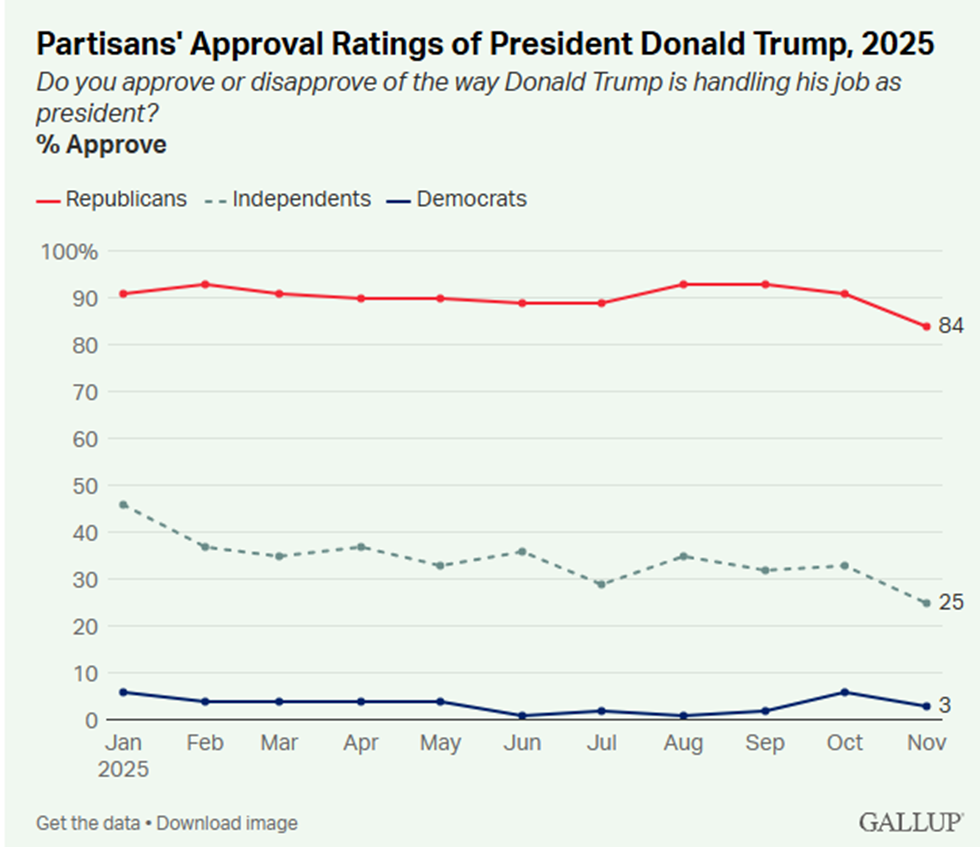
As you can see, among Republicans Trump started 2025 with a 91% approval rating, while finishing in November at 84%. Among Independents, Trump went from 46% approval to 25% approval, a 19-point drop. And job approval from Democrats went from 6% to 3%. The Gallup analysis also finds that among all adult citizens, Trump went from 47% approval and 48% disapproval in January to 36% approval and 60% disapproval in November.
Pew Research Center, January 29, 2026
A January 29 report from the Pew Research Center depicts similar erosion in support from all adults, as well as Democrat/lean Democrat, and Republican/lean Republican. Here is the key graphic:
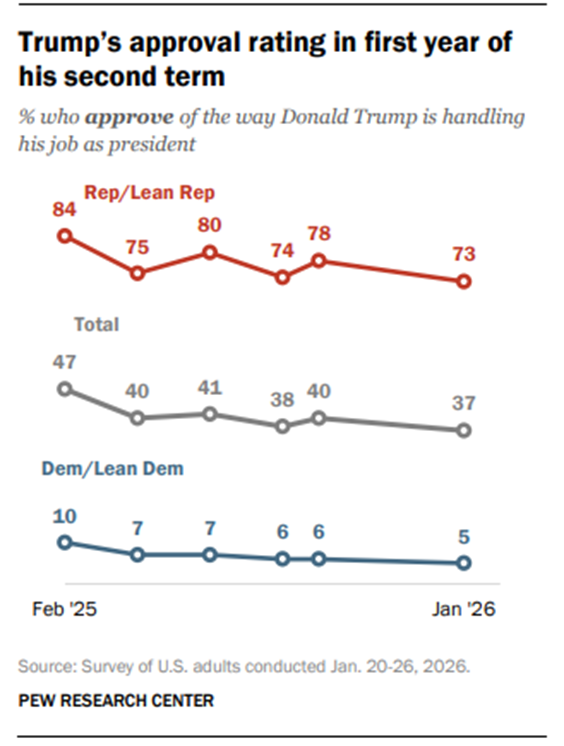
As you can see Trump’s approval rating from all adults went from 47% to 37%, a 10-point drop. Approval from Republican/lean Republican went from 84% to 73%, an 11-point drop. And approval from Dem/lean Dem went from 10% to 5%, a 5-point drop.
Fox News Poll, January 23-26, 2026
A recent Fox News poll also focuses on Trump’s job approval ratings. While the poll doesn’t so much document the erosion in support from Republicans and conservatives, it does show just how underwater the President is on his handling of many issues. Here is a key graphic from the report:
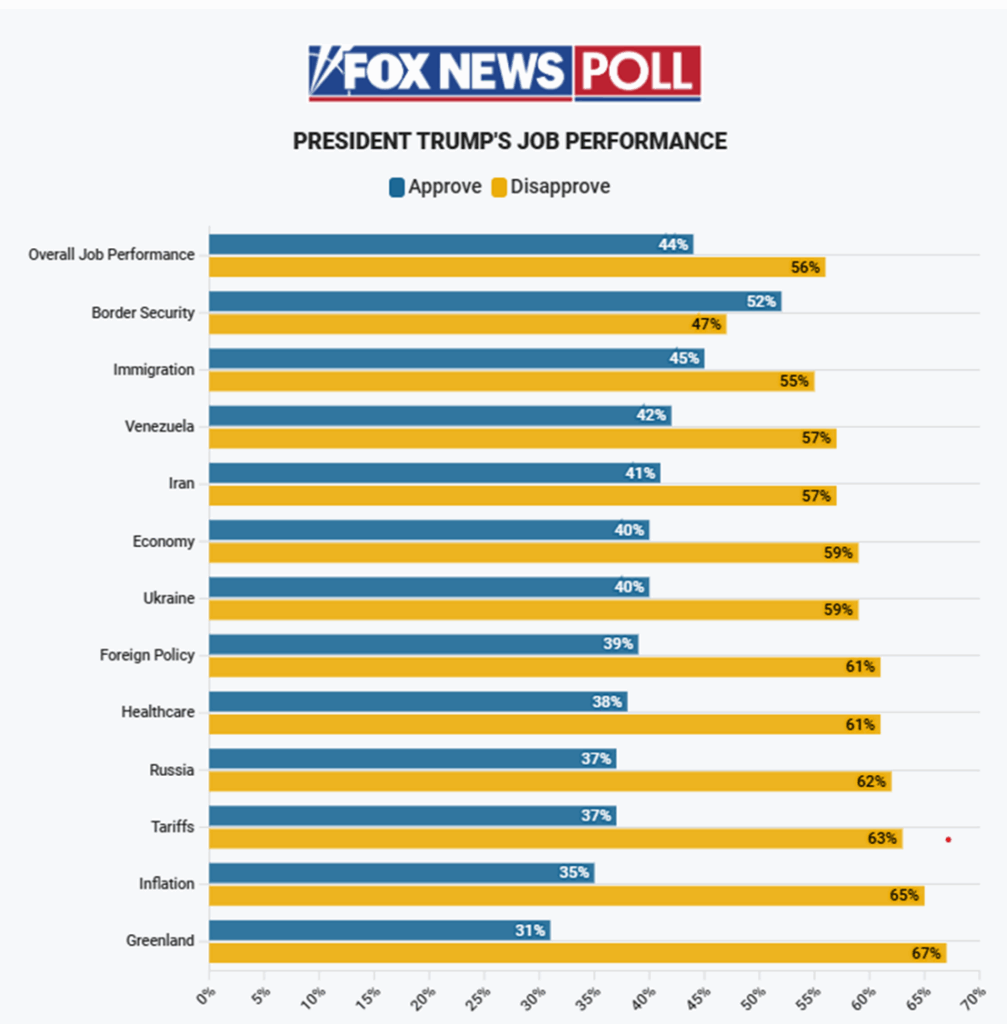
The crosstabs on overall job performance show that as of late January 2026, 85% of the GOP either strongly approves (52%) or somewhat approves (33%) of Trump’s performance, while 16% of the GOP either strongly disapproves (6%) or somewhat disapproves (10%) of his performance.
Seventeen percent (17%) or over 13 million of you who voted for Trump in November 2024, now disapprove of his performance.
Clearly, the results from these four different surveys and studies show that there has been a serious erosion in support for President Trump across the partisan landscape (Independents, Republicans, and Democrats). But let’s hone in on those of you who voted for Trump. How serious is this erosion?
The “Trump voter” crosstabs from The Economist/YouGov Poll survey of January 23-26, 2026, show that 17% of you who voted for Trump in November 2024, now disapprove of President Trump’s job performance. Given that there were 77.3 million Trump voters that November, this 17% translates to over 13 million of you who voted for him. Put simply, about one-sixth of you who voted for Trump now disapprove of his performance. About five-sixths of you (81%) continue to approve of his performance.
When I put on my data geek hat and dig deeper into the crosstabs, I can draw some insights regarding the 13+ million of you who have soured on Trump. Between January 2025 and January 2026, there were very sizable erosions in Trump’s job approval coming from Hispanics, 18-29 year old’s, males, and those earning less than $50,000 per year. Tellingly, these are four of the key demographic groups in Trump’s coalition that enabled him to win the presidency.
But just because many of you now disapprove of Trump’s job performance, does this mean you also reject his policies and political agenda? Does this mean you reject him as a leader? It’s a huge leap to conclude that concerns over the President’s job performance equates to a rejection of his policies, his agenda, and his leadership. Let’s take a look at this question.
There is also significant evidence that Republicans and those who voted for Trump have growing concerns about his political agenda, his policies, his actions, his leadership abilities, and his fitness for office.
This Pew Research report cited above goes on to focus on the drop in support from Republicans, particularly as to his agenda and his values. Below are two key graphics:
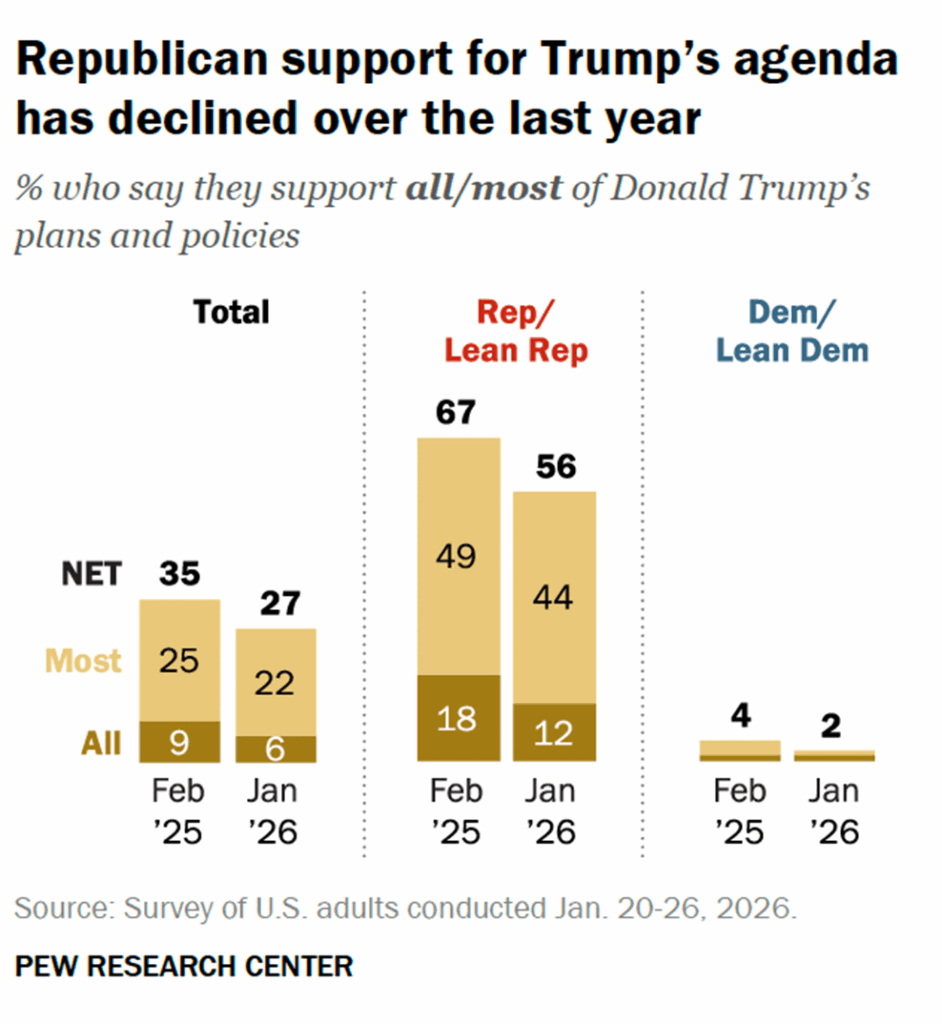
In February of 2025, 67% of Republican/lean Republican supported all or most of Trump’s plans and policies. In January 2026, that level of support had dropped 11 points, to 56%.
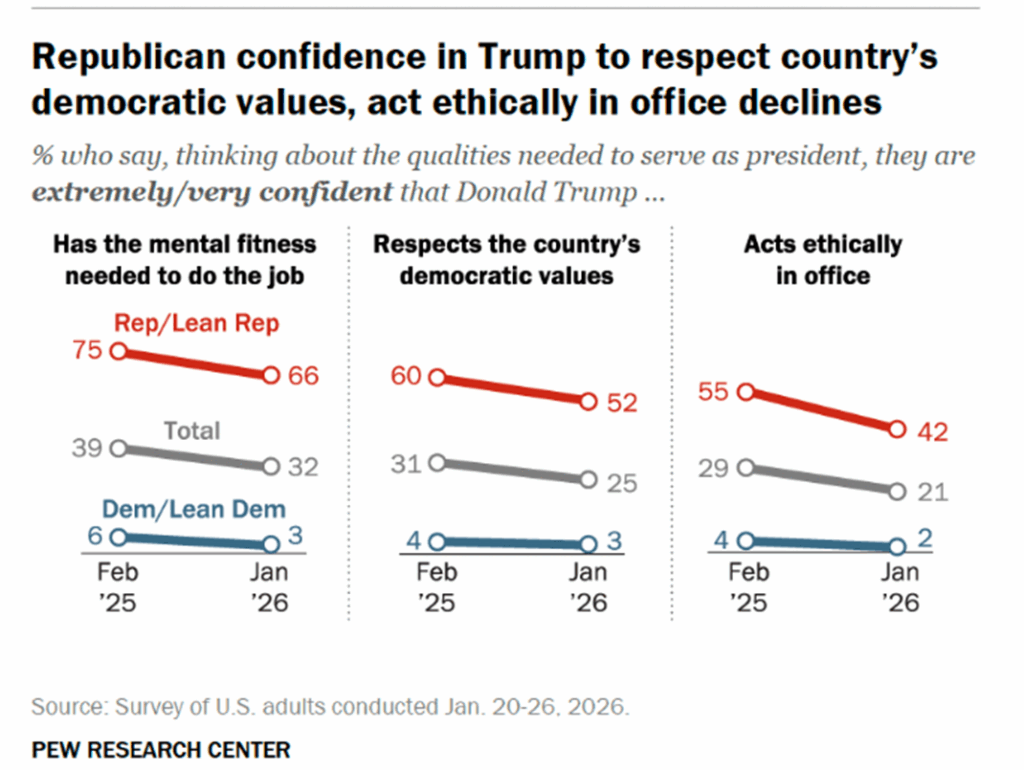
Between February 2025 and January 2026, significantly smaller percentages of Republican/lean Republican have confidence in Trump’s mental fitness, his respect for democratic values, and his ethics.
The Economist/YouGov Poll also tracks Trump’s honesty and trustworthiness. A January 26-28, 2025 survey found 78% of Trump voters viewed him as honest and trustworthy, while 8% found him not honest and trustworthy. A year later (January 16-19, 2026), only 70% of Trump voters found him honest and trustworthy, and 15% found him not honest and trustworthy.
There are also many instances where Trump’s agenda, policies, and actions are no longer supported by majorities of Americans; instead, his agenda, polices, and actions are frequently in conflict with the views of substantial majorities of Americans.
Given Trump’s win in November, you probably saw this as a sign that the majority of Americans supported his agenda, policies, and plans. But now, in 2026, is this still true? Let me document where substantial majorities of Americans stand on given issues, and then compare with the stances of Trump and Republicans. My list below is not exhaustive; but I believe it serves to prove that Trump and Republicans are out of step with the views of substantial majorities of Americans.
Immigration
- 61% of Americans (Economist/YouGov June 6-9) say that undocumented immigrants who have lived in the country for many years without committing any crimes should not be deported. Only 24% say these people should be deported. The Trump Administration is conducting the largest mass deportation in US history; and the vast majority of those arrested, detained, and deported do not have criminal convictions.
- 61% of Americans (same survey) say that undocumented immigrants who came to the US as children should not be deported. Only 22% say these people should be deported. The Trump Administration is deporting such individuals.
- 66% of Americans (same survey) say that undocumented immigrants who are married to US citizens should not be deported. Only 26% say these people should be deported. The Trump Administration is deporting such individuals.
- 54% of Americans (same survey) say that undocumented immigrants with children who are US citizens should not be deported. Only 26% say these immigrants should be deported. The Trump Administration is deporting such individuals.
- 78% of Americans (Gallup July 11, 2025) support allowing immigrants living in the U.S. illegally the chance to become U.S. citizens if they meet certain requirements over a period of time. The Trump Administration opposes this policy and is currently rounding up and deporting such individuals.
- 58% of Americans (Economist/YouGov January 25, 2026) say current ICE tactics are “too forceful”, while only 10% say they are “not forceful enough” and 23% say they are “about right.” The Trump Administration staunchly defends current tactics.
Gun control
- 55% of Americans (Economist/YouGov, August 1-4) support making gun laws more strict. Only 14% say gun laws should be less strict. The Trump Administration and Republicans have not supported any gun control measures in Congress.
- 83% of Americans (Economist/YouGov Aug 1-4), favor requiring criminal and mental background checks for all those buying guns. The Trump Administration and Republicans oppose background check legislation.
- 73% of Americans (Aug 1-4) favor creating red flag laws that allow courts to temporarily remove firearms that present a danger to self and others. The Trump Administration and Republicans have opposed red flag laws enacted by Congress.
- 60% of Americans (Aug 1-4) favor banning assault rifles. The Trump Administration and Republicans have opposed assault rifle bans enacted by Congress.
Climate change
- 57% of Americans (Economist/YouGov July 11-14), agree the world’s climate is changing because of human activity. Trump maintains climate change is a “hoax” and is undoing federal law, policy, and funding to address climate change.
- 54% of Americans (same survey, July 11-14) agree that global warming has increased natural disasters. Trump maintains climate change is a hoax.
- 61% of voters (YouGov, Dec 17-19) strongly or somewhat support keeping federal clean energy tax credits, compared to just 18% of voters who favor their repeal. 77% of voters back home energy efficiency rebates, 72% back incentives for efficient appliances, 73% back investments in solar panel manufacturing, and 76% back inititatives to reduce pollution and improve air quality. The Trump Administration is ending and repealing all such programs.
- 69% of Americans (Chicago Council on Global affairs/IPSOS) favor maintaining the US commitment to the Paris Agreement. Trump withdrew from the Paris Agreement.
Abortion
- 58% of Americans (Economist/YouGov July 4-7) say abortion should always be legal, or should be legal with some restrictions (such as for minors or late-term abortions). 32% said abortion should only be legal in special circumstances (e.g., life of mother in danger), and 10% said abortion should always be illegal. Trump called for the overturning of Roe v. Wade, and celebrates his role in the US Supreme Court decision that did so.
- 52% of Americans (same survey) support Congress establishing a national right to abortion. The Trump Administration opposes a national right to abortion, saying the matter should be controlled by the states.
Taxes and government spending
- 58% of Americans (Pew Research, March 19, 2025)say tax rates on household income over $400,000 should be raised; and 63% say taxes on large businesses and corporations should be raised. Trump and the Republicans refused to increase taxes on the wealthy and corporations in adopting the One Big Beautiful Bill Act.
- 72% of Americans (Economist/YouGov, November 2025) favor raising taxes on billionaires, while only 15% oppose. Trump and Republicans oppose raising taxes on billionaires.
- 63% of Americans (American Compass, March 2024) say the federal budget deficit and national debt should be addressed by a combination of cuts and tax increases, with at least 25% of the deficit reduction coming from each. Trump and the Republicans have opposed all tax increases.
- 74% of Americans (Economist/YouGov, July 4-7) say that Medicaid should be given more funding (49%) or the same level of funding (25%), while only 15% say Medicaid should be given less funding. Trump and the Republicans cut Medicaid in the One Big Beautiful Bill Act.
- 84% of Americans (same July 4-7 survey) say that Medicare should be given more funding (56%) or the same level of funding (28%), while only 15% say Medicare should be given less funding. Trump and Republicans cut Medicare funding in the One Big Beautiful Bill Act.
- 70% of Americans (same July 4-7 survey) say SNAPS (Supplemental Nutritional Assistance Program) should be given more funding (41%) or the same level of funding (29%), while only 16% say SNAPS should be given less funding. Trump and the Republicans cut SNAPS funding in the One Big Beautiful Bill Act.
- 52% of Americans say the Trump Administration has “gone too far” in imposing tariffs on foreigh imports (Economist/YouGov August 22-25). Trump continues to expand and revise tariffs on an almost daily basis.
Ramifications for Trump voters who continue to support all or most of his policies, plans, and actions
The polling data say that most of you who voted for Trump remain loyal to his policies, plans, and actions. But this, I am afraid, puts you in a quandary. How do you square supporting Trump with the fact that in many instances the policies and plans he is pushing are in conflict with the views of substantial majorities of Americans?
I know many of you must reject that Trump could be at odds with the will of the people. But it’s true that many of Trump’s policies and actions simply conflict with where the majority of Americans are. This means, with all due respect, that both you and Trump are intent upon imposing your will on the majority of Americans. Millions of Americans who joined you in voting for Trump have resolved this quandary. They respect the views of the majority and regularly disapprove of Trump’s policies and initiatives that go against these views.
I understand that many of you who elected and continue to strongly support the President believe that Trump is right. You continue to support his policies and positions, even if they go against the views of substantial majorities of Americans, because you believe those views are wrong. This is particularly the case if it is Democrats who are making up a large percentage of any substantial majority. You believe that initiatives Democrats pursue are “radical,” “socialist,” “lunatic,” and “disastrous.” These initiatives must be resisted, even if they are popular. I suspect this is where many of you who continue to support Trump have landed.
But let me ask you to consider one final question. How would you feel about Democrats imposing their will on you when your views are supported by substantial majorities of Americans and Democrat policies are only embraced by small percentages? Surely, you would resent and resist this imposition. You would not simply roll over in compliance. Just as majorities of Americans are now resisting Trump, majorities of Americans will rise up against Democrat policies that go against the views of most Americans. Leaders and political parties imposing their will only guarantees that American will continue to be divided. On the other hand, if both sides pay more respect to the views and positions of substantial majorities of Americans, this is common ground that can unite us.
Final thoughts
A sizable percentage of you who voted for Trump have already changed your views about the President. The policy mandate that Trump claimed after the election has disappeared. The President is unpopular and increasingly resisted because he is pursuing policies and actions that aren’t embraced by majorities of Americans.
These are tough realities for those of you who elected and continue to strongly support the President. Even if you read this article, you will likely decide it is right to join Trump in imposing his will even when there are substantial majorities of Americans who support doing something else. I respect your decision, but I don’t believe it’s in the best interests of our country. I thus will go on urging every American to be deferential to policy that reflects the views and values of substantial majorities of Americans. This is the path to unity.
Thank you, Trump voters, for considering my analysis and thoughts.
Leave a Reply