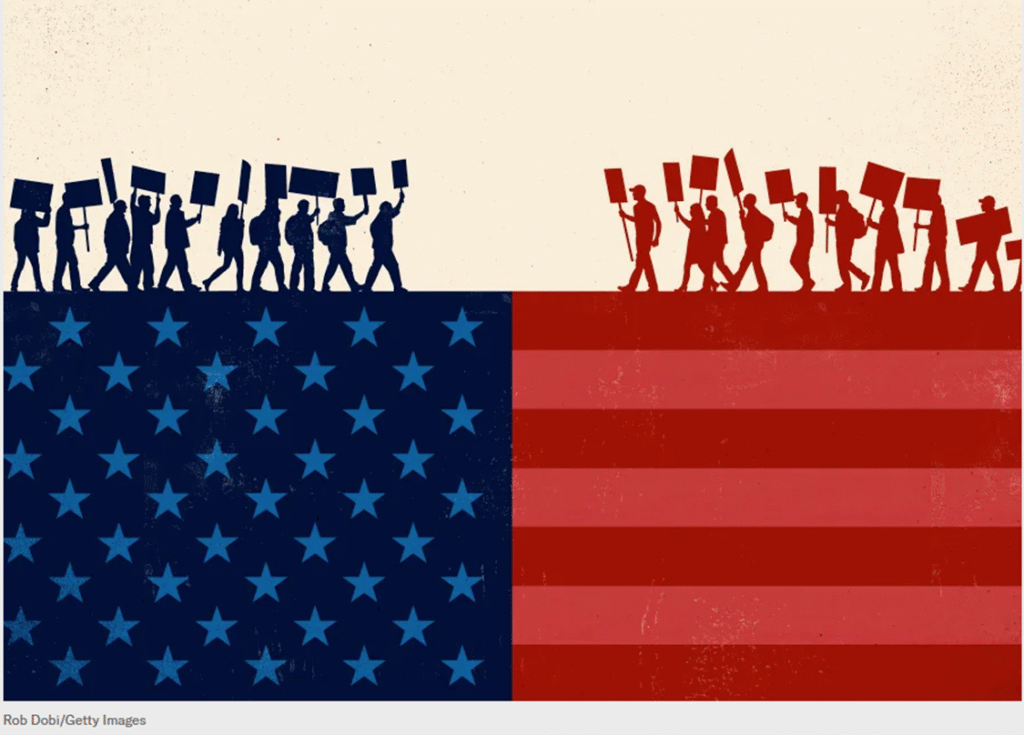
It’s old news that Republicans and Democrats are becoming increasingly alienated from one another. The rapid deterioration is depicted in this Pew Research Center graphic:
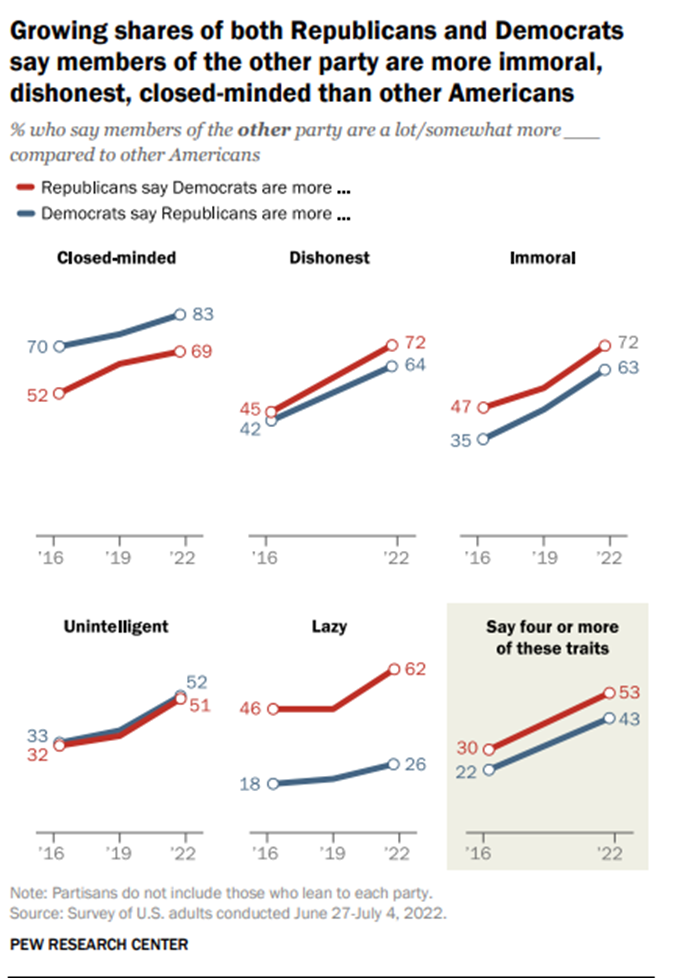
It’s also old news that our political leaders, political parties, and their respective media allies all-too-often create and stoke this division. After all, polling studies tell us that hate, fear, and division are far more powerful in garnering votes than promises to work with the other side, search for middle ground, and accept compromise.
We have thus become accustomed to Democrats being portrayed as left-wing Marxists who tax and spend the country into oblivion, overregulate everything, confiscate guns, promote anytime abortions, establish hiring quotas for everyone but Whites, coddle criminals, and hate America. Meanwhile, Republicans only care about the wealthy and businesses, slash programs for the poor, reject climate change as a hoax, promote White supremacy, ban all abortions, resist any and all gun control, and conduct mass deportations that snare millions of law-abiding migrants who have lived in the country for decades.
The practices we have devolved to have pernicious consequences. Hate, fear, and division destroy communication and trust. And, eventually, these forces promote political violence. Americans are alarmed about the uptick in political killings and assassinations. Recent polling shows that 67% of Americans feel we are at a turning point in history, with 83% saying there’s more political violence than 10 years ago, and 78% saying political violence is never justified.
In this article we’ll explore what we need to do to step back from the hyper-partisan politics of division, anger, and hate. We’ll start by assessing whether we are actually as divided as we are being made out to be. And, after exploring what is actually causing the alienation, we’ll identify steps we can take to stop the downward spiral.
Are Americans as divided as we are being made out to be?
To answer this question, let’s search for instances where significant majorities of Americans agree on solutions to the country’s problems. I say this because neither party commands a majority of Americans. Currently, (Gallup, July 31, 2025) 43% of Americans identify as Republican/lean Republican, and 46% identify as Democrat/lean Democratic. Thus, when a significant majority agrees on a particular problem or solution—say 60%–this connotes support beyond a partisan preference. This is noteworthy consensus because it is beyond what what either party could muster on its own. It is a bipartisan solution. We may not like a particular proposal because it isn’t embraced by our political party. But we can’t really argue that a solution embraced by more than half of Americans is extreme and highly partisan.
I went to The Economist/YouGov surveys and trackers, Pew Research, Gallup, and other polling organizations. I found 30 noteworthy examples of policy solutions embraced by substantial majorities of Americans.
Gun control
- 55% of Americans (Economist/YouGov, August 1-4) support making gun laws more strict (including 53% of Independents and 31% of Republicans). Only 14% say gun laws should be less strict.
- 83% of Americans (Economist/YouGov Aug 1-4), favor requiring criminal and mental background checks for all those buying guns (including 80% of Independents, and 82% of Republicans).
- 73% of Americans (Aug 1-4) favor creating red flag laws that allow courts to temporarily remove firearms that present a danger to self and others (including 69% of Independents and 65% of Republicans)
- 60% of Americans (Aug 1-4) favor banning assault rifles (including 57% of Independents, and 39% of Republicans)
Abortion
- 58% of Americans (Economist/YouGov July 4-7), including 59% of Independents and 31% of Republicans, say abortion should always be legal, or should be legal with some restrictions (such as for minors or late-term abortions). 32% said abortion should only be legal in special circumstances (e.g., life of mother in danger), and 10% said abortion should always be illegal.
- 52% of Americans (same survey) support Congress establishing a national right to abortion (including 52% of Independents and 22% of Republicans).
- 65% of Americans (same survey) say that states restricting abortions should allow people to travel to states with less restrictive law. This view is held by 68% of Independents and 41% of Republicans.
Climate change
- 57% of Americans (Economist/YouGov July 11-14), agree the world’s climate is changing because of human activity (including 59% of Independents and 25% of Republicans)
- 54% of Americans (same survey, July 11-14) agree that global warming has increased natural disasters (including 55% of Independents and 18% of Republicans)
- 61% of voters (YouGov, Dec 17-19) strongly or somewhat support keeping federal clean energy tax credits, compared to just 18% of voters who favor their repeal. 77% of voters back home energy efficiency rebates, 72% back incentives for efficient appliances, 73% back investments in solar panel manufacturing, and 76% back initiatives to reduce pollution and improve air quality.
- 69% of Americans (Chicago Council on Global affairs/IPSOS) favor maintaining the US commitment to the Paris Agreement
Taxes and government spending
- 58% of Americans (Pew Research, March 19, 2025)say tax rates on household income over $400,000 should be raised; and 63% say taxes on large businesses and corporations should be raised. This includes 43% of Republicans/lean Republican, and 81% of Democrats/lean Democrat.
- 63% of Americans (American Compass, March 2024) say the federal budget deficit and national debt should be addressed by a combination of cuts and tax increases, with at least 25% of the deficit reduction coming from each.
- In March of 2025, 64% of Americans (US Chamber of Commerce survey) supported extending the Tax Cut and Jobs Act (TCJA). This includes 81% of Republicans, 55% of Independents, and 53% of Democrats. After the TCJA extension was incorporated into the One Big Beautiful Bill Act, support levels for that bill dropped well below a majority.
- 74% of Americans (Economist/YouGov, July 4-7) say that Medicaid should be given more funding (49%) or the same level of funding (25%), while only 15% say Medicaid should be given less funding
- 84% of Americans (same July 4-7 survey) say that Medicare should be given more funding (56%) or the same level of funding (28%), while only 15% say Medicare should be given less funding
- 70% of Americans (same July 4-7 survey) say SNAPS (Supplemental Nutritional Assistance Program) should be given more funding (41%) or the same level of funding (29%), while only 16% say SNAPS should be given less funding
- 52% of Americans say the Trump Administration has “gone too far” in imposing tariffs on foreign imports. 55% of Independents and 15% of Republicans share this view (Economist/YouGov August 22-25)
Immigration
- 61% of Americans (Economist/YouGov June 6-9) say that undocumented immigrants who have lived in the country for many years without committing any crimes should not be deported (including 59% of Independents and 37% of Republicans). Only 24% say these people should be deported.
- 61% of Americans (same survey) say that undocumented immigrants who came to the US as children should not be deported (including 57% of Independents and 36% of Republicans). Only 22% say these people should be deported.
- 66% of Americans (same survey) say that undocumented immigrants who are married to US citizens should not be deported (including 66% of Independents and 46% of Republicans). Only 26% say these people should be deported.
- 54% of Americans (same survey) say that undocumented immigrants with children who are US citizens should not be deported (including 53% of Independents and 26% of Republicans). Only 26% say these immigrants should be deported.
- 59% of Americans (same survey) say undocumented immigrants should have the right to go to court to challenge their deportation (including 51% of Independents and 31% of Republicans). Only 28% say they should not have this right.
- 78% of Americans (Gallup July 11, 2025) support allowing immigrants living in the U.S. illegally the chance to become U.S. citizens if they meet certain requirements over a period of time (including 79% of Independents and 59% of Republicans).
- 59% of Americans (same Gallup poll) favor hiring significantly more border patrol agents
- 51% of Americans (Pew Research, March 26, 2025) say “some” of the immigrants living in the US illegally should be deported, versus 32% who say “all” illegal immigrants should be deported, and 16% who say “none” should be deported. A January 2025 AP-NORC poll found 83% of Americans support deporting undocumented immigrants who have been convicted of a violent crime.
- 56% of Americans (Pew Research, June 17, 2025) support substantially expanding the wall along the US-Mexico border (includes 88% of Republicans/lean Republican, and 27% of Democrats/lean Democratic).
Political violence
- 78% of Americans (Economist/YouGov, September 15, 2025) say it is never justified for citizens to resort to violence in order to achieve political goals, while only 10% say it can be.
- 77% of Americans (YouGov, September 8, 2025) say it is always or usually unacceptable to be happy about the death of a public figure they oppose.
- 70% of Americans (Pew Research, January 31, 2024) say elected officials should avoid heated or aggressive language because it could encourage some people to take violent action (including 56% of Republican/lean Republican, and 83% of Democrat/lean Democratic).
While the American people share notable consensus on a host of solutions and policies, why aren’t our elected officials embracing and implementing these solutions?
I don’t know about you, but I was astonished to find so many solutions that are embraced by majorities—usually significant majorities—of Americans. I attempted to be thorough in identifying the 30 consensus solutions listed above; but I’m relatively certain there are more.
But why are most of these solutions being rejected or ignored by lawmakers? In the current situation, it’s the Trump Administration and the Republican-controlled Congress that is dismissing these solutions. But it’s important to recognize that when Democrats have been in power, they too have ignored or rejected consensus solutions. Why does this happen?
The obvious answer is that the political party in control is only inclined to pursue solutions that are backed by majorities of its party faithful. Thus, in the current situation, the Trump Administration and the Republican-controlled Congress are only inclined to pursue solutions that are supported by significant majorities of Republicans. For instance, Trump and Congress have pursued substantially expanding the border wall, hiring more border patrol agents, and extending Trump’s 2017 tax reform, the Tax Cut and Jobs Act.
Most of the consensus solutions my search uncovered are not supported by majorities of Republicans. Instead, the solutions are supported by high percentages of Democrats and Independents, combined with modest or moderate percentages of Republicans. This results in solutions supported by significant majorities of all respondents.
While the political party in control may not be inclined to embrace consensus solutions that aren’t backed by majorities of its members, we have to ask whether this practice is harmful to democracy and the quest for unity. When a substantial majority of Americans are united on a solution, why should that solution be kicked to the curb because of a partisan litmus test? Even more confusing, why is it that consensus solutions like background checks for gun purchases and red flag laws—solutions backed by solid majorities of Republicans—are also kicked to the curb? We need to dig deeper to answer these questions.
The underlying reason that these consensus solutions are being rejected or ignored is that political parties and elected officials are more concerned about gaining control and enacting their agendas than pursuing the will of the majority. Candidates who preach compromise and finding middle ground usually have a tough time surviving their primaries. Usually, the more extreme candidate wins. This is consonant with a political party’s objectives to gain control of a legislative chamber and enact its agenda. In stark terms, the political party wants to impose its will by enacting its agenda and blocking anything that conflicts, even if it means rejecting solutions supported by significant majorities of Americans.
Let’s take an example to help us understand what this means. A very solid majority of Americans (61%) say that undocumented immigrants who have lived in the country for many years without committing any crimes should not be deported. This includes 59% of Independents and 37% of Republicans. Only 24% of Americans say these people should be deported. Yet the Trump Administration is deporting these people to fulfill its promise of mass deportations. This means that Trump is forcing his will on a policy that is supported by only 24% of Americans, a policy that conflicts with what 61% of Americans want to do (including almost 4 in 10 Republicans).
To bolster the necessity of “mass deportations,” the Trump Administration ignores these public opinion statistics and maintains that the American people support mass removal. After all, Trump won the election, and one of his campaign promises was mass deportations. Republicans blame the radical left Democrats for wanting to block the removal of millions of undocumented who are criminals and bad people. It’s not the will of the American people that long-term and law-abiding immigrants shouldn’t be deported. Rather, it’s the irresponsible and reprehensible Democrats who don’t want to deport “illegals” who mostly vote for Democrats.
As I said, both parties are guilty of only embracing solutions that conform to their policy agendas. When Democrats controlled the White House and Congress during Biden’s term, they ignored consensus solutions to address Budget deficits and the national debt. They also mostly ignored strong public support for increased border security and reducing the flow of undocumented immigrants into the country. Only when Biden’s handling of illegal immigration became a political liability did he work with Republicans on bipartisan border security legislation late in his term (February 2024).
When the political parties and those in control ignore consensus solutions, and instead pursue their political agendas and attack the other side, it’s no wonder Americans are left feeling divided and angry.
Let’s start with the Democrats and Independents who lean Democratic. With Trump in office and Republicans in control of Congress, there is no hope of reforming gun laws. Trump and Republicans won’t even consider gun reforms supported by significant majorities of their voters. There is also no hope of a nationwide policy on legal abortion. Instead, the Red states continue to consider and enact draconian policies. Trump withdrew the U.S. from the Paris Agreement, and put an end to greenhouse gas reduction efforts. Green energy incentives were eliminated. Huge cuts were made to Medicare, Medicaid, SNAPS and other federal programs to help finance tax cuts that mostly benefit the wealthy. There is no hope of comprehensive immigration reform. And, all the while, extreme Marxist Democrats are blamed for ruining the economy, fomenting political violence, ruining the schools and colleges, enabling rampant crime, and a long list of other problems. Finally, Trump keeps trying to circumvent Congress and the Constitution with illegal executive orders and dictatorial behavior.
For Republicans and Independents who lean Republican, Trump’s laudable policies and actions are attacked endlessly and unfairly. Fake news and the lamestream media spread lies and Democrat propaganda. Democrat-appointed judges with political agendas overturn Trump’s responsible actions to carry out his agenda and address real problems. Democrats use every procedural trick imaginable to prevent Congress from acting. And they won’t raise a finger to work in cooperation with the President. Democrats ruined the economy with runaway inflation and massive government spending. And now they blame the President and Republicans for not fixing problems overnight.
But I don’t have to tell you any of this. You’ve seen the movie. We’re so alienated towards one another that we’ve stopped communicating. We hurl insults instead. There’s zero trust. We can’t even agree on basic facts. There’s no point in trying to reach middle ground when the other side is evil, corrupt, inept, and just plain wrong. And all this is amplified by social media, removing us further from actual human contact and in-person communication.
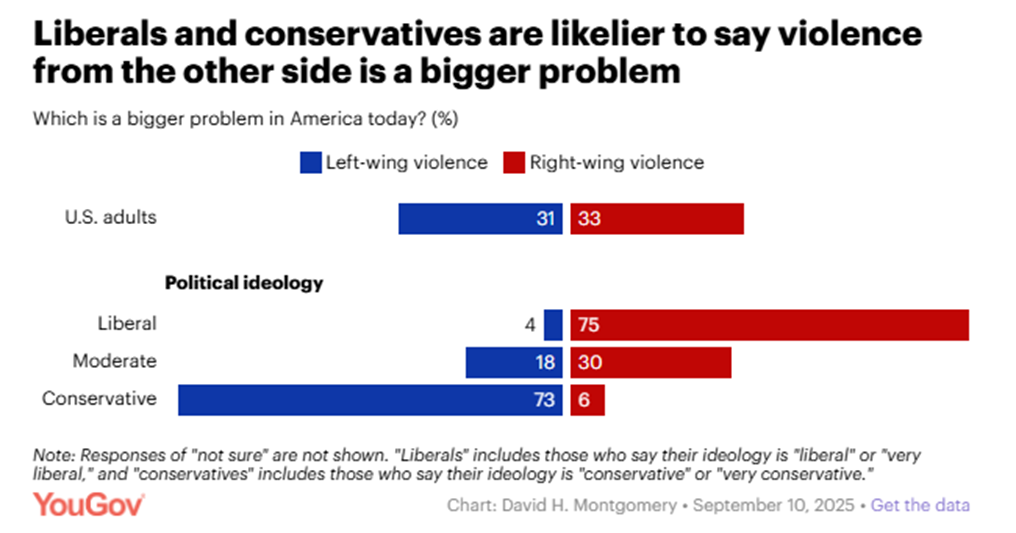
Sadly, the latest pernicious consequence of this alienation is an uptick in political violence. As usual, we’re blaming one another for this problem, as you can see from this YouGov graphic:
How can we break free of this downward spiral of division, anger, hate, and political violence; restore a level of communication and trust; and unite to solve America’s problems?
If you love America and study social and political trends, I’m betting you too have pondered this question. The fact is that most of us probably already know what needs to be done. The research consistently tells us the steps we need to take. Put simply, the change is going to be up to us–everyday Americans. It’s on us to revamp our political parties, change the kind of candidates we elect, and overcome strong forces that have vested interests in continuing hyper-partisan politics.
The sticking points to bringing about this change are personal. Each of us must admit and embrace the necessity to change. And each of us must exercise the will to change. To cut to the chase, here is what we need to do:
- Each of us needs to decide whether we’re done with the politics of division, anger, hate, and political violence. Do you reject the dysfunction and harm that comes from politicians and political parties that focus on blaming and denigrating the other side rather than working collaboratively to develop mutually agreeable solutions? Do you value knowing where significant majorities of Americans stand in terms of solutions being considered? Are you ready to do the work necessary to break free of powerful forces that will draw you back to what are probably deeply-engrained partisan tendencies?
- An important first step is to audit and broaden your sources of information. Most of us, wittingly or unwittingly, have curated information sources that tend to reinforce what we know and believe. Here are some suggestions for completing this task.
- Along with auditing and broadening your sources of information, commit to doing your own research and fact-checking. There is a lot of misinformation out there. Don’t fall to the temptation to believe something simply because you want it to be true. Instead, be on a mission to understand the facts and the truth. This will especially help you when investigating the legitimacy of claims made by others.
- Commit to giving extra weight or consideration to policy solutions that are supported by significant majorities of Americans. If we focus on policies where there is a significant degree of consensus, this will help unify America. In seeking middle ground, it makes obvious sense to start where significant percentages of Americans are in agreement. Doing so doesn’t compel your acceptance. You can still end up disagreeing if you have good reasons.
- Take responsibility for everything that comes out of your mouth and writings, including what you post and repost. It’s perfectly okay to disagree; just be respectful, civil, and fact-based when you do. What you read or hear from others may strike you as uninformed, hateful, racist, depraved, or deplorable. You may be attacked unfairly. At times it will be very hard to resist not striking back or saying what you’re strongly feeling. But lashing out and putting someone in their place are behaviors that only perpetuate division and anger. Experts give us this sage advice: “Be hard on the facts, but easy on the people.”
- Monitor your elected officials and candidates for office in terms of their behaviors. Are they divisive and blaming? Or are they civil, collaborative, and willing to look for common ground? You can choose to withdraw support and not vote for those who are mostly divisive and blaming. Let elected officials and candidates know where you stand, and especially that you give weight to solutions that are embraced by majorities of Americans. Back up your beliefs by only contributing to those committed to civil dialogue, collaboration, and finding middle ground.
Final thoughts
More than two-thirds of Americans (67%) are sounding the alarm that the country is “much more divided” than it was five years ago. The same percentage say we are at a significant turning point in history. The disconcerting uptick in political violence–the latest manifestation of this division–is denounced by vast majorities of Americans (78%).
The growing division, anger, hatred, and violence is the direct result of our hyper-partisan politics. Political parties and their candidates demean opponents, using fear and anger to win elections, gain control, and impose their policy agendas. Ironically, while the American people actually share a high degree of consensus in solving many problems, our political parties, leaders, and their media allies have left Americans feeling more divided and angry than ever.
Pew Research (2023) finds that 86% of Americans believe, “Republicans and Democrats are more focused on fighting each other than solving problems.” This helps explain the exodus from the Republican and Democratic parties that has been going on for at least two decades. And recent Gallup polling shows that increasing percentages of Democrats and Republicans want their parties to be more moderate. In 2025—compared with 2021—more Democrats want their party to be more moderate (45% versus 34%); and smaller percentages want their party to be more liberal (29% versus 34%). In 2025, more Republicans want their party to be more moderate (27% versus 24%), and smaller percentages want their party to be more conservative (28% versus 40%).
But we must confront the reality that because this dysfunctional system serves the interests of powerful political parties, candidates, and their media allies, they will resist mightily. It’s going to be a huge fight. If we are to turn away from hyper-partisan politics, the movement can only be led by the people. And this involves the daunting tasks of imposing reform on our political parties and rethinking the attributes we want in our elected officials.
The path ahead is difficult, and the likelihood of success is low. But our current hyper-partisan practices are only driving the country further into dysfunction. Waiting and hoping is not a solution. I hope you’ll join me in the fight to change our politics and restore a level of unity in America.
Leave a Reply