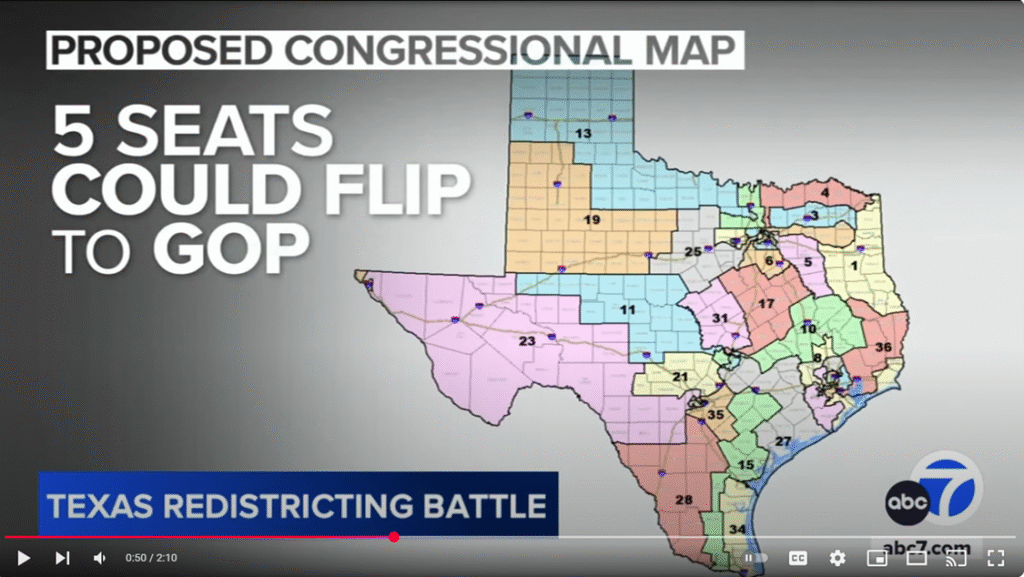
No doubt you’ve heard that President Trump asked Texas (as well as other Republican-controlled states) to conduct a mid-decade redrawing of its Congressional districts. The expressed aim of this redistricting is to create more seats that can be held by Republicans. Currently, 25 Republicans and 13 Democrats occupy the state’s 38 House seats. Trump, Texas Governor Greg Abbott, and the Texas Legislature want to make that 30 Republicans and 8 Democrats, a pickup of 5 Republican seats.
The launch of this initiative by Trump and Texas Republicans touched off a furious debate that involves numerous critical questions:
- Why are the lines being redrawn in the middle of the decade? Aren’t Congressional district lines only redrawn once a decade, in connection with the decennial census?
- Isn’t it illegal for a state to redraw district lines for the express purpose of creating a partisan advantage?
- Given that partisan gerrymandering has been going on for decades, and given that both sides do it, what’s the problem?
- What do the American people think about partisan gerrymandering, including whether it should be legal and what should be done about it?
- Finally, even if what Trump and Texas Republicans are attempting to do is legal, is it a bad idea nonetheless? What does going down this road mean for the country and our democracy?
I did a deep dive on the proposed Texas gerrymander and the questions raised above. Let me share my findings.
Why are the lines being redrawn in the middle of the decade? Aren’t Congressional district lines only redrawn once a decade, in connection with the decennial census?
While federal law requires Congressional districts to be redrawn every decade, in connection with the decennial census, states are not prohibited from redrawing district lines at other times. Federal law and the Constitution give states considerable leeway when it comes to redistricting. Thus, while it is unusual for a state to redraw its lines, it is perfectly legal and has happened on occasion.
Isn’t it illegal for a state to redraw Congressional district lines for the express purpose of creating a partisan advantage (e.g., “partisan gerrymandering”)?
Ostensibly, the very concept of partisan gerrymandering seems legally problematic. How is it fair for a political party that controls state government (Governor plus the Legislature) to carve up districts so that its candidates are highly likely to win in many more districts than the party might win given its voter registration numbers in the state?
In the case at hand, the Independent Voter Project reports Texas has 17,485,702 registered voters. Prior voting records indicate these registrants consist of 8,133,683 Democrats (46.52%), 6,601,189 Republicans (37.75%), and 2,750,830 Unaffiliated (15.73%). Yet because Texas is already a highly gerrymandered state, 25 of its 38 seats are held by Republicans, with only 13 held by Democrats. And the Governor and Texas Legislature now want to gerrymander further to enable 30 Republicans and 8 Democrats.
In the view of federal courts, Texas is free to pursue this gerrymander. A 2019 US Supreme Court decision, Rucho v Common Cause, held that partisan gerrymandering was a “nonjusticiable political issue” for the federal courts. Chief Justice John Roberts, who wrote the 5-4 decision, basically declared that the federal courts couldn’t be involved in reviewing partisan gerrymandering because there was no clear and manageable standard. Without an objective measure or standard, federal courts have no authority to decide whether partisan gerrymandering is legal or goes too far.
The Rucho decision recognized, however, that state courts could be involved in reviewing partisan gerrymanders. For instance, a partisan gerrymander might be challenged under a state’s equal protection clause. Also, states are free to enact laws that limit partisan gerrymanders, including, for example, creating independent redistricting commissions.
Also, under the Voting Rights Act and the Constitution, federal courts can review redistricting proposals that discriminate on the basis of race. Thus, the Texas gerrymander could be challenged in federal court if it also has the effect of discriminating on the basis of race.
Given that partisan gerrymandering has been going on for decades, and given that both sides do it, what’s the problem?
It’s true that partisan gerrymandering has been going on for decades. And it’s also true that both Republican-controlled and Democrat-controlled states practice gerrymandering. But this does not mean that partisan gerrymandering is not a problem, particularly when it comes to citizens participating equally in the political process.
Let’s explore the example of Texas to illustrate the real harms that come out of partisan gerrymandering. As stated earlier, voting records of registered Texans show that 8.13 million/46.5% are Democrats, 6.6 million/37.6% are Republicans, and 2.75 million/15.7% are Unaffiliated. Texas, with a population of 32 million, has 38 seats in Congress (House of Representatives), meaning it needs to construct districts with a population of about 840,000. Given that Texas is a state where the Legislature controls redistricting, here are some options for Republicans:
- They could place huge populations of Democrats into a few districts. Thus, for instance, a district could be drawn so that 90% or more of its voters are Democrats, and the remaining 10% are Unaffiliated or Republican. This is called “packing.” Republicans are thus conceding this district to Democrats as a means of allocating their voters to a larger number of districts where they have a competitive advantage and are likely to win.
- They could take an area where there very large numbers of Democrats (typically an urban area) and carve that area up into several districts. Instead of creating a district in an urban area with huge numbers of Democrats, it could allocate pieces of that area to neighboring districts with moderate to high levels of Republicans. This is called “cracking.” Republicans can thus prevent Democrats from having a majority by spreading Democrat voters to districts Republicans are likely to win.
Using tactics such as those described above, Republicans currently control 65.8% (25) of the state’s 38 Congressional seats when they only comprise 37.6% of the state’s voters. And they now seek to gerrymander further to control almost 79% (30) of the 38 seats. Democrats comprise 46.5% of the state’s registered voters, yet they are likely to end up with only 8 of 38 seats (21%).
Because federal law and U.S. Supreme Court decisions largely leave the matter of redistricting (including partisan gerrymandering) to the states, a variety of practices have evolved. While most states still put their legislature in charge of redistricting, nine states have created independent commissions to do the task. Others have commissions that are advisory to the legislature. Also, some states are very aggressive when it comes to partisan gerrymandering; while others focus on creating districts that meet traditional criteria (e.g., contiguity, compactness, preservation of communities of interest, and preservation of other political subdivisions).
There are at least two systematic efforts to evaluate and grade gerrymandering by states, the Princeton Gerrymandering Project produces a Redistricting Report Card and the World Population Review lists the most gerrymandered states. The World Population Review list for 2025 lists 11 states as most gerrymandered for 2025, 10 of which are controlled by Republicans: Texas, Wisconsin, Utah, Arkansas, Louisiana, Ohio, Kentucky, Pennsylvania, West Virginia, and North Carolina. Maryland, controlled by Democrats, is the eleventh.
The Princeton Redistricting Report Card (see below) gives most of these states a “D” or “F” grade, along with several other states: Oregon, Nevada, New Mexico, Nebraska, Illinois, Tennessee, Georgia, South Carolina, and Florida. On the other hand, a good half of the states have grades of “A” or “B.” A significant feature of the Princeton Report Card is that the website also has a “States” button that enables you to get more information about the state’s practices, including a grade for “partisan fairness.”
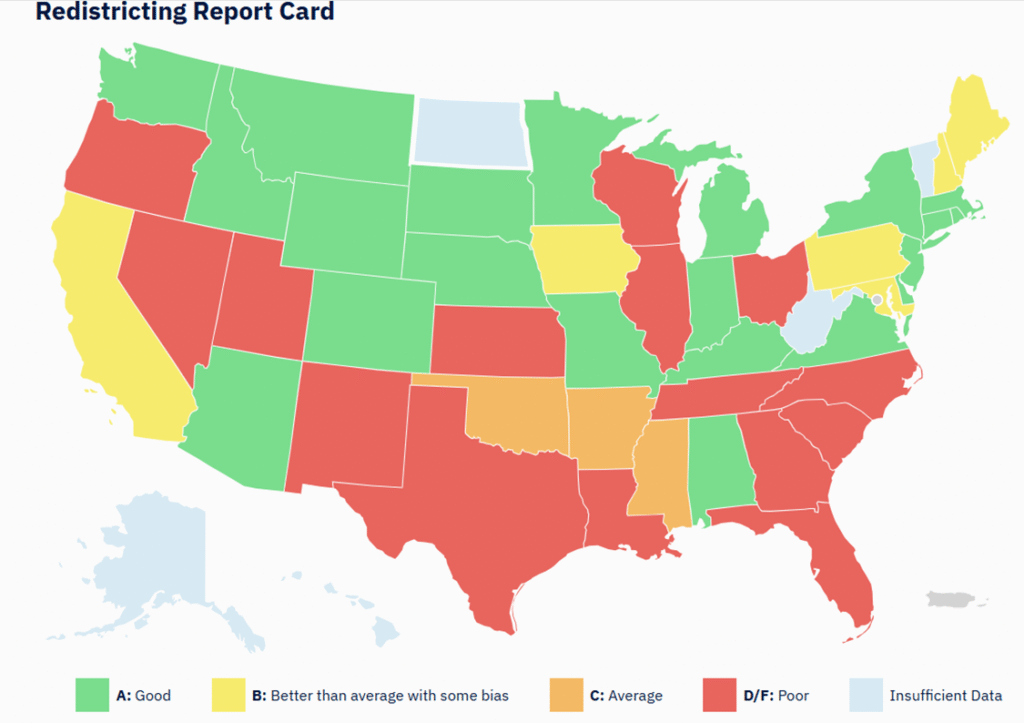
In summary, a third to a half of states continue to use partisan gerrymandering to advantage the political party in power and disadvantage the party out of power (including its voters). The prospect of mid-decade redistricting, or even multiple redistricts per decade, is an escalation of this tactic that has implications far beyond a state’s boundaries. States working aggressively, in concert, can use partisan gerrymandering to gain control of Congress. Put simply, every U.S. citizen and every state are affected by the gerrymandering decisions of the individual states. This is not a problem that should be left to the states.
What do the American people think about partisan gerrymandering, including whether it should be legal and what should be done about it?
Polls show that vast majorities of Americans, across party lines, oppose gerrymandering, including partisan gerrymandering. Most recently, an August 1-3 Economist/YouGov poll surveyed views on several critical aspects of gerrymandering. Here are some of the key findings:
- 69% of respondents said it should be illegal to draw electoral districts in a way that makes it harder for members of a particular party to elect their preferred candidates. Only 9% said it should be legal, while 22% weren’t sure.
- 49% of respondents said that it would be best for an independent commission to draw legislative districts in their state. Only 21% thought it should be their state legislature, and 30% weren’t sure.
- 75% said it was a major problem for states to draw legislative districts that intentionally favor one party. Only 19% identified it as a minor problem, and 6% did not see it as a problem.
- 62% said it was completely unfair for a state to redraw their districts for the U.S. House of Representatives to favor one party in elections. An additional 15% said it was “somewhat unfair.” Only 2% said it was “completely fair”; and only 4% saw it as “somewhat fair.” 18% weren’t sure.
I encourage you to read the full article from Economist/YouGov on this poll as it shows that percentages for Republicans, Democrats, and Independents are consistent with the overall percentages stated above. For further confirming evidence, an April 2025 poll from by AP-NORC found that 74 percent of Democrats, 60 percent of Republicans and 63 percent of independents believe gerrymandering is “a major problem.”
Clearly, there is a disconnect between the views of the American people and the actions of politicians and their political parties. Overwhelmingly, the American people, regardless of political party, don’t like partisan gerrymandering and believe it should be illegal. Yet the practice abounds in many states where one party controls both the legislature and the governorship.
Finally, even though what Trump and Texas Republicans are attempting to do is probably legal, is it a bad idea nonetheless? What does going down this road mean for the country and our democracy?
Our inquiry into the questions raised above tells us that partisan gerrymandering—and mid-decade partisan gerrymandering in particular—are imprudent and wrong. The American people, regardless of political party, are opposed to going in this direction.
By going ahead with this strategy in Texas, other states are certain to join the fray. California, along with Illinois and New York are considering similar proposals to counteract the action by Texas. And other Republican-controlled states are also considering action. Within a matter of months, Trump’s Texas ploy may touch off mid-decade redistricting in a half dozen or more states.
Instead of going in the direction Americans clearly favor, Trump and Texas Republicans are doing the opposite by making partisan gerrymandering far more prevalent. Doing so will erode trust in democracy. Americans will be further prevented from participating equally in the political process. Politicians will increasingly choose their voters, instead of the people choosing their elected officials.
A far better solution is to prohibit redistricting Congressional seats at times other than in connection with the decennial census or a court-ordered redistricting. In addition, since the Supreme Court is reluctant to establish standards governing partisan gerrymandering for House seats, Congress should establish those standards.
Unfortunately, President Trump has shown no sign of backing down on his redistricting ploy. And action by Congress is highly unlikely unless he is on board. If his ploy is successful and Democrat-controlled states don’t step in to neutralize the advantage, this will only encourage the behavior in the future. Once again, the President controls whether the country goes down a dangerous road. And if he doesn’t back down, he will be accountable for the damaging consequences.
Leave a Reply