Part 2 in a 2-Part Series
In Part 1 of this series, we examined demographic data from The Economist/YouGov polls on President Trump’s job approval at two points in time—upon entering office and seven months in. We quantified the decline in job approval for various demographic groups based on political party identification, race, gender, age, and income. For all but one of the 14 demographic groups, the decline in approval was either major or significant.
Now that we have a better idea of how much President Trump’s job approval declined with respect to each of the demographic groups, we can turn to the question of what is causing these groups to sour on his performance. In Part 2 of this series, we’ll start by identifying the issues that each group rates as most important. Then we’ll look at data from The Economist/YouGov surveys and trackers on how each group is evaluating the President on its key issues.
Once we tease out the reasons behind each demographic group’s declining job approval ratings, we’ll hone in on the issues that are most potent in causing all or most groups to downgrade Trump’s job approval. Trump must improve his performance on these “potent issues” if he is to have any hope of reversing his declining job approval numbers. What needs to happen for Trump to be successful? And what is the likelihood of success? Finally, if Trump is unable to improve his handling of these issues, what are the implications for the November 2026 midterm election?
Let’s start by identifying the most important issues for each of the 14 demographic groups and assess whether his performance on these issues is a factor in declining job approval ratings.
1. Independents
According to the Economist/YouGov poll of August 22-25, here are the issues that are most important to Independents: inflation and prices (25%), jobs and the economy (13%), health care (9%), civil rights (8%), climate change and the environment (8%) and immigration (7%). Let’s see how Independents are rating the President’s performance on these issues, again using trackers and surveys from Economist/YouGov. As a point of reference, Trump’s job approval from Independents went from 41% approve and 45% disapprove in January, to 32% approve and 62% disapprove in August. This is indeed a sharp drop.
- In late August, 25% of Independents approved of Trump’s handling of inflation and prices, while 67% disapproved. These percentages rate Trump worse on this issue than Independents rated his job performance. Clearly, Trump’s handling of this issue is weighing heavily on Independents when it comes to rating his overall job performance.
- In August, 30% of Independents approved of Trump’s handling of jobs and the economy, while 59% disapproved, and 10% had no opinion. These percentages rate Trump’s performance on this issue about the same as Independents rate his job performance. We can conclude that Trump’s handling of this issue is a factor in declining job approval from Independents.
- Related to the first two issues is the issue of foreign trade (tariffs). Independents are also down on Trump’s performance with respect to tariffs. As of late August, 28% of Independents approve, and 62 disapprove of his handling of foreign trade (tariffs). Further, 55% of Independents now say Trump has “gone too far” in imposing tariffs on foreign imports. This is a large shift towards disapproval, but not as dramatic as those for inflation and prices, and jobs and the economy. Thus, Trump’s handling of foreign trade appears to be a modest factor in Trump’s declining job approval.
- In August (1-4), 23% of Independents approved of Trump’s handling of health care, while 64% disapproved, and 13% had no opinion. These percentages rate Trump worse on this issue than Independents rated his job performance. We can thus conclude that Trump’s handling of this issue was a factor in declining job approval from Independents. Concerns about cuts to Medicare, Medicaid, and other health care programs made in Trump’s “One Big Beautiful Bill” likely influenced Independents to downgrade Trump’s job approval on health care.
- In August (9-11), 29% of Independents approved of Trump’s handling of civil rights, while 50% disapproved and 21% had no opinion. The level of disapproval on Trump’s handling of this issue is significantly less than 62% disapproval from Independents on job performance. This suggests that Trump’s handling of civil rights isn’t a significant reason why Independents are downgrading his overall job approval.
- In late August, 24% of Independents approved of Trump’s handling of climate change and the environment, while 57% disapproved. As of late August, only 24% of Independents approve of his handling of this issue, while 57% disapprove, and 19% have no opinion. The level of disapproval on this issue is less than the level of disapproval on job performance. This suggests that Trump’s handling of this issue is not a key factor in declining job approval from Independents.
- In late August, 42% of Independents approved of Trump’s handling of immigration, while 51% disapproved. Almost half (49%) of Independents felt Trump had “gone too far” on the issue of immigration. Overall, these percentages suggest that Trump’s handling of immigration is not a a key reason or factor in declining job approval from Independents.
- I thought the issue of taxes and government spending would be viewed as crucial for Independents, but it didn’t make their list. I By August (1-4) only 28% approved of his handling of this issue, while 63% disapproved. Likely this decline in approval from Independents was related to Trump’s tax and spend legislation, the “One Big Beautiful Bill.” A July 25-28 survey found that only 22% of Independents approved of Trump’s Budget, while 54% disapproved, and 24% had no opinion. Again, their views on the “One Big Beautiful Bill” are clearly a factor in their declining job approval of the President.
In summary, concerns about Trump’s handling of inflation and prices, jobs and the economy, tariffs, and health care were most influential in causing Independents to downgrade Trump’s overall job approval. Concerns about the One Big Beautiful Bill have also led Independents to sour on Trump’s job performance.
2. Republicans
The most important issues for Republicans (according to Economist/YouGov poll of August 22-25), are inflation and prices (22%), jobs and the economy (20%), immigration (15%), taxes and government spending (11%), and national security (11%). Let’s see how Independents are rating the President’s performance on these issues, again using trackers and surveys from Economist/YouGov. As a point of reference, Trump’s job approval from Republicans declined from 94% approve and 3% disapprove in January, to 88% approve and 10% disapprove in August. This is a significant erosion in job approval coming from Republicans.
- In late August, 72% of Republicans approved of Trump’s handling of inflation and prices, while 22% disapproved. These percentages rate Trump far worse on this issue than Republicans rated his job performance (88% approve, 10% disapprove). Over one in four Republicans (22%) now disapprove of his handling of this issue, versus just 10% who disapprove of his overall performance. Clearly, Trump’s handling of inflation and prices has been a factor in declining job approval from Republicans.
- By August, 81% of Republicans approved of Trump’s handling of jobs and the economy, while 14% disapproved. These percentages rate Trump worse on this issue than Republicans rated his job performance (88% approve, 10% disapprove). Thus, Trump’s handling of jobs and the economy has been a factor in declining job approval from Republicans.
- Related to the first two issues is the issue of foreign trade (tariffs). Republicans have never been wildly supportive of Trump’s tariff policies. An April 5-8 survey around the time comprehensive tariffs were announced found 72% of Republicans approved, 15% disapproved, and 13% had no opinion. In August, 73% of Republicans approved of Trump’s handling of foreign trade (tariffs), while 18% disapproved and 9% had no opinion. A July 4-7 Economist/YouGov survey found 74% of Republicans believed tariffs would cause short-term pain, but would lead to long-term economic growth. Only 10% of Republicans said tariffs were “harmful.” Thus, rather than downgrading Trump’s job approval because of his handling of tariffs, Republicans embrace the notion that tariffs will be helpful to the country in the long run. This suggests that tariffs have not been factor in declining job approval from Republicans.
- In late August, 86% of Republicans approved of Trump’s handling of immigration, while 12% disapproved. These percentages are only minimally worse than how Republicans rated Trump on this issue in February (90% approve and 5% disapprove). Also, the percentages for Trump’s handling of immigration are very similar to how Republicans rate Trump’s job performance. However, 72% of Republicans “strongly approve” of his handling of immigration, while only 56% “strongly approve of his job performance. Thus, we can conclude that Trump’s handling of immigration has not been a factor in declining job approval from Republicans.
- In August (1-4), 78% of Republicans approved of Trump’s handling of taxes and government spending, while 18% disapproved. These percentages rate Trump worse on this issue than Republicans rate his job performance. Also, there has been a modest erosion of approval on this issue since January, when 87% approved and 5% disapproved. Finally, Republicans have been lukewarm when it comes to the Budget and the “One Big Beautiful Bill.” A July 25-28 survey found 71% of Republicans approved of this tax and spending legislation, but over half of those approving only “somewhat approved.” Almost a fourth expressed “no opinion”, and 14% disapproved. Republicans appear to have doubts about the legislation—particularly about increasing the deficit and the potentially negative effects on Medicare, Medicaid, SNAPS, and other programs. Overall, Trump’s handling of taxes and government spending is clearly a factor in declining job approval from Republicans.
- In August (15-18), 85% of Republicans approved of Trump’s handling of national security, while 7% disapproved. The level of disapproval on this issue is both modest and below the 10% Republican disapproval on job performance. We can thus conclude that Trump’s handling of national security is not a factor in declining job approval from Republicans.
- Related to the issue of national security is the issue of foreign policy. By August, only 76% of Republicans approved, with only 49% strongly approving. Disapproval went from 7% in February to 13% in August. Thus, Trump’s handling of foreign policy appears to have a modest effect on his declining approval ratings from Republicans concerns.
- Based on my research, also I believe the Jeffrey Epstein matter has influenced the erosion in job approval from Republicans. Economist/YouGov surveys from July and August reveal significant percentages of Republicans have concerns about whether Trump was involved in the crimes, whether he had knowledge, and whether he (his Administration) is covering up information about the crimes. Polling on whether Trump is “honest and trustworthy” also reveals that increased percentages of Republicans are having doubts. In January, 77% viewed the President as “honest and trustworthy,” while only 7% of Republicans found him “not honest and trustworthy.” By August (9-11) only 71% saw him as “honest and trustworthy,” while the percentage who saw him as “not honest and trustworthy” doubled to 14%.
In summary, concerns about Trump’s handling of inflation and prices, jobs and the economy, tariffs, and taxes and government spending were most influential in causing Republicans to downgrade Trump’s overall job approval. In addition, more Republicans are seeing Trump as “not honest and trustworthy”; and the Jeffrey Epstein matter has added fuel to this fire.
3. Racial group: Blacks
The most important issues for Blacks are inflation and prices (22%), civil rights (19%), jobs and the economy (10%), health care (9%), crime (8%) and guns (8%). Let’s see how Blacks currently rated Trump’s performance on these issues. As a point of reference, Trump’s job approval from Blacks went from 29% approve, 60% disapprove and 11% no opinion in January, to 15% approve, 79% disapprove, and 5% no opinion in August. This is a major decline in approval.
- In August, 17% of Blacks approved of Trump’s handling of inflation and prices, while 76% disapproved, and 8% had no opinion. These percentages are very similar to how Black’s viewed Trump’s overall job performance in late August. We can thus conclude their views regarding his handling of this issue were a factor in declining job approval from Blacks.
- In August (9-11) 11% of Blacks approved of Trump’s handling of civil rights, while 70% disapproved and 18% had no opinion. Trump’s 11% approval percentage on this issue is less than the 15% job approval Blacks gave him; but 79% of Blacks disapproved of Trump’s job performance, versus 70% disapproval on this issue. The very high “no opinion” response (18%) indicates that almost one in five Blacks have not yet made up their mind on this matter. We can thus conclude the concerns of Blacks regarding his handling of this issue were a modest factor in the declining job approval numbers from this group.
- In August, 19% of Blacks approved of Trump’s handling of jobs and the economy, while 72% disapproved, and 9% had no opinion. A slightly higher percentage of Blacks approved of his handling of this issue than the 15% who approved of his job performance. And there was less disapproval on this issue than the 70% who disapproved of job performance. On the other hand, in January, 39.2% of Blacks said the economy was getting worse; and by August, 72.1% said the economy was getting worse. Thus, we can conclude that Trump’s handling of this issue was a modest factor for Blacks in evaluating Trump’s job performance.
- In August (1-4), 13% of Blacks approved of Trump’s handling of health care, while 78% disapproved, and 10% had no opinion. These percentages are very similar to the approval and disapproval numbers from Blacks on job performance. This suggests Trump’s handling of this issue was a factor in declining job approval numbers from this age group.
- In August (9-11), 18% of Blacks approved of Trumps handling of crime, while 67% disapproved, and 10% had no opinion. Given that Trump’s percentages on this issue are more favorable than his job approval percentages, we can conclude that his handling of this issue had minimal influence on the declining job approval ratings from Blacks.
- In August (9-11) 14% of Blacks approved of Trump’s handling of the guns issue, while 63% disapproved, and 24% had no opinion. The disapproval percentage regarding this issue was considerably less than the 79% disapproval on job performance. And the very high “no opinion” response (24%) says that nearly one out of four Blacks had not made up their mind on this matter. We can thus conclude the concerns of Blacks regarding his handling of this issue were probably not a factor in the declining in job approval from this group.
In summary, concerns about Trump’s handling of inflation and prices, and health care were most influential in causing Blacks to downgrade Trump’s job approval since January. In addition, concerns about civil rights and the economy and jobs were modest factors. Based on additional research, I would add that many Blacks are concerned about unkept promises regarding prices and the economy. Also, a sizable percentage of Blacks (58%) are concerned that Trump has gone too far in removing DEI (Diversity, Equity, and Inclusion) programs. Finally, other research reveals a persistent frustration with the Democratic party that is keeping some Blacks from abandoning Trump.
4. Racial group: Hispanics
The most important issues for Hispanics are inflation and prices (23%), jobs and the economy (18%), immigration (12%), civil rights (8%), and health care (8%). Let’s see how Hispanics currently rated Trump’s performance on these issues. As a point of reference, Trump’s job approval went from 42% approve, 47% disapprove and 12% no opinion in January to 33% approve, 61% disapprove, and 6% no opinion in August. This is a major decline in approval.
- In August, 27% of Hispanics approved of Trump’s handling of inflation and prices, while 69% disapproved. These percentages rate Trump worse on this issue than Hispanics rated Trump’s overall job performance. Clearly, Trump’s handling of this issue was a factor in declining job approval ratings from Hispanics.
- In August, 26% of Hispanics approved of Trump’s handling of jobs and the economy, while 65% disapproved, and 10% had no opinion. These percentages rate Trump worse on this issue than Hispanics rated Trump’s overall job performance. Clearly, Trump’s handling of this issue was a factor in declining job approval ratings from Hispanics.
- In August, 34% of Hispanics approved of Trump’s handling of immigration, while 60% disapproved. These percentages are almost identical to how Hispanics rated Trump on overall job performance. It’s also important to note that slippage on Trump’s handling of immigration has been modest. In February (2-4), 40% of Hispanics approved and 50% disapproved of his handling of immigration, compared with 34% approval and 60% disapproval in August. Thus, we can conclude that Trump’s handling of immigration was a modes factor in declining job approval ratings from Hispanics.
- In August (9-11), 27% of Hispanics approved of Trump’s handling of civil rights, while 56% disapproved, and 17% had no opinion. These percentages are similar to how Hispanics rated Trump’s job performance, except for large percentage with no opinion (17%). We can thus conclude that Trump’s handling of this issue was a modest factor in the declining job approval from Hispanics. This is bolstered by the fact that in August, 58% of Hispanics said Trump had “gone too far” in arresting and deporting immigrants.
- In August (1-4) 30% of Hispanics approved of Trump’s handling of health care, while 62% disapproved, and 8% had no opinion. These percentages are very similar to how Hispanics rated Trump on job performance. Thus, we can conclude that Trump’s handling of this issue was a factor in declining job approval from Hispanics.
In summary, concerns about Trump’s handling of inflation and prices, jobs and the economy, immigration, civil rights, and health care were all influential in causing Hispanics to downgrade Trump’s job approval.
5. Racial group: Whites
The most important issues for Whites are inflation and prices (21%), jobs and the economy (13%), health care (10%), civil rights (9%), and immigration (9%). Let’s see how Whites currently rated Trump’s performance on these issues. As a point of reference, Trump’s job approval went from 56% approve,39% disapprove and 6% no opinion in January to 50% approve, 48% disapprove, and 2% no opinion in August. This is a significant decline in approval.
- In August, 39% of Whites approved of Trump’s handling of inflation and prices, while 55% disapproved, and 6% had no opinion. These percentages rate Trump worse on this issue than Whites rated Trump’s job performance. Thus, Trump’s handling of inflation prices was clearly a factor in declining job approval from Whites.
- In August, 47% of Whites approved of Trump’s handling of jobs and the economy, while 48% disapproved. These percentages are very similar to how Whites evaluated Trump’s job performance. Thus, Trump’s handling of this issue was a factor in declining job approval from Whites.
- In August (1-4), 38% of Whites approved of Trump’s handling of health care, while 51% disapproved, and 11% had no opinion. These percentages rate Trump worse on this issue than Whites rated Trump’s job performance. Thus, his handling of health care was clearly a factor in declining job approval from Whites.
- In August (9-11), 44% of Whites approved of Trump’s handling of civil rights, while 43% disapproved, and 14% had no opinion. Lower percentages approved of his handling of this issue (44% versus 50%), but lower percentages also disapproved (43% vs 48%). Thus, Trump’s handling of this issue was probably not a factor in declining job approval ratings from Whites.
- In August, 53% of Whites approved of Trump’s handling of immigration, while 44% disapproved. These percentages rate Trump better on this issue than Whites rated Trump’s job performance. Thus, Trump’s handling of immigration was probably not a factor in declining job approval from Whites.
In summary, concerns about Trump’s handling of inflation and prices, jobs and the economy, and health care were all influential in causing Whites to downgrade Trump’s job approval.
6. Age group: 18-29 years old
As noted earlier, there was a major erosion in approval from those 18-29, a significant erosion with respect to those 30-44, a modest erosion with respect to those 45-64, and a negligible erosion with respect those 65 and older. Because the erosion from the 65+ group is negligible, we’ll exclude it from the analysis and take the other three groups separately.
The most important issues for those 18-29 are civil rights (20%), inflation and prices (17%), jobs and the economy (16%), climate change and the environment (9%), and health care (9%). Let’s see how this age group currently rated Trump’s performance on these issues. As a point of reference, Trump’s job approval from those 18-29 went from 48% approve and 43% disapprove in January to 30% approve and 67% disapprove in August. This is a major decline.
- In August (9-11), 33% of those 18-29 approved of Trump’s handling of civil rights, while 51% disapproved, and 15% had no opinion. These numbers suggest Trump’s handling of this issue was not a major reason motivating their disapproval.
- In August (22-25), 30% of those 18-29 approved of Trump’s handling of inflation and prices, while 65% disapproved. These percentages are almost identical to how they view Trump’s overall job performance; and we can thus conclude that Trump’s handling of inflation and prices was a factor in the declining job approval numbers for this age group.
- In August (22-25), 30% of those 18-29 approved of Trump’s handling of jobs and the economy, while 64% disapproved. Again, these percentages are almost identical to how they view Trump’s overall job performance. We can thus conclude their views regarding his handling of this issue factored in to the declining job approval numbers from this group.
- In August (22-25), 29% of those 18-29 approved of Trump’s handling of climate change and the environment, while 57% disapproved, and 14% had no opinion. Again, these percentages are very similar to how they view Trump’s overall job performance. We can thus conclude their views regarding his handling of this issue influenced their views on overall performance.
- In August (1-4), 23% of those 18-29 approved of Trump’s handling of health care, while 61% disapproved, and 16% had no opinion. Again, these percentages are similar to how they view Trump’s overall job performance, but the 23% approval is lower than the 30% overall job approval. We can thus conclude their views regarding his handling of this issue influenced their views on overall performance.
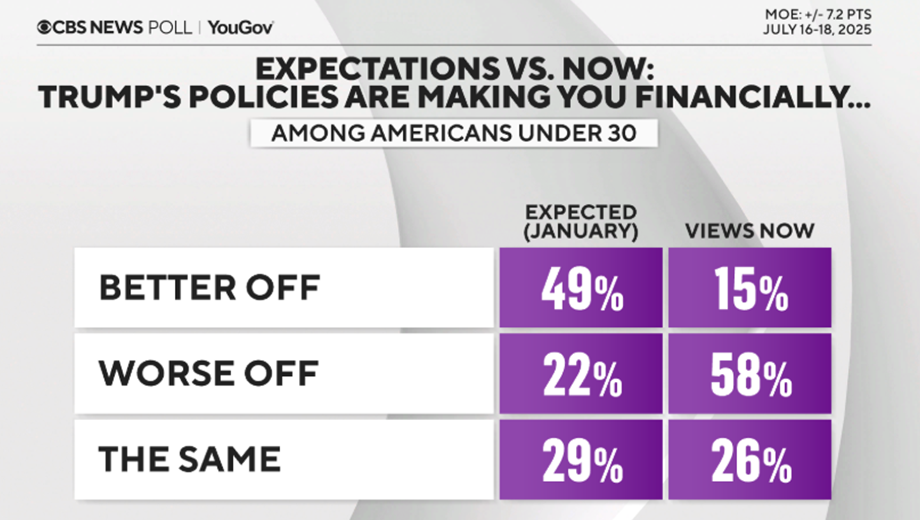
In summary, concerns about Trump’s handling of inflation and prices, jobs and the economy, climate change and the environment, and health care were all influential in causing those 18-29 to downgrade Trump’s job approval. A recent CBS News report especially focuses on how this age group feels worse off financially under Trump (see the graphic below). They feel the President is paying too much attention to tariffs and not enough attention to inflation, prices, and the economy.
7. Age group: 30-44 years old
The most important issues for those 30-44 are inflation and prices (23%), jobs and the economy (20%), civil rights (11%) and health care (8%). Let’s see how this age group currently rated Trump’s performance on these issues. As a point of reference, Trump’s job approval from those 30-44 went from 44% approve and 45% disapprove in January to 37% approve and 59% disapprove in August. This is a significant decline.
- In August, 29% of those 30-44 approved of Trump’s handling of inflation and prices, while 63% disapproved. These percentages rate Trump worse on this issue than the age group rated his overall job performance. Clearly, Trump’s performance on the issue of inflation and prices was a factor in the declining job approval.
- In August, 34% of those 30-44 approved of Trump’s handling of the jobs and the economy, while 59% disapproved. These percentages are almost identical to how they view Trump’s overall performance. We can thus conclude their views regarding his handling of this issue factored in to the declining job approval numbers from this group.
- In August (9-11), 30% of those 30-45 approved of Trump’s handling of civil rights, while 52% disapproved, and 18% had no opinion. While the 30% approval on civil rights is lower than the 37% who approve his job performance, the 52% disapproval on civil rights is less than the 59% who disapprove of his performance. Thus, Trump’s handling of civil rights only appears to be a modest factor in driving those 30-44 to downgrade Trump’s job performance.
- In August (1-4) 30% of those 30-45 approved of Trump’s handling of health care, while 61% disapproved, and 9% had no opinion. These percentages rate Trump slightly worse on this issue than the age group rated his overall job performance. This suggests that Trump’s handling of this issue was a factor in the declining approval ratings for this age group.
In summary, concerns about Trump’s handling of inflation and prices, jobs and the economy, and health care were most influential in causing those 30-45 year to downgrade Trump’s job performance.
8. Age group: 45-64 years old
The most important issues for those 45-64 are inflation and prices (24%), immigration (12%), jobs and the economy (11%), health care (8%), civil rights and liberties (8%), and national security (8%). Let’s see how this age group currently rated Trump’s performance on these issues. As a point of reference, Trump’s job approval from those 45-64 went from 55% approve and 39% disapprove in January to 49% approve and 49% disapprove in August. This is a modest decline.
- In August, 37% of those 45-64 approved of Trump’s handling of inflation and prices, while 57% disapproved. These percentages rate Trump worse on this issue than the age group rated his overall job performance. Clearly, Trump’s performance on the issue of inflation and prices was a factor in the declining job approval. Clearly, Trump’s performance on the issue of inflation and prices was a factor in the declining job approval.
- In August, 56% of those 45-64 approved of Trump’s handling of immigration, while 41% disapproved. These percentages rate Trump better on this issue than the age group rated his overall performance. Thus, Trump’s handling of this issue does not appear to be a factor in Trump’s declining job approval ratings from this group.
- In August, 44% of those 45-64 approved of Trump’s handling of jobs and the economy, while 47% disapproved, and 8% had no opinion. These percentages rate Trump slightly worse on this issue than the group rated him on job performance. Again, this suggests Trump’s handling of jobs and the economy was a factor in declining job approval numbers from this age group.
- In August (1-4), 39% of those 45-64 year approved of Trump’s handling of health care, while 52% disapproved, and 9% had no opinion. These percentages rate Trump slightly worse on this issue than the age group rated his overall performance. Again, this suggests Trump’s handling of health care was a factor in declining job approval numbers from this age group.
- In August (9-11), 39% of those 45-64 approved of Trump’s handling of civil rights, while 46% disapproved, and 15% had no opinion. While the 39% approval percentage on this issue is lower than Trump’s 49% job approval from this age group, the disapproval percentage is slightly more favorable towards Trump. Overall, Trump’s handling of this issue doesn’t appear to be causing declining job approval ratings from this age group.
- In August (15-18), 47% of those 45-64 approved of Trump’s handling of national security, while 43% disapproved, and 10% had no opinion. These percentages rate Trump slightly better on this issue than the age group rated his overall performance. Thus, Trump’s handling of this issue doesn’t appear to be a factor in declining approval ratings from this age group.
In summary, concerns about Trump’s handling of inflation and prices, jobs and the economy, and health care were most influential in causing those 45-64 to modestly downgrade Trump’s job performance over the past seven months.
9. Age group: 65 and older
The most important issues for those 65 and older are inflation and prices (20%), health care (15%), taxes and government spending (11%), national security (10%), and immigration (9%). However, I believe this age group should be excluded from our analysis because its job approval ratings for Trump remained mostly steady during the period of January through August. In January, Trump’s job approval from those 65 and older was 47% approve and 48% disapprove. In August, their rating was 46% approve and 53% disapprove. While the August ratings were very slightly more negative, we can’t view the decline as significant or major. Thus, while those 65 and older might be unhappy with Trump’s handling of their important issues, it hasn’t contributed to a significant or major decline in job approval from this age group.
10. Income group: less than $50,000
The most important issues for those earning less than $50,000 are inflation and prices (24%), health care (15%), civil rights (12%), jobs and the economy (10%), and immigration (8%). Let’s see how this income group currently rated Trump’s performance on these issues. As a point of reference, Trump’s job approval with respect to this income group went from 46% approve, 42% disapprove, and 12% no opinion in January to 40% approve and 57% disapprove in August. This is a significant decline in job approval.
- In August, 31% of those earning less than $50,000 approved of Trump’s handling of inflation and prices, while 62% disapproved, and 7% had no opinion. These percentages rate Trump worse on this issue than this income group rated his job performance. Thus, Trump’s handling of inflation prices was clearly a factor in declining job approval from those earning less than $50,000. .
- In August, 29% of those earning less than $50,000 approved of Trump’s handling of health care, while 59% disapproved, and 12% had no opinion. These percentages rate Trump worse on this issue than this income group rated his job performance. Thus, Trump’s handling of health care was a factor in the declining job approval from this income group.
- In August, 33% of those earning less than $50,000 approved of Trump’s handling of civil rights, while 50% disapproved, and 17% had no opinion. The approval percentage on this issue was worse (33% versus 40%), but the disapproval percentage was less (50% versus 57%). We can thus conclude that Trump’s handling of this issue was a modest factor in the declining job approval from this income group.
- In August, 36% of this income group approved on Trump’s handling of jobs and the economy, while 53% disapproved, and 12% had no opinion. The approval percentage on this issue was worse (36% versus 40%), but the disapproval percentage is slightly less (53% versus 57%). We can thus conclude that Trump’s handling of this issue was a modest factor in the declining job approval from this income group.
- In August, 43% of this income group approved of Trump’s handling of immigration, while 51% disapproved. These percentages rate Trump’s performance on this issue better than this income group rated his job performance. Thus, we can conclude that Trump’s handling of this issue was not a factor in declining job approval from those earning less than $50,000.
In summary, concerns about Trump’s handling of inflation and prices, and health care were most influential in causing those earning less than $50,000 to downgrade Trump’s job performance. With respect to the One Big Beautiful Bill, only 29% of this income group approved, and 53% disapproved. This income group also expressed disapproval with respect to cuts in Medicare, Medicaid, and SNAPS. Finally, related to inflation and prices, 35% of this income group approves of Trump’s handling of foreign trade (tariffs), while 55% disapprove.
11. Income group: $50,000 to $100,000
The most important issues for those earning $50,000-$100,000 are inflation and prices (23%), jobs and the economy (17%), immigration (9%), civil rights (9%), and taxes and government spending (8%). Let’s see how this income group currently rated Trump’s performance on these issues. As a point of reference, Trump’s job approval from this income group went from 51% approve and 44% disapprove in January to 45% approve and 53% disapprove in August. This is a significant decline.
- In August, 37% of those earning $50,000 to $100,000 approved of Trump’s handling of inflation and prices, while 58% disapproved. These percentages rate Trump’s performance on this issue worse than this income group rated Trump’s job performance. Thus, Trump’s handling of inflation prices was clearly a factor in declining job approval from this income group.
- In August, 44% of this income group approved of Trump’s handling of jobs and the economy, while 54% disapproved. These percentages are virtually identical to how this income group rated Trump’s job performance. Thus, Trump’s handling of this issue was a factor in declining job approval from this income group.
- In August, 51% of this income group approved of Trump’s handling of immigration, while 47% disapproved. Trump is thus rated more favorably on his handling of immigration than his overall job performance. We can conclude that Trump’s handling of this issue was not a factor in declining job approval from those earning $50,000 to $100,000.
- In August, 40% of this income group approved of Trump’s handling of civil rights, while 50% disapproved, and 11% had no opinion. Approval on this issue is lower (40% versus 45%), but so is disapproval (50% versus 53%). Thus, Trump’s handling of this issue played very little role in declining job approval from this age group.
- In August, 36% of this age group approved of Trump’s handling of taxes and government spending, while 59% disapproved, and 15% had no opinion. These percentages rate Trump’s performance on this issue worse than this income group rated his job performance. Thus, Trump’s handling of this issue was a factor in declining job approval from the $50,000 to $100,000 income group.
In summary, concerns about Trump’s handling of inflation and prices, jobs and the economy, and taxes and government spending were influential in causing those in the $50,000 to $100,000 income group to downgrade Trump’s job performance.
12. Income group: $100,000 and greater
The most important issues for those earning more than $100,000 are inflation and prices (17%), jobs and the economy (16%), civil rights (12%), taxes and government spending (10%), and climate change and the environment (9%). Let’s see how this income group currently rates Trump’s performance on these issues. As a point of reference, Trump’s job approval from this income group went from 52% approve and 44% disapprove in January, to 39% approve and 59% disapprove in August. This is a major decline in job approval.
- In August, 35% of this income group approved of Trump’s handling of inflation and prices, while 60% disapproved. These percentages rate Trump’s peformance on this issue slightly worse than this income group rated his job performance. Thus, Trump’s handling of inflation and prices was a factor in declining job approval from this income group.
- In August, 40% of those earning over $100,000 approved of Trump’s handling of jobs and the economy, while 57% disapproved. These percentages are almost identical to the approval and disapproval percentages this group gave to Trump’s job performance. Thus, Trump’s handling of this issue was a factor in declining job approval from this income group.
- In August, 39% of this income group approved of Trump’s handling of civil rights, while 50% disapproved, and 10% had no opinion. The approval percentage for this issue (39%), matches job approval; but the disapproval percentage is smaller (50% versus 59%). Thus, concerns about Trump’s handling of this issue probably didn’t influence the decline in job approval from this income group.
- In August (1-4), 43% of this income group approved of Trump’s handling of taxes and government spending, while 54% disapproved. These percentages rate Trump more favorably on this issue than this income group rated Trump’s job performance. This would suggest that Trump’s handling of this issue wasn’t a factor in declining job approval. On the other hand, the over $100,000 income group had a less favorable view of Trump’s One Big Beautiful Bill that addressed taxes and spending. On the bill, 36% of this income group approved, while 53% disapproved, and 11% had no opinion. Thus, it’s uncertain whether Trump’s handling of this issue caused those earning over $100,000 to downgrade Trump’s job performance.
- In August, 31% of this income group approved of Trump’s handling of climate change and the environment, while 60% disapproved, and 10% had no opinion. These percentages rate Trump’s performance on this issue worse than this income group rated Trump’s job performance. Thus, Trump’s handling of this issue was clearly a factor in declining job approval from this income group
In summary, concerns about Trump’s handling of inflation and prices, jobs and the economy, and climate change and the environment were most influential in causing those earning over $100,000 to downgrade Trump’s job performance. On the related issue of foreign trade (tariffs), 36% of this income group approved of Trump’s performance, while 61% disapproved. It is thus also likely that Trump’s handling of tariffs contributed to the decline in job approval from those earning over $100,000.
13. Gender: males
The most important issues for males are inflation and prices (21%), jobs and the economy (15%), civil rights (9%), taxes and government spending (85), and health care (8%). Let’s see how males currently rate Trump on these issues. As a point of reference, Trump’s job approval from males was 55% approve, 39% disapprove in January, and 48% approve, 50% disapprove in August. This is a major decline.
- In August, 41% of males approved of Trump’s handling of inflation and prices, while 54% disapproved. These percentages rate Trump’s handling of this issue worse than males rated his job performance. Thus, Trump’s handling of inflation prices was clearly a factor in declining job approval from males.
- In August, 46% of males approved of Trump’s handling of jobs and the economy, while 49% disapproved. These percentages are nearly identical to how males rated Trump’s job performance. We again can conclude Trump’s handling of this issue was a factor in declining job approval from males.
- In August (9-11), 37% of males approved of Trump’s handling of civil rights, while 54% disapproved, and 9% had no opinion. These percentages are worse than how males evaluated Trump’s job performance. Thus, Trump’s handling of this issue was clearly a factor in declining job approval from males.
- In August, 43% of males approved of Trump’s handling of taxes and government spending, while 53% disapproved. These percentages are slightly worse than how males evaluated Trump’s job performance. Thus, Trump’s handling of this issue was a factor in declining job approval from males.
- In August, 37% of males approved of Trump’s handling of health care, while 54% disapproved and 9% had no opinion. These percentages are worse than how males evaluated Trump’s job performance. Thus, again, Trump’s handling of this issue was a factor in declining job approval from males.
In summary, concerns about Trump’s handling of inflation and prices, jobs and the economy, civil rights, taxes and government spending, and health care were all factors in the decline in job approval from males.
14. Gender: females
The most important issues for females are inflation and prices (22%), jobs and the economy (12%, civil rights (11%), health care (10%), and immigration (9%). Let’s see how females currently rate Trump on these issues. As a point of reference, Trump’s job approval from females was 43% approve, 47% disapprove, and 10% no opinion in January; and 35% approve, 61% disapprove in August. This is a major decline.
- In August, 27% of females approved of Trump’s handling of inflation and prices, while 67% disapproved. These percentages are worse than how females rated Trump’s job performance. Thus, Trump’s handling of this issue was clearly a factor in declining job approval from females.
- In August, 32% of females approved of Trump’s handling of jobs and the economy, while 59% disapproved. These percentages are very similar to how females evaluated Trump’s job performance. Thus, Trump’s handling of this issue was a factor in declining job approval ratings from females.
- In August, 33% of females approved of Trump’s handling of civil rights, while 51% disapproved, and 16% had no opinion. There is not as much disapproval on this issue (51% versus 61%), but there is also less approval (33% versus 35%). We can conclude that Trump’s handling of this issue had minimal effect on declining job approval from females.
- In August, 29% of females approved of Trump’s handling of health care, while 59% disapproved and 12% had no opinion. There is slightly less disapproval on this issue (59% versus 61%), but also less approval (29% versus 35%). We can conclude that Trump’s handling of this issue had a slight effect on declining job approval from females.
- In August, 40% of females approved of Trump’s handling of immigration, while 55% disapproved. These percentages rate Trump better on this issue than females rate his job performance. We can thus conclude that Trump’s handling of immigration was not a factor in declining job approval from females.
In summary, Trump’s handling of inflation and prices, and jobs and the economy were the most influential factors in causing females to downgrade Trump’s job performance.
What issues are most potent in causing all or most demographic groups to downgrade Trump’s job approval?
I went through the 14 demographic groups and looked for the issues that were mostly frequently identified by all or most groups. I looked for the issues that were not only deemed “most important,” but also that were influential in causing the group to downgrade its job approval of President Trump. I found three issues that stood out: inflation and prices, jobs and the economy, and health care.
Inflation and prices
Trump’s handling of inflation and prices was by far and away the most powerful factor in causing demographic groups to sour on his job performance. Inflation and prices was the #1 most important issue for 13 of the 14 demographic groups, and the #2 issue for the remaining demographic group (those 18-29). In every instance, Trump’s handling of inflation and prices was a factor in declining job approval ratings from the group.
Jobs and the economy
Trump’s handling of jobs and the economy was the second most powerful factor in causing demographic groups to sour on his job performance. Jobs and the economy was #2 most important issue for 9 of the 14 demographic groups, and the #3 most important issue for 3 other groups. Again, in every instance, Trump’s handling of jobs and the economy was a factor in declining job approval ratings from the group.
Health care
Trump’s handling of health care was the third most powerful factor in causing demographic groups to sour on his job performance. Health care was among the top five most important issues for 9 of the 14 demographic groups. And, in most instances, their rating of President Trump on this issue was at least a modest factor in their declining job approval of the President.
Other influential issues: civil rights, taxes and government spending, and foreign trade (tariffs)
Ten groups (Independents, Blacks, Hispanics, 18-29, 45-64, less than $50,000, $50,000-$100,000, >$100,000, males, and females) identified civil rights as one of their top five most important issues. However, their ratings of Trump on civil rights seldom reflected that it was a factor in their declining job approval of the President. At least four groups (Republicans, $50,000-$100,000, >$100,000, and males) identified taxes and government spending as one of their top 5 most important issues. Again, their ratings of the President on this issue seldom reflected that it was a factor in their declining job approval of the President. Three groups (Independents, Republicans, $100,000+) identified foreign trade (tariffs) as one of their top 5 most important issues. Their ratings of Trump on this issue were at least a modest factor in their declining job approval of the President.
In summary, it’s paramount to understand that Trump’s handling of economic issues–especially inflation and prices–is the key driver in Trump’s declining job approval ratings. Large percentages of virtually every demographic group are upset that prices have not come down, as the President promised. Other data show that large majorities of Americans are struggling with their personal finances and trying to make ends meet. Americans are concerned about the accessibility and costs of health care, especially after huge cuts to Medicaid, and Medicare enacted in Trump’s One Big Beautiful Bill. They are concerned that tariffs are going to further increase prices and lead to inflation. These pocketbook issues are at the forefront. And issues such as immigration, guns, abortion, crime, climate change, education, and national security have less often been a factor in driving Trump’s declining job approval.
What needs to happen for Trump to improve his performance on inflation and prices, jobs and the economy, and health care?
The answer to this question is long and complicated, but l will try to state it in simple terms. Essentially, public opinion on issues like inflation and prices, and jobs and the economy is influenced just as much by one’s personal financial circumstances as it is by official statistics or measures of inflation, prices, or the growth of the economy. History teaches us, as I will demonstrate shortly, that it won’t be enough for Trump to celebrate dropping the inflation rate to 2.5%, crow about monthly job reports with lots of new jobs and low unemployment percentages, and brag about 3% GDP (gross domestic product) growth. To improve ratings on issues like inflation and prices, and jobs and the economy, those responding to the surveys will need to be feeling some improvement in their immediate circumstances–including personal, family, and community. Thus, Trump faces a compound challenge, as I elaborate below.
- First, he must bring down the rate of inflation. He not only needs to get it below the roughly 3% level when Biden handed over the keys, but further to around 2%, which reflects the Federal Reserve’s preferred inflation rate. Trump promised “no inflation,” which would mean getting inflation to zero. At minimum, he needs to get inflation to the Fed’s 2% preferred rate.
- Second, Trump promised to bring down the prices of gas, groceries, energy, insurance, and a whole lot of other things “on day one.” It won’t be enough to slightly reduce the prices that existed at the end of Biden’s term. Those responding to surveys on job performance remember prices from 2020 or 2021, that skyrocketed in 2022, and kept increasing at a rate above 3% since then. Thus, the cost of eggs was around $1.50 per dozen in 2021, and in 2025 the cost is around $3.50 per dozen. Gas was around $2.00 per gallon in 2020 and early 2021. At the end of Biden’s term gas was around $3.00 to $3.25 a gallon, where it has hovered ever since. Trump needs to get gas prices down to 2020 or 2021 levels if he wants to improve his ratings on handling inflation and prices.
- Third, Trump needs to prevent his implementation of widespread tariffs from increasing costs to consumers and increasing inflation. The media and many interest groups will be paying strict attention to price increases and inflation brought about by tariffs. Those rating Trump’s performance on inflation and prices will take a dim view if they are paying more because of his tariffs.
- Fourth, Trump needs reverse troubling trends in job growth and unemployment. For most of Biden’s term there was robust job growth and low unemployment, as reflected in monthly job reports. Since coming into office, job growth has slowed, especially since May. Unemployment just ticked up to 4.3%, the highest level since 2021. In the coming months, job reports need to show robust job growth–150,000 or more per month–and the unemployment rate needs to drop down at least to levels that existed for most of the Biden Administration. High levels of unemployment will be deadly, as those out of work and those whose jobs are threatened will not be inclined to approve of Trump’s job performance.
- Fifth, in the big picture, the personal finances of the vast majority of Americans need to improve. Huge percentages of Americans are struggling with credit card debt, energy costs, housing costs, and the costs of everything else. Many are living paycheck to paycheck. They are going without. If their personal finances don’t improve, they’re not likely to give Trump higher approval ratings when it comes to his handling of jobs and the economy and inflation and prices.
- Sixth, and finally, on the issue of health care, Trump needs to stabilize the cost of premiums (insurance). Currently, annual premium increases are in the range of 6-7%, far above the 1-3% annual premium increases that usually prevailed in the 2020 through 2022 time period. Also, the media and many interest groups will be monitoring those losing Medicaid or Medicare coverage because of deep spending cuts for these programs in the One Big Beautiful Bill.
How likely is it that Trump will succeed on the six challenges and reverse his declining job approval numbers?
It will be a minor miracle if the rate of inflation comes down to around 2% within the next 12-14 months (i.e., before the November 2026 midterm election). I reviewed numerous inflation forecasts, including those from the Federal Reserve. Most forecasts see inflation remaining in the 2.5% to 3% range for 2025 and 2026. Inflation has been stable or ticking up slightly in recent months. Trump’s tariffs and the expected lowering of interest rates by the Federal Reserve will increase inflationary pressures.
It is also virtually certain that Trump will not be able to bring prices down to levels that existed pre-pandemic or early in the Biden Administration. It is possible that prices will stabilize or go down slightly. I spent some time reviewing recent price change forecasts for 2025 and 2026 from various organizations. The USDA forecasts that food prices will rise moderately in 2025 (2.9%), and more slowly in 2026 (2.2%). Home price growth is projected to moderate from 2024 levels, increasing by around 2.9% in 2025, and 2.8% in 2026. Mortgage rates expected to average 6.7% in 2025 and fall to 6% in 2026. The US Energy Information Administration (EIA) projects that the price for retail gasoline across the U.S. will average $2.90 per gallon or slightly less in 2026, about 20 cents per gallon (6%) less than 2025. The EIA also projects that electricity costs in the U.S. will continue rising. Average residential prices will increase by about 4% in 2025, and then by at least that much 2026. Since the Covid-19 pandemic, electricity costs have been increasing at an annual rate of 5% per year.
Most labor market forecasts I reviewed, including those by the Federal Reserve Bank of Philadelphia, predicted a continued slowdown in job growth and rising unemployment. For the remainder of 2025, monthly job growth is projected to be in the range of 110,000 to 120,000; and for 2026, monthly job growth is projected at 113,500. The unemployment rate is predicted to move up to 4.5% by the end of 2025, and average 4.5% for 2026. These projected numbers are much worse than Biden’s actual results, which averaged 364,000 new jobs per month, and a 4.1% unemployment average for his 4 years.
Forecasts on debt (home and credit card), including those from the Federal Reserve Bank of New York, predict increasing levels of debt on homes, automobiles, credit cards, and student loans. Increased delinquencies are also projected. Credit card interest rates are projected to decrease slightly from the current average rate of 22.77%(September 2025). By the end of 2025, the average rate is projected to be around 19.8% (driven by expected interest rate cuts by the Federal Reserve). Still, tens of millions of Americans will remember the 14-15% credit card interest rates in the 2020-2022 time period. And they also remember Trump’s campaign promise to put a temporary limit of 10% on credit card rates.
Trump will also be running against the wind when it comes to stabilizing health care premiums. The Kaiser Family Foundation (KFF) did a comprehensive study of 312 insurers in all 50 states and found the proposed median increase in premiums for 2026 will be 18%, more than double 2025’s increase of 7%.
In summary, my analysis says there is zero chance that Trump will actually meet these six challenges. Instead, look for him claim victory by spinning modest and sporadic gains. He will say he beat inflation when the inflation rate hovers in the 2.5 to 3% range. He will say he brought down the price of groceries by citing the reduced price of selected items. When gas drops 20 cents to an average of $2.90 per gallon, he will claim victory. He will claim that monthly job reports bearing bad numbers are “rigged” and inaccurate. He will say jobs are exploding and unemployment is at an all-time low. He will crow about bringing credit card interest rates to below 20%, and he will blame the Federal Reserve for not lowering interest rates sooner. He’ll blame “Obamacare” (the Affordable Care Act) for rising health insurance premiums.
Will Trump’s spin campaign be enough for him to turn around his job approval ratings? Let’s keep digging before we answer.
What does recent history teach us about a president being able to turn around sagging job approval numbers when a substantial majority of Americans are still struggling with their personal finances?
Joe Biden’s four years in office provide us with some important history lessons when it comes to turning around sagging job approval numbers. Let’s trace the history of his job approval numbers, as well as his numbers on handling the issues of inflation and prices and jobs and the economy. As a preface to this discussion, let me display inflation rate data (see below) for his 48 months in office.
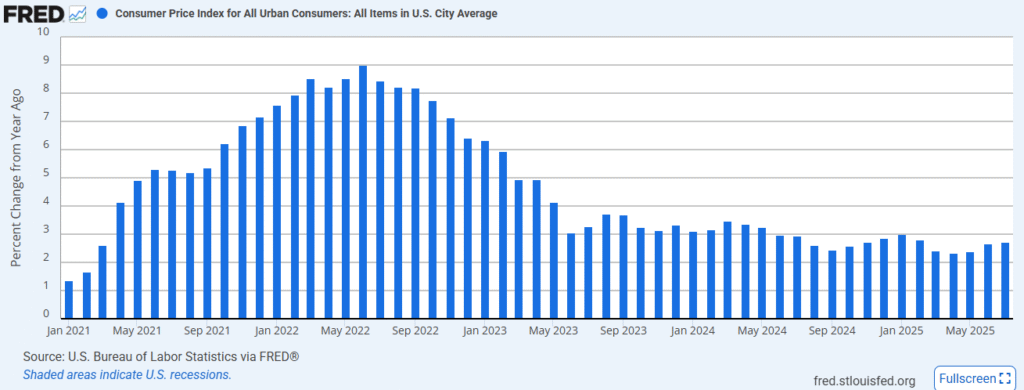
Biden assumed the presidency with a 57% job approval rating, and this number largely held for about six months. As you can see, inflation began to jump in April 2021 (4%); and just over a year later it peaked at 9.1% in June 2022. By this time Biden’s job approval rating had plummeted to 36% approve, 55% disapprove, and 8% no opinion (Economist/YouGov, June 25-28, 2022). In that same survey, Biden’s handling of jobs and the economy was rated at 36% approve, 54% disapprove, and 10% no opinion. Biden’s handling of inflation and prices was surveyed by Economist/YouGov on October 22-25, 2022, and his rating was 32% approve, 56% disapprove, and 12% no opinion.
Clearly, Americans had a very disapproving view of Biden’s handling of inflation and prices and jobs and the economy. And these very harsh ratings clearly translated into a sharp drop in overall job approval .
As you can see from the CPI inflation graph above, by June of 2023–one year after the 9.1% peak in inflation–the inflation rate dropped way down to 3%. And, as you can also see, since that time the rate has remained relatively steady, hovering in the range of 2.5% to slightly over 3%. One would think that successfully bringing down and maintaining a relatively low rate of inflation for 18 months would translate into improved ratings Biden’s handling of inflation and prices, jobs and the economy, and overall job approval. Let’s take a look.
While inflation was largely tamed for the remainder of Biden’s term, his ratings on jobs and the economy and inflation and prices didn’t rebound. In June of 2024, his handling of jobs and the economy was rated at 38% approve, 54% disapprove, and 8% no opinion. And his handling of inflation and prices was a dismal 31% approve, 61% disapprove, and 8% no opinion. These percentages rate Biden worse on his handling of inflation and prices than he was rated on that issue during the time inflation reached its highest levels in 2022. Even by late in his term, when the economy continued to prosper and inflation remained low, Biden’s ratings on jobs and the economy and inflation and prices scarcely rebounded. In the September 29-October 1, 2024 Economist/YouGov survey, his handling of jobs and the economy was 43% approve, 48% disapprove, and 10% no opinion. And his handling of inflation and prices was 35% approve, 54% disapprove, and 11% no opinion. And his job approval rating in November was 38% approve, 56% disapprove.
These numbers tell us that job approval ratings don’t rebound simply because the inflation rate goes back to near normal. Instead, Americans tend to hold presidents accountable for the higher prices that got baked in because of prior high inflation. It’s not enough for inflation rates to return to normal (around 2%). Instead, Americans are still experiencing difficulty because gas is at $3.25 a gallon when it used to be around $2.00. And when we feel the squeeze from higher electricity costs, higher health care premiums, higher credit card rates, and higher food costs, we don’t care what the inflation rate is. This translates into poor job approval ratings for the sitting president, including dismal ratings on inflation and prices and jobs and the economy.
History teaches us that most Americans won’t buy Trump’s attempts to spin a great economy and proclaim victory over inflation and high prices. Instead, they’ll be looking at their bank accounts, their wallets, their credit card balances, and all the things they can no longer afford. Every time they fill up their car with gas, buy groceries, or go out to dinner they’ll be jolted by the high prices they’re still paying. Trump’s MAGA base may be ready to give him higher job approval ratings based on spin; but the vast majority of Americans are likely to rate Trump’s job performance as badly as they rated Biden.
If Trump is unable to secure a sizable improvement in job approval numbers, what are the implications for the November 2026 midterm election?
Going back to at least the 1990’s, when a sitting president suffers low job approval numbers, this usually translates into the president’s party losing seats in the Senate and/or House of Representatives. Congressional Republicans have been totally supportive of Trump in using their control of Congress to enact and protect his policy agenda. If Trump remains unpopular and suffers low approval, Congressional Republicans will be blamed for Trump’s policy failures that enacted and protected. History shows that time and again, voters have a tendency to vent their disapproval by turning out those who supported and enabled an unpopular president.
Final thoughts
Our deep dive into the demographics of Trump’s declining job approval provides extensive and convincing evidence that Trump will not be able to turn his declining job approval numbers around. It is thus likely that Republicans will lose seats in both the House and the Senate in the 2026 midterm election.
However, our analysis is merely predictive, and the future cannot be controlled. I could list all the possible alternate scenarios, and something entirely different could happen. I’ll stick by my analysis, but I also realize it’s a good time for all of us to be buckling our seat belts.
Leave a Reply